
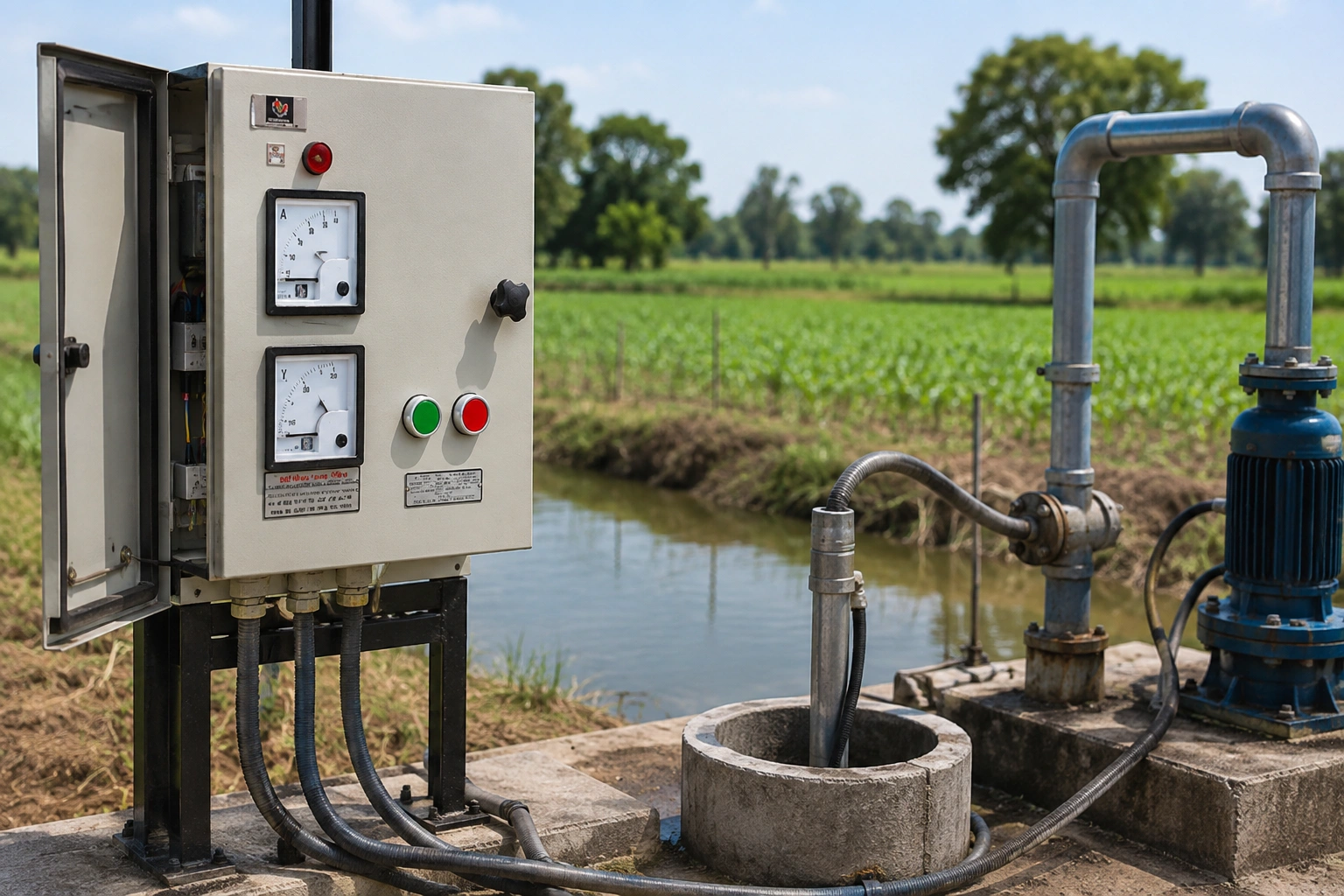
Which protection features matter most in a submersible pump starter?
A submersible pump starter may need different protection functions because dry run, overload, phase loss and abnormal voltage are not the same fault. Dry run often reduces pump load, while overload increases current; single phasing creates severe imbalance in a three-phase motor; undervoltage can reduce starting torque and lengthen acceleration. Define each required function explicitly and commission it against the real pump and supply. BCH’s single-phase submersible pump starter range provides product-family context, while the wider motor starter range covers other motor-control arrangements.
How do dry run, single phasing and voltage faults differ?
|
Condition |
Possible evidence |
Typical protective objective |
|
Dry run |
Low load current, low power or dedicated level/sensor input | Stop after the condition is validated and apply an appropriate restart delay |
|
Single phasing |
Missing phase voltage or severe current imbalance | Trip quickly enough to protect the motor and prevent unsafe continued operation |
| Phase reversal | Incorrect phase sequence on applicable three-phase pumps |
Prevent incorrect rotation or starting where required |
|
Undervoltage |
Low terminal voltage, slow acceleration, high current | Prevent start or trip according to motor/control limits and delay philosophy |
| Overvoltage | Supply above the acceptable operating band |
Alarm or trip according to motor/control limits |
| Overload | Sustained current above the intended operating level |
Protect the motor from prolonged overcurrent |
Why does dry-run protection need commissioning on the actual pump?
Dry run does not always look like an overload. If the pump loses water, the hydraulic load can fall and motor current may decrease. A conventional overload relay that waits for excessive current may therefore not detect the condition early enough. Current-based dry-run protection must be set from the actual loaded current range and water-level behaviour. A threshold that is too high can trip during legitimate low-flow operation; a threshold that is too low may fail to detect loss of load.
When trips are already occurring, use BCH’s diagnostic guide on why a submersible pump starter trips to separate dry-run evidence from supply, cable, overload and mechanical causes before changing settings.
Does an overload relay protect against dry run?
Not reliably in every pump application. An overload relay is intended to respond to excessive motor current according to its design and settings, while dry run can reduce mechanical load and current. Use the current BCH overload relay range for overload-protection information, but specify dry-run detection separately when the pump and borewell conditions require it.
What happens during single phasing?
Single phasing occurs when one phase is lost in a three-phase supply or circuit. The motor may fail to start or continue running with severe current imbalance in the remaining phases. The protection design should detect the condition using the selected relay or starter architecture and should not depend on an operator noticing reduced flow or unusual sound.
Commissioning should prove phase-failure detection using a safe test method defined by competent personnel. Do not create a hazardous live fault merely to demonstrate that the relay can trip.
How should undervoltage and overvoltage protection be set?
Voltage protection should be based on the motor, starter and site operating limits rather than a universal percentage copied from another installation. Undervoltage can reduce motor torque and extend starting time; overvoltage can increase electrical stress. The control philosophy also needs a delay so short supply disturbances do not create unnecessary trips while sustained abnormal voltage does not leave the pump exposed.
Long cable runs can worsen the voltage available at the motor even when the starter terminals appear acceptable. For borewell-cable context, review BCH’s 3-core flat cable range and check the actual route, conductor size and starting voltage drop.
What should a pump-protection specification decide?
- Which faults must be detected: overload, dry run, phase failure, phase reversal, undervoltage and/or overvoltage.
- Which signal identifies each fault: current, voltage, power, phase sequence, water-level sensor or another approved input.
- Trip delay and restart delay for each condition.
- Whether automatic restart is permitted by the risk assessment and process requirements.
- How the operator will distinguish dry run from overload or voltage events.
- How trips and settings will be recorded for maintenance.
- Which separate device provides short-circuit protection and how it coordinates with the starter.
- How the cable route and voltage drop affect the motor-terminal condition.
A practical commissioning workflow
- Record the motor nameplate, phase arrangement, cable route and starter reference.
- Measure normal supply voltage and loaded motor current under representative water conditions.
- Record the expected low-water or low-load behaviour without creating an unsafe condition.
- Set overload protection from the motor and product documentation.
- Set or validate dry-run detection from the actual pump-load evidence and chosen detection method.
- Verify phase-failure and, where required, phase-sequence protection using a safe approved test method.
- Review undervoltage and overvoltage thresholds and delays against the motor/starter limits and site variation.
- Set restart delay to avoid rapid cycling and allow borewell recovery where applicable.
- Confirm that the operator display or indication clearly identifies the trip cause.
- Save final settings, measurements, product references and test results in the maintenance record.
Why should automatic restart be treated carefully?
Automatic restart can be useful in unattended pumping, but it also creates a risk of unexpected motor operation. The decision should consider the machine, water system, access to moving equipment and the consequences of a restart after power or water returns. Where automatic restart is permitted, use a defined delay, verify that the supply has stabilised and prevent rapid cycling.
What failure patterns help diagnose the real cause?
|
Observed pattern |
What to check first |
|
Trip immediately on start |
Supply voltage, phase availability, cable/connection fault, motor condition and starter logic |
|
Trip after several minutes |
Overload, rising temperature, ventilation, low voltage or process loading |
| Trip when water level falls |
Dry-run threshold, pump load, sensor/monitoring input and restart delay |
|
Intermittent trip in wet conditions |
Cable, joints, moisture ingress and insulation condition |
| Repeated undervoltage events |
Incoming feeder, long cable voltage drop, loose connections and upstream switching |
|
Trip cause unclear after reset |
Preserve indication/event record before resetting and compare measured values |
How do starter, cable and water system interact?
A protection device only sees the electrical or sensor evidence available to it. A weak supply, undersized cable, deteriorated joint or falling water level can all change the measured current or voltage. That is why the system boundary should include the incoming supply, starter, motor cable, pump and borewell condition rather than treating each trip as a starter defect.
For broader starter-selection logic, review BCH’s single-phase DOL starter guide for water pumps when the application uses that architecture, and use the current motor starter downloads for product-specific information.
What should maintenance record after a protection trip?
- Exact trip indication or alarm before reset.
- Time and operating state when the trip occurred.
- Phase voltages and motor current where safe to measure.
- Water-level or flow condition if available.
- Cable/joint observations and any recent field changes.
- Starter and relay settings before any adjustment.
- Corrective action and evidence that the original trigger condition has been resolved.
If product-selection help is needed, submit the motor, cable, voltage and trip information through the BCH enquiry page. For local commercial support, the BCH sales-office directory provides the appropriate regional route.
Frequently asked questions
Does an overload relay protect against dry run?
Not reliably in every application. Dry run can reduce load current, while a conventional overload function is designed around excessive current. Use a dedicated or validated dry-run method where the pump requires it.
Should a pump restart automatically after voltage returns?
Only when the risk assessment and process allow it. Use a safe delay, verify stable supply and prevent rapid cycling or unexpected hazardous movement.
Can low voltage be caused by the borewell cable?
Yes. A long or undersized cable, poor joint or resistive connection can reduce motor-terminal voltage, especially during starting. Check supply and cable evidence before changing voltage-protection settings.
Is every low-current event a dry-run condition?
No. Low current can have several causes. Validate the pump state, water condition, supply and sensor or relay evidence before classifying the event.
Technical note
Trip thresholds, delays and protection functions are product- and motor-specific. Confirm the exact starter/relay capability and permitted settings from current BCH and motor-manufacturer documentation before commissioning or publishing numerical limits.
