
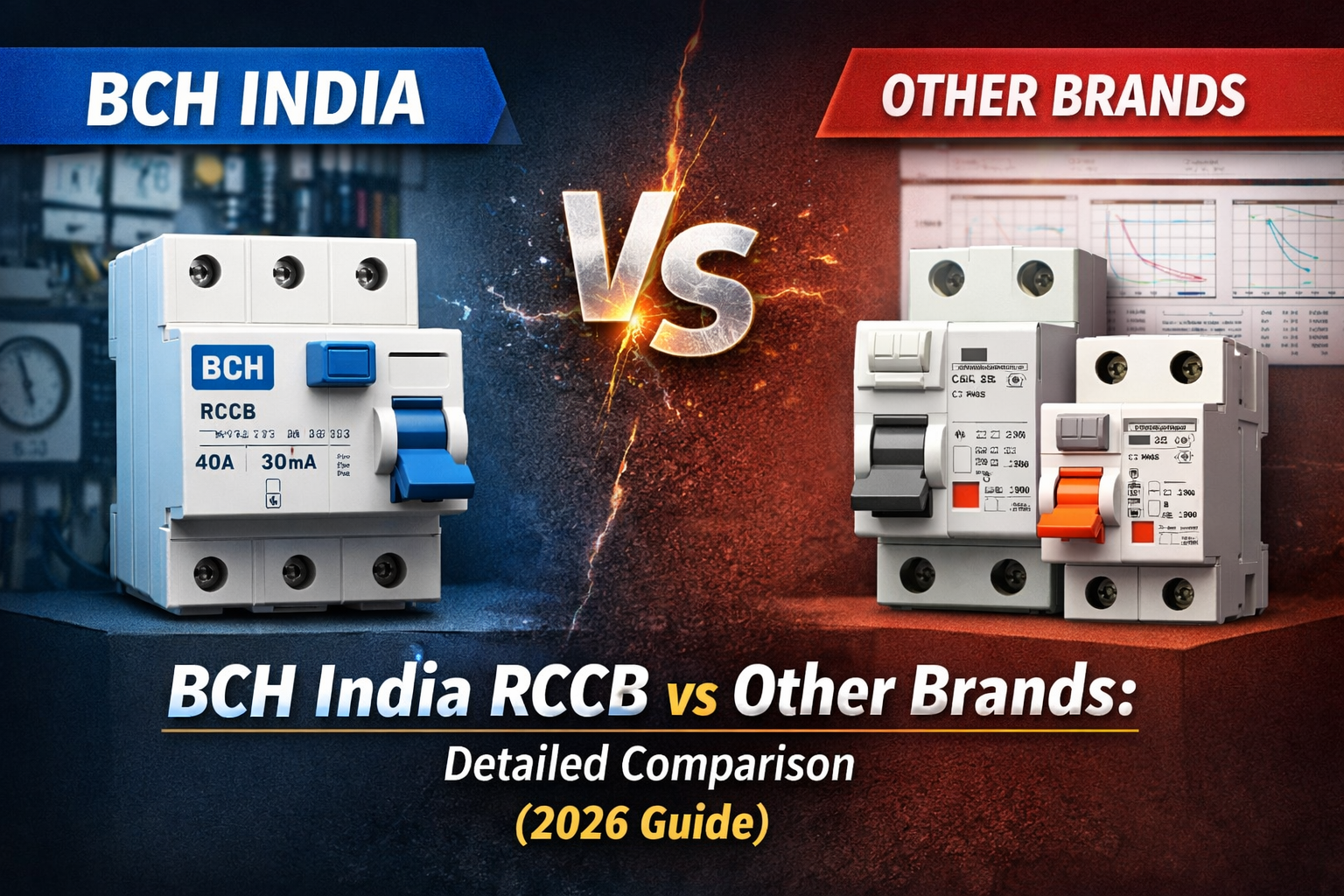
Electrical safety has become more critical than ever in modern homes, commercial buildings, and industrial facilities. With increasing dependence on electronic appliances, automation systems, and high-load equipment, protection against earth leakage and electric shock is essential.
This is where RCCBs (Residual Current Circuit Breakers) play a vital role.
However, not all RCCBs are built the same. When selecting an RCCB, buyers often compare multiple brands before making a decision. In this detailed guide, we compare BCH India RCCBs vs other brands, focusing on standards compliance, technical specifications, reliability, safety performance, installation flexibility, and long-term value.
This comparison will help you make an informed and technically sound decision.
What is an RCCB and Why is It Important?
An RCCB is a safety device designed to detect earth leakage currents and disconnect the circuit when leakage exceeds a predefined level (such as 30mA, 100mA, or 300mA).
Unlike MCBs, which protect against overload and short circuit, RCCBs specifically protect against:
- Electric shock
- Earth faults
- Fire risk due to leakage current
- Insulation failure
In modern electrical systems, RCCBs are no longer optional—they are a mandatory safety requirement in many installations.
Key Comparison Parameters: BCH India RCCB vs Other Brands
To make a fair comparison, let’s evaluate RCCBs across critical technical and practical parameters.
1. Compliance with Standards & Certifications
Why It Matters
RCCBs are life-saving devices. Compliance with recognized standards ensures:
- Accurate tripping performance
- Thermal stability
- Electrical endurance
- Safety under fault conditions
BCH India RCCB
BCH India RCCBs are manufactured in accordance with:
- IS 12640 (Part 1)
- IEC / EN 61008-1
These standards define performance benchmarks for residual current protection devices used in residential and similar applications.
Other Brands
Most established brands also claim IEC compliance. However, buyers should verify:
- Clear marking of standards on device body
- Availability of technical datasheets
- BIS compliance where applicable
Verdict: Compliance transparency is essential. Always choose devices with clearly documented adherence to recognized standards.
2. Sensitivity Ratings (mA)
RCCBs are available in various sensitivity levels:
- 30mA – Personal protection (most common for residential use)
- 100mA – Indirect protection, small commercial setups
- 300mA – Fire protection and upstream circuits
BCH India
BCH India RCCBs are available in:
- 30mA
- 100mA
- 300mA
This range covers residential, commercial, and industrial applications.
Other Brands
Most premium brands offer similar sensitivity options. Differences often lie in:
- Stability under fluctuating voltage
- Resistance to nuisance tripping
- Accuracy under real-world leakage conditions
Verdict: Sensitivity range is comparable across leading brands. Performance consistency becomes the differentiator.
3. Rated Current Options (In)
Rated current must match the circuit load.
BCH India Options
Typically available in:
- 25A
- 40A
- 63A
These ratings suit most residential and small commercial applications.
Other Brands
Some brands extend up to:
- 80A
- 100A
- 125A
However, in many standard applications, 25–63A is sufficient when coordinated properly.
Verdict: Ensure correct coordination with upstream MCB/MCCB. Oversizing does not improve safety.
4. Pole Configuration
Correct pole selection is essential.
- DP (1P+N) – Single-phase systems
- FP (3P+N) – Three-phase systems
BCH India
Offers both:
- 2 Pole (240V)
- 4 Pole (415V)
Suitable for most installations in India.
Other Brands
Offer similar pole configurations.
Verdict: Standard across brands. Selection depends on supply type.
5. Protection Type: AC vs A
Modern loads such as:
- LED drivers
- Inverters
- Washing machines
- UPS systems
- EV chargers
can produce pulsating DC leakage currents.
- Type AC RCCB detects sinusoidal AC leakage
- Type A RCCB detects AC + pulsating DC leakage
When comparing brands, ensure you choose the correct type based on application.
Note: This factor often matters more than brand name.
6. Build Quality & Mechanical Reliability
This is where practical differences emerge.
BCH India Strengths
- Robust housing construction
- Reliable terminal clamping
- Clear trip indication
- Strong mechanical switching mechanism
- Dual termination compatibility (cable & busbar)
Other Brands
Premium brands offer high mechanical endurance ratings. However:
- Low-cost brands may compromise on terminal strength
- Some devices may show inconsistent toggle feel over time
Verdict: For long-term durability, mechanical reliability and terminal integrity are critical.
7. Resistance to Nuisance Tripping
Nuisance tripping is a common complaint in installations with:
- Voltage fluctuations
- Generator supply
- High EMI
- Sensitive electronics
BCH India
Designed for Indian grid conditions and varying load behavior, helping reduce unwanted tripping under stable leakage levels.
Other Brands
Performance varies depending on product series and design quality.
Verdict: Stable performance in fluctuating environments is a strong advantage.
8. Installation Flexibility
Electricians and panel builders value:
- Easy wiring
- Busbar compatibility
- Clear terminal markings
- Compact size
BCH India
Provides:
- Dual termination capability
- Standard DIN rail mounting
- Clear labeling
Other Brands
Some international brands offer additional accessories, but at higher cost.
Verdict: Ease of installation directly impacts labor time and wiring neatness.
9. After-Sales Support & Availability
Electrical protection devices must be:
- Easily available
- Supported with technical documentation
- Backed by responsive service
BCH India
Strong domestic presence and availability through distribution networks in India. The official website https://bchindia.com/ provides product information and support access.
Other Brands
Availability may vary by region. Imported brands may face supply delays.
Verdict: Reliable supply chain matters for contractors and large projects.
10. Price vs Value
While comparing RCCBs, price is often a deciding factor.
However, consider:
- Safety performance
- Mechanical endurance
- Warranty support
- Brand reliability
- Installation compatibility
Low-cost alternatives may compromise on:
- Contact durability
- Tripping consistency
- Material quality
Verdict: Value is not about lowest price—it’s about long-term reliability.
Side-by-Side Summary Comparison
|
Parameter |
BCH India RCCB | Other Leading Brands |
| Standards | IS 12640, IEC 61008-1 |
IEC compliant (varies) |
|
Sensitivity |
30mA, 100mA, 300mA | Similar options |
| Current Ratings | 25A, 40A, 63A |
Wider range in some brands |
| Poles | 2P & 4P |
Similar |
| Installation | Dual termination |
Depends on model |
| Nuisance Tripping | Designed for Indian conditions |
Varies |
| Availability | Strong domestic presence |
Region dependent |
|
Price-to-Value |
Competitive |
Higher in premium brands |
When Should You Choose BCH India RCCB?
BCH India RCCBs are a strong choice when:
- You need compliance with Indian and IEC standards
- Installation is in residential or commercial buildings
- You want reliable performance under Indian voltage conditions
- You need cost-effective, durable solutions
- You prefer easy availability and local support
Final Thoughts
Selecting the right RCCB is not just about brand recognition—it’s about safety, compliance, and reliability.
When comparing BCH India RCCB vs other brands, consider:
- Standards compliance
- Sensitivity accuracy
- Mechanical strength
- Installation convenience
- Availability and support
- Overall value
BCH India offers a dependable RCCB range designed for Indian electrical systems, making it a trusted choice for electricians, contractors, and facility managers.
For technical specifications, product details, and application guidance, visit https://bchindia.com/.
