
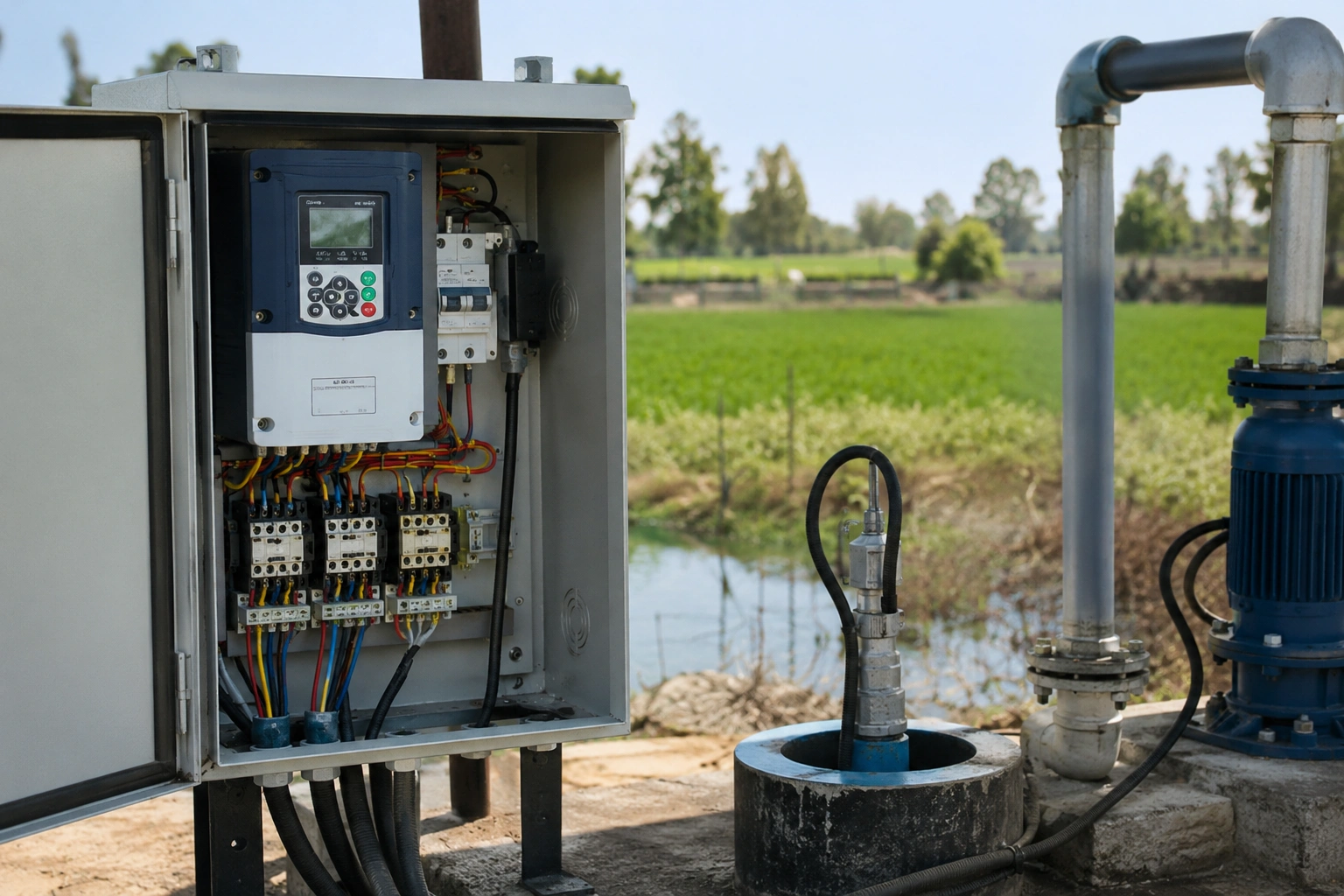
How do you select the right submersible pump starter?
Select a submersible pump starter from the motor nameplate current, phase, voltage, starting method, borewell cable length and required protection—not from horsepower alone. Borewell installations add variables such as long cable runs, voltage variation, moisture, dry-run risk and limited access to the motor after installation. BCH India lists a dedicated single-phase submersible pump starter range, while the wider motor starter portfolio covers other motor-control arrangements. The exact starter range and protection features must be checked against current product data for the motor and installation.
What information should you collect before choosing a starter?
| Input | Why it changes the selection |
| Motor HP, voltage and rated current | Determines the electrical operating range; current is more useful than HP alone for setting selection |
| Single or three phase | Changes starter architecture and phase-protection needs |
| Starting method | Changes inrush, acceleration and contactor duty |
| Cable length and cross-section | Affects voltage drop and motor-terminal voltage |
| Supply variation | Can affect coil operation, starting time and undervoltage behaviour |
| Borewell water behaviour | Influences dry-run detection and restart logic |
| Environment | Determines enclosure, gland and moisture/dust considerations |
| Required protection | Defines overload, dry-run, phase and voltage functions that must be provided |
A practical field method is to photograph the motor nameplate, record the complete cable length and measure supply voltage at rest and during a representative start. That evidence is more useful than selecting a starter from a general horsepower chart.
Why should motor current be checked instead of relying on HP?
Horsepower describes mechanical output, while the starter must carry and switch the motor’s electrical current. Motors with the same HP can differ in rated current, efficiency, design and starting behaviour. The overload range must contain the motor’s nameplate current and be set from the approved motor/starter data rather than from a generic HP assumption.
If the installation uses a conventional direct-on-line arrangement, BCH’s DOL starter product range and its article on DOL starters in water-supply management provide useful context for where this starting method fits.
How do cable length and voltage drop affect pump-starter selection?
Long borewell cable increases resistance and can lower the voltage available at the motor during starting. That may lengthen acceleration, reduce starting torque and keep the motor at high current for longer. The starter therefore has to be reviewed with the cable, not in isolation. For cable-specific checks, use BCH’s 3-core flat cable range and the separate sizing guidance for deep pump installations.
Measure supply voltage at the starter and, where the commissioning method allows, verify the system’s behaviour during a representative start. A weak feeder plus a long cable can create a starting problem even when the starter itself is correctly selected.
Which protection functions should a submersible pump starter provide?
| Protection / function | What it addresses | Selection note |
| Overload | Sustained motor overcurrent | Set from motor current and approved relay/starter data |
| Short-circuit protection | High fault current | Usually provided by the appropriate upstream protective device; verify coordination |
| Dry-run protection | Pump operating without adequate water/load condition | Detection method and threshold must match the actual pump behaviour |
| Single phasing / phase failure | Loss of one phase in a three-phase system | Required for applicable three-phase installations |
| Under/overvoltage | Supply outside the acceptable operating band | Use product/motor limits and appropriate delay logic |
| Restart delay | Prevents rapid cycling and can allow borewell recovery | Set to the process and risk assessment |
For deeper fault logic, BCH’s blog on why a submersible pump starter trips is a useful diagnostic companion. Protection should identify the actual fault path rather than encouraging repeated resets or blanket setting increases.
What does BCH publish for submersible starter applications?
The supplied BCH draft notes single-phase variants for oil-cooled and water-cooled submersible pumps, wide-band encapsulated coil availability in specified variants, complete supply isolation when off and provision for dry-run protection. Those features should be treated as variant-dependent and confirmed for the exact reference being considered.
Use the current motor starter and submersible pump starter downloads for the latest range information rather than copying ratings from an older field sheet or distributor listing.
A practical pump-starter selection workflow
- Record motor HP, voltage, phase and nameplate current.
- Identify the motor type and starting method required by the installation.
- Measure supply voltage at rest and during a representative start where safe and permitted.
- Record the borewell cable route, conductor size and joint condition.
- Check cable current capacity and running/starting voltage drop.
- Choose a starter whose published operating range covers the motor current.
- Define dry-run, overload, short-circuit, phase and voltage protection that the application requires.
- Select the enclosure, cable glands and installation arrangement for the real environment.
- Verify upstream/downstream coordination and any separate protective devices.
- Commission by recording voltage, current, starting time, trip indication and final settings.
Single-phase vs three-phase pump starter: what changes?
A single-phase pump starter may include motor-specific arrangements that differ from a three-phase starter, while a three-phase system introduces phase-loss, phase-sequence and current-imbalance considerations. Do not assume that a starter is suitable merely because the HP label looks similar. Match the motor type, current range, control scheme and protection functions.
For water-pump applications using single-phase DOL control, BCH’s single-phase DOL starter guide for water pumps provides additional application context.
Worked example: rural borewell with voltage variation
Consider a borewell pump on a rural feeder with noticeable voltage variation and a long cable run. The motor nameplate and cable route are recorded first. Voltage is measured at rest and during a representative start. The team then checks whether the cable provides adequate motor-terminal voltage and whether the starter current range covers the motor nameplate current. Dry-run and voltage functions are defined from the site behaviour, while upstream short-circuit protection is checked separately. Only after those checks does the team freeze the starter reference and settings. This process avoids using a larger starter or higher overload setting to mask a cable or supply problem.
What should be included in the purchase specification?
- Motor voltage, phase, HP and nameplate current.
- Starting method and expected starts per hour.
- Cable length, cross-section and installation route.
- Expected supply-voltage range.
- Required overload, dry-run, phase and voltage functions.
- Short-circuit protection and coordination requirements.
- Enclosure/environment conditions and cable-entry requirements.
- Exact product reference and documentation required at handover.
- Commissioning tests, measured values and setting record.
Before ordering, check the latest BCH price list only after the technical shortlist is complete; price should not replace the motor and protection checks. For application support, send the nameplate, cable and supply information through the BCH enquiry page or contact the appropriate BCH sales office.
Frequently asked questions
Can a single-phase starter be used for any pump of the same HP?
No. Rated current, motor design and any capacitor/control arrangement can differ. Match the exact motor and starter documentation.
Why is cable length important when choosing a starter?
Long cable runs increase voltage drop, especially during starting. Low motor-terminal voltage can reduce starting torque and lengthen acceleration.
Does the starter itself provide short-circuit protection?
That depends on the architecture. Treat overload, switching and short-circuit protection as separate functions unless the exact selected product documentation states otherwise.
What should be measured during commissioning?
Record supply voltage, phase values where applicable, motor current, starting time, trip indications and final settings under representative operating conditions.
Technical note
Exact current ranges, coil features, dry-run functions and motor compatibility are product-specific. Confirm them from the latest BCH starter documentation and the motor manufacturer before publishing a rating or approving a field substitution.
