
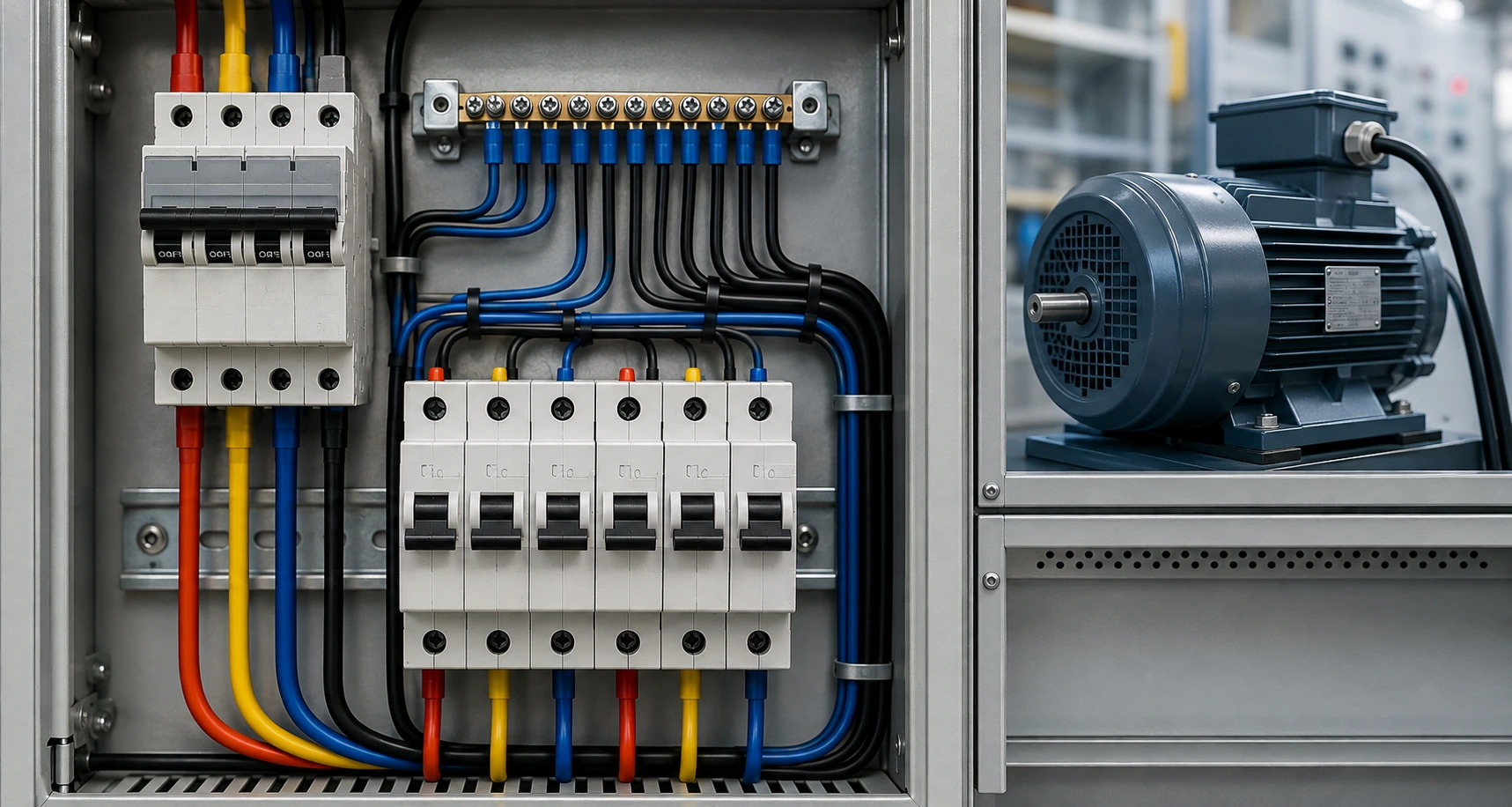
Balancing a three-phase MCB DB means distributing single-phase circuits across L1, L2 and L3 so the phase currents remain reasonably close during real operating conditions. Equal circuit counts are not enough. A lighting circuit, air-conditioning circuit and plug-load circuit can have very different demand and operating schedules.
| Quick answer Build a circuit inventory, place the largest predictable loads first, distribute cyclic or intermittent loads across the three phases, then measure phase and neutral current during representative demand. Reallocate suitable circuits where needed, update the circuit schedule and repeat the review after tenancy or equipment changes. |
For product context, review BCH’s MCB Distribution Box range and MCB product family.
Why equal circuit counts do not mean balanced loads
Three outgoing circuits on each phase can still produce a poor balance if one phase carries several high-demand loads while another carries mostly light or intermittent circuits. The useful comparison is current under representative operating conditions, not the number of ways assigned to each phase.
|
Finding |
What it can indicate |
Practical response |
|
One phase consistently higher |
Large or coincident single-phase loads concentrated on one phase |
Reallocate compatible circuits after a design review |
|
Neutral current unexpectedly high |
Harmonics, shared-neutral arrangement or load pattern |
Measure and investigate before changing neutral sizing |
|
Voltage differs noticeably by phase |
Upstream supply or connection issue |
Check supply and connections as well as load allocation |
|
Imbalance appears only at certain times |
Different operating schedules or coincident peaks |
Review logged demand by time of day |
|
Repeated trips on one phase |
Overload, protection, conductor or local circuit issue | Diagnose the affected circuit; do not move loads blindly |
A practical load-balancing method
- Create a complete inventory of single-phase outgoing circuits.
- Record connected load, realistic demand and normal operating schedule for each circuit.
- Place large, predictable loads first rather than assigning circuits only in numerical order.
- Spread cyclic and intermittent loads across L1, L2 and L3.
- Measure phase currents during representative demand, not just during a quiet period.
- Measure neutral current and investigate unexpected values.
- Move only suitable circuits after isolation and a documented electrical review.
- Update phase labels, the DB schedule and drawings.
- Repeat measurements after the change to confirm the result.
- Review the balance again after major tenancy, equipment or operating-hour changes.
Step 1: Build a useful circuit inventory
Start with the single-line diagram and the distribution-board schedule. For every single-phase circuit, record what it supplies, the connected load, expected demand and when it normally operates. The purpose is to understand which loads are likely to run together, not just their maximum nameplate values.
Large predictable loads are normally the easiest place to start because their contribution to phase current is easier to anticipate. Smaller plug and lighting circuits can then be distributed around them.
Step 2: Measure current under representative conditions
A paper schedule gives the starting point; measurements show what the building or plant actually does. Record L1, L2 and L3 current during representative demand. If the imbalance changes during the day, logging at different operating periods can be more useful than one snapshot.
Phase balancing is not about forcing every reading to be identical. The goal is a sound operating condition that fits the project, equipment and utility limits.
Step 3: Check the neutral, not only the phases
Electronic loads can complicate the picture. Triplen harmonics can add in the neutral even when the fundamental phase currents look comparatively balanced. If neutral current is unexpectedly high, measure and assess the circuit with suitable instruments before making assumptions about neutral capacity or load allocation.
The source material specifically cautions against reducing neutral capacity without a harmonic assessment.
Step 4: Reallocate only suitable circuits
When one phase remains consistently high, identify circuits that can be reassigned without creating a new problem elsewhere. Reallocation is electrical work: isolate the board, verify absence of voltage, use competent personnel and update the circuit schedule when the work is complete.
Do not move a circuit simply to improve a current reading if doing so conflicts with the approved design, shared-neutral arrangement, protection, cable routing or operational requirements.
Step 5: Confirm the distribution board still suits the system
Load balancing does not replace distribution-board design. Verify busbar rating, enclosure temperature, incoming and outgoing protective devices, terminal capacity, neutral arrangement and the board’s declared short-circuit capability. Spare modules do not prove that the busbar, neutral link or thermal design can accept a new large load.
BCH’s MCB Distribution Box maintenance guide is a useful companion when the review includes an existing board.
What to record in the load-balancing worksheet
- Connected load for each outgoing circuit
- Expected or measured coincident demand
- Phase allocation
- Measured phase current
- Measured neutral current
- Operating time or schedule
- Relevant harmonic observations
- Protective-device reference and circuit label
- Date of measurement and person performing the review
- Any circuit moves and the updated drawing or DB schedule
Worked application: an office MCB DB with different daily peaks
Consider an office board where air-conditioning loads, lighting and socket circuits peak at different times. A circuit-count approach might look balanced on paper while one phase carries a larger share of the air-conditioning demand during the afternoon. The better process is to compare the circuit inventory with measured phase current at the times when the building is heavily loaded.
If one phase remains consistently higher, suitable single-phase circuits can be redistributed after an engineering review. Then repeat the measurements. The final schedule should show the new phase allocation so future maintenance teams do not have to reconstruct the change from memory.
Protection and MCB selection still matter
An MCB rating must protect the conductor and suit the fault level at the point where it is installed; it cannot be selected from load current alone. Upstream and downstream protection, time-current behaviour, busbar capacity and the overall board assembly remain part of the design even after the phase currents have been improved.
For related panel-safety context, see BCH’s article on how MCBs enhance safety and compliance in electrical panels.
Installation and documentation checks
- Verify conductor cross-section, terminal capacity and tightening requirements.
- Confirm protective-earth continuity and neutral routing.
- Keep the circuit schedule and phase labels accurate after any reallocation.
- Measure currents under representative load after the work is complete.
- Retain the readings with the board documentation for future comparison.
- Revisit the balance after significant equipment, tenancy or operating-pattern changes.
If the task also involves a new board installation, use the BCH MCB Distribution Box installation guide as a separate installation reference.
Frequently Asked Questions
What is an acceptable phase imbalance?
Use the project, equipment and utility limits. The objective is not a cosmetic zero difference but a safe and efficient operating condition based on representative demand.
Can I balance phases by giving each phase the same number of circuits?
No. Equal circuit counts can still produce very different currents because loads have different sizes and operating schedules.
Why can neutral current be high even when phase currents look balanced?
Electronic loads can produce harmonic currents that add in the neutral. Measure and assess the harmonic condition before changing neutral capacity.
Can circuits be moved while the board is energised?
No. Circuit reallocation is electrical work requiring isolation, verification, competent personnel and updated documentation.
When should phase balance be checked again?
Repeat the review after major tenancy changes, new equipment, altered operating hours or whenever measurements or trip history suggest the original load pattern has changed.
Review BCH MCB and distribution-board options
Explore the BCH MCB Distribution Box and MCB ranges for product information. For an application-specific requirement, send the circuit and load details to BCH.
