
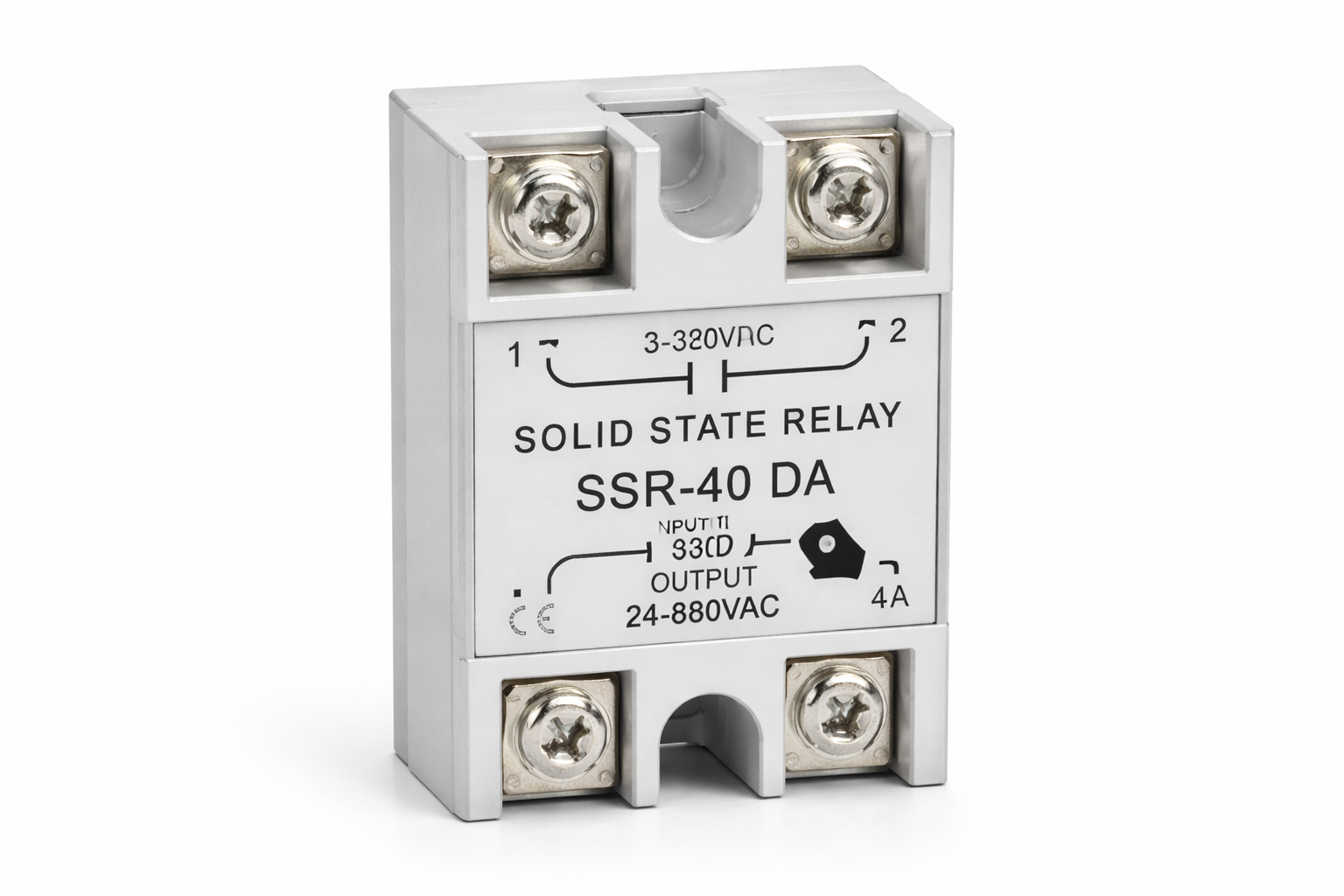
Modern industrial automation systems require electrical components that are fast, reliable, and capable of operating continuously without mechanical wear. One such component that has gained significant importance in recent years is the Solid State Relay (SSR).
Unlike traditional electromechanical relays that use moving contacts, solid state relays use semiconductor devices to perform switching operations. This design offers several advantages, including higher switching speed, longer lifespan, and silent operation.
In this guide, we provide a complete overview of solid state relays, including their working principle, types, advantages, and industrial applications. Whether you are an automation engineer, electrician, or system designer, understanding SSR technology can help you select the right switching solution for modern electrical systems.
What Is a Solid State Relay?
A Solid State Relay (SSR) is an electronic switching device that uses semiconductor components instead of mechanical contacts to control electrical circuits.
It performs the same basic function as a traditional relay—turning electrical loads ON or OFF—but does so electronically without moving parts.
The key components inside a solid state relay typically include:
-
An input control circuit
-
An optical isolation device (opto-coupler)
-
A semiconductor switching device such as a TRIAC, SCR, or MOSFET
-
An output power circuit
Because SSRs have no moving parts, they provide faster switching and greater durability compared to conventional relays.
How Solid State Relays Work
The working principle of a solid state relay is based on electronic switching using semiconductor devices.
The operation can be understood in three main steps:
1. Control Signal Activation
A low-voltage control signal is applied to the SSR input terminal. This signal can come from:
-
PLC systems
-
Microcontrollers
-
Industrial controllers
-
Automation equipment
The control signal activates the internal input circuit.
2. Optical Isolation
Inside the SSR, an opto-isolator (optocoupler) transfers the signal from the input side to the output side using light instead of electrical contact.
This isolation provides several benefits:
-
Protection for control circuits
-
Electrical noise reduction
-
Improved system safety
Optical isolation ensures that high-voltage loads remain separated from sensitive control electronics.
3. Semiconductor Switching
The optocoupler activates the semiconductor switching device, such as:
-
TRIAC
-
SCR
-
MOSFET
These components allow current to flow through the load circuit, turning the connected equipment ON.
When the control signal is removed, the semiconductor device stops conducting, turning the load OFF.
This entire process occurs almost instantly, enabling rapid and precise switching.
Advantages of Solid State Relays
Solid state relays provide several advantages over traditional electromechanical relays.
1. No Mechanical Wear
Since SSRs have no moving contacts, they do not experience mechanical wear or contact erosion.
This leads to:
-
Longer operational life
-
Reduced maintenance
-
Higher reliability in industrial environments
2. Faster Switching Speed
Solid state relays switch significantly faster than mechanical relays.
This makes them ideal for applications requiring:
-
Rapid switching
-
High-frequency operation
-
Precise control systems
3. Silent Operation
Traditional relays produce audible clicking sounds due to mechanical movement.
SSRs operate silently, which is beneficial in:
-
Medical equipment
-
Laboratory systems
-
Commercial buildings
4. Improved Resistance to Vibration
Mechanical relays can fail in environments with heavy vibration.
SSRs are highly resistant to vibration and shock, making them suitable for:
-
Industrial machinery
-
Automotive production lines
-
Heavy equipment systems
5. Longer Operational Life
Because there are no moving contacts, SSRs often provide millions of switching cycles, significantly extending device lifespan.
This improves reliability in continuous operation environments.
Types of Solid State Relays
Solid state relays are available in various configurations depending on the application.
1. AC Solid State Relay
AC SSRs are used to switch alternating current loads.
They typically use TRIAC or SCR technology and are commonly used in:
-
Heating systems
-
Lighting control
-
Industrial automation
2. DC Solid State Relay
DC SSRs are designed to switch direct current loads and often use MOSFET or transistor switching devices.
Typical applications include:
-
Battery-powered systems
-
Solar power installations
-
DC motors
3. Zero-Cross Solid State Relay
Zero-cross SSRs switch the load only when the AC waveform crosses zero voltage.
Advantages include:
-
Reduced electrical noise
-
Lower switching stress
-
Improved load protection
These are ideal for resistive loads such as heaters.
4. Random Turn-On Solid State Relay
Random turn-on SSRs activate immediately when the control signal is applied, regardless of the AC waveform position.
These are commonly used for:
-
Phase control systems
-
Motor speed control
-
Industrial power regulation
Applications of Solid State Relays
Solid state relays are widely used across many industries due to their reliability and switching performance.
Industrial Automation
SSRs are commonly used in PLC-based automation systems to control:
-
Industrial heaters
-
Motors
-
Conveyor systems
-
Process control equipment
Automation systems benefit from SSRs due to their fast switching capabilities and reliability.
Temperature Control Systems
Solid state relays are widely used in temperature control applications, such as:
-
Industrial ovens
-
Plastic molding machines
-
HVAC systems
-
Food processing equipment
Their fast switching ensures precise temperature regulation.
Lighting Control Systems
In commercial and industrial lighting systems, SSRs provide efficient switching for:
-
Stage lighting
-
Industrial illumination
-
Automated lighting control systems
Medical Equipment
Medical systems require silent and reliable switching. SSRs are often used in:
-
Diagnostic machines
-
Laboratory equipment
-
Healthcare devices
Their silent operation makes them suitable for noise-sensitive environments.
Renewable Energy Systems
Solid state relays are also used in renewable energy applications, including:
-
Solar power systems
-
Battery management systems
-
Energy storage systems
Their durability makes them suitable for long-term operation in power systems.
Solid State Relays vs Electromechanical Relays
Understanding the differences between SSRs and traditional relays helps determine the right solution for specific applications.
| Feature | Solid State Relay | Electromechanical Relay |
|---|---|---|
| Switching mechanism | Semiconductor devices | Mechanical contacts |
| Switching speed | Very fast | Slower |
| Noise | Silent | Audible clicking |
| Mechanical wear | None | Contact wear over time |
| Vibration resistance | High | Moderate |
| Operational life | Very long | Limited by contact wear |
Both relay types have their own advantages depending on application requirements.
Factors to Consider When Choosing a Solid State Relay
Selecting the correct SSR requires evaluating several technical parameters.
Key considerations include:
-
Load voltage and current rating
-
AC or DC switching requirement
-
Heat dissipation and cooling
-
Switching frequency
-
Control voltage compatibility
Choosing a properly rated SSR ensures safe and reliable operation.
Importance of Quality in Industrial Relays
Industrial switching devices must operate reliably under demanding conditions. Low-quality relays can lead to:
-
Overheating
-
System instability
-
Equipment damage
-
Increased maintenance costs
Reliable manufacturers such as BCH India provide industrial-grade electrical components designed to support modern automation systems.
Through the official website https://bchindia.com/, professionals can explore product specifications, technical resources, and electrical solutions suited for industrial applications.
Future of Solid State Relay Technology
As industries adopt automation, IoT, and smart manufacturing technologies, solid state relays are expected to play an increasingly important role.
Future developments may include:
-
Higher efficiency semiconductor designs
-
Integration with smart control systems
-
Improved thermal management
-
Compact and modular designs
These advancements will further improve the performance and reliability of industrial switching devices.
Conclusion
Solid state relays have become essential components in modern electrical and automation systems. Their ability to provide fast, silent, and reliable switching makes them ideal for a wide range of applications.
By understanding the working principle, types, advantages, and applications of solid state relays, engineers and electricians can select the right solution for their systems.
For professionals seeking reliable electrical solutions and technical guidance, the resources available at https://bchindia.com/ provide valuable insights into industrial electrical components and modern automation infrastructure.
