
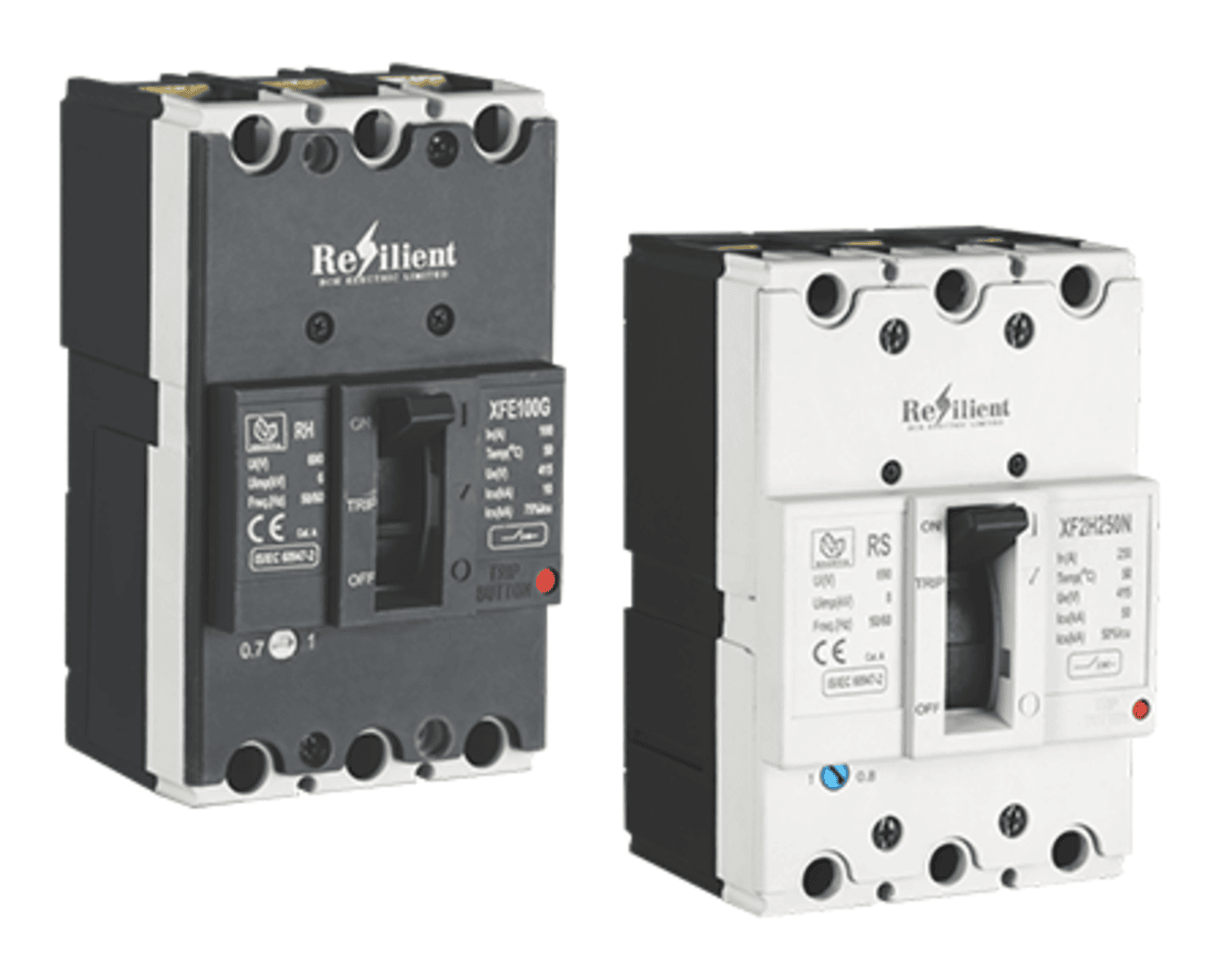
In industrial electrical systems, fault currents can reach extremely high levels due to large transformer capacities, dense load networks, and interconnected distribution systems. In such environments, selecting the right protection device is critical to ensure system safety, equipment protection, and operational continuity.
One of the most important devices used for protection in such systems is the Moulded Case Circuit Breaker (MCCB). However, selecting an MCCB for high fault level applications requires careful evaluation of parameters such as breaking capacity, protection settings, system design, and coordination with other devices.
This guide explains how to select the right MCCB for high fault level industrial systems, helping professionals make safe and technically sound decisions.
What Is an MCCB?
A Moulded Case Circuit Breaker (MCCB) is an electrical protection device used to protect circuits from:
-
Overload conditions
-
Short circuit faults
-
Ground faults (in advanced models)
MCCBs are widely used in industrial applications due to their:
-
High current handling capability
-
Adjustable protection settings
-
Robust construction
-
Reliable fault interruption
They are essential components in power distribution panels, motor control centers (MCC), and industrial electrical networks.
What Are High Fault Level Systems?
High fault level systems are electrical systems where the prospective short circuit current is very high.
This typically occurs in:
-
Large industrial plants
-
Facilities with high-capacity transformers
-
Systems with multiple power sources
-
Heavy manufacturing units
Fault levels can range from 25kA to 100kA or more, depending on system configuration.
In such systems, selecting the wrong MCCB can lead to:
-
Breaker failure
-
Equipment damage
-
Fire hazards
-
System shutdown
Key Factors to Consider When Selecting MCCB
1. Breaking Capacity (Icu)
The most critical parameter in high fault level systems is the breaking capacity (Icu).
What Is Icu?
Icu (Ultimate Breaking Capacity) is the maximum fault current that an MCCB can safely interrupt.
Selection Rule:
👉 Icu of MCCB must be greater than the system fault current
For example:
-
System fault current: 50kA
-
Required MCCB Icu: ≥ 50kA (preferably higher, e.g., 65kA)
If Icu is lower than the fault current, the MCCB may fail during a short circuit.
2. Service Breaking Capacity (Ics)
Ics (Service Breaking Capacity) indicates how much fault current the MCCB can interrupt repeatedly without damage.
Typically expressed as a percentage of Icu:
-
25%
-
50%
-
75%
-
100%
For critical industrial systems, choose MCCBs with higher Ics (≥ 75% of Icu) to ensure reliability.
3. Rated Current (In)
The MCCB’s rated current must match the load requirement.
Selection should consider:
-
Full load current
-
Future load expansion
-
Safety margin
Avoid:
-
Undersized MCCB → overheating and nuisance tripping
-
Oversized MCCB → inadequate protection
4. Adjustable Protection Settings
Modern MCCBs offer adjustable protection features, including:
-
Long-time delay (overload protection)
-
Short-time delay (short circuit protection)
-
Instantaneous protection
-
Ground fault protection
These settings allow engineers to fine-tune protection according to system requirements.
This is especially important in high fault level systems where precise coordination is required.
5. Selectivity (Discrimination)
Selectivity ensures that only the faulty section of the system is isolated, not the entire network.
For example:
-
A downstream MCCB trips for a fault
-
Upstream breakers remain operational
This improves:
-
System reliability
-
Operational continuity
-
Reduced downtime
Proper selectivity requires coordination between:
-
MCCBs
-
MCBs
-
Relays
6. Type of Trip Unit
MCCBs come with different trip units:
Thermal-Magnetic Trip
-
Basic protection
-
Cost-effective
-
Suitable for standard applications
Electronic Trip Unit
-
Advanced protection
-
Higher accuracy
-
Adjustable settings
-
Communication capabilities
For high fault level systems, electronic trip MCCBs are preferred due to their precision and flexibility.
7. Voltage Rating
Ensure the MCCB is compatible with system voltage:
-
415V (low voltage industrial systems)
-
Higher voltages in specialized applications
Incorrect voltage rating can compromise performance and safety.
8. Number of Poles
Choose based on system configuration:
-
3 Pole (3P) → three-phase systems
-
4 Pole (4P) → systems requiring neutral protection
In industrial systems, 3P and 4P MCCBs are most commonly used.
9. System Earthing Type
The type of earthing system affects MCCB selection.
Examples:
-
TN system
-
TT system
-
IT system
Ground fault protection requirements vary based on the earthing system.
10. Environmental Conditions
Industrial environments often involve:
-
High temperature
-
Dust and pollution
-
Moisture
-
Vibration
Choose MCCBs with:
-
High durability
-
Proper enclosure protection
-
Reliable performance in harsh conditions
Manufacturers like BCH India design MCCBs suitable for demanding industrial environments.
Steps to Select MCCB for High Fault Level Systems
Step 1: Calculate Fault Current
Determine the prospective short circuit current at the installation point using:
-
Transformer capacity
-
Cable impedance
-
System configuration
Step 2: Select Breaking Capacity
Choose MCCB with:
Icu ≥ calculated fault current
Always include a safety margin.
Step 3: Select Rated Current
Match MCCB rating with:
-
Load current
-
Future expansion requirements
Step 4: Choose Trip Type
-
Thermal-magnetic → basic protection
-
Electronic → advanced protection
Step 5: Ensure Proper Coordination
Check coordination with:
-
Upstream breakers
-
Downstream protection devices
Step 6: Consider Installation Conditions
Select MCCB based on:
-
Temperature
-
Panel design
-
Application type
Common Mistakes to Avoid
Avoid these critical errors:
- Selecting MCCB based only on current rating
- Ignoring breaking capacity
- Not calculating fault level
- Poor coordination with other devices
- Choosing low-quality MCCBs
These mistakes can lead to serious system failures.
Applications of MCCBs in High Fault Systems
MCCBs are widely used in:
-
Main distribution boards (MDBs)
-
Motor control centers (MCC panels)
-
Industrial power distribution systems
-
Manufacturing plants
-
Infrastructure projects
In all these applications, proper MCCB selection ensures system protection and reliability.
Importance of High-Quality MCCBs
In high fault level systems, the quality of MCCBs is critical.
High-quality MCCBs provide:
-
Reliable fault interruption
-
Consistent performance
-
Long operational life
-
Reduced maintenance
-
Improved safety
BCH India offers industrial-grade electrical solutions designed for modern power systems. Through https://bchindia.com/, professionals can explore product specifications and technical resources for selecting the right MCCB.
Future Trends in MCCB Technology
MCCBs are evolving with:
-
Smart trip units
-
Remote monitoring
-
IoT integration
-
Energy management features
These advancements improve system efficiency and fault detection capabilities.
Conclusion
Selecting the right MCCB for high fault level industrial systems is critical for ensuring safety, reliability, and operational continuity.
Key factors to consider include:
-
Breaking capacity (Icu & Ics)
-
Rated current
-
Trip unit type
-
Selectivity and coordination
-
Environmental conditions
A properly selected MCCB protects electrical systems from severe faults and ensures long-term performance.
For technical guidance, product specifications, and reliable industrial solutions, professionals can explore https://bchindia.com/.
