
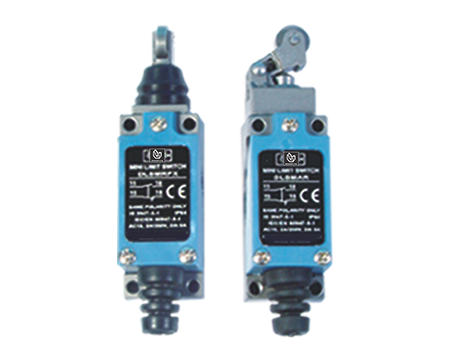
What Is a Limit Switch?
A limit switch is a contact-based position sensor. When a moving object touches its actuator, the internal contacts change state and send an electrical signal.
The signal from the switch is usually sent to a PLC, relay, contactor, alarm circuit, or machine controller. The limit switch itself normally does not decide the complete machine response. It provides position information to the control system, which then performs the programmed action.
How Does a Limit Switch Work?
The working process is straightforward:
- A machine component moves toward the switch.
- The component touches the actuator.
- The actuator moves the internal switching mechanism.
- The contacts change from open to closed or closed to open.
- The control system receives the signal.
- The machine performs the programmed action.
For example, a box moving on a conveyor may press a roller lever. The switch then signals the PLC to stop the conveyor and begin a filling or packaging cycle.
Because the switch responds to actual physical movement, it can provide more dependable position confirmation than a timer alone.
Main parts of a limit switch
A typical limit switch includes the following components.
Actuator
The actuator is the external part that makes contact with the moving object. Common actuator types include:
- Roller lever
- Adjustable lever
- Plunger
- Roller plunger
- Flexible rod
- Whisker
- Rotary shaft
The actuator must match the movement, speed, direction, and shape of the target.
Contact Mechanism
The internal contacts open or close when the actuator reaches the operating point. Common arrangements include normally open, normally closed, and changeover contacts.
Enclosure
The enclosure protects the internal mechanism and electrical contacts against dust, moisture, oil, impact, and other environmental conditions.
Normally open and normally closed contacts
A normally open contact does not conduct when the actuator is at rest. When the actuator is pressed, the contact closes.
It may be used to:
- Confirm that a product has arrived
- Start the next machine step
- Activate an indicator
- Count products
- Energise a control relay
A normally closed contact conducts when the actuator is at rest. When the actuator is pressed, the contact opens.
It may be used to:
- Stop machine movement
- Interrupt a control circuit
- Detect the opening of a guard
- Prevent overtravel
- Generate a fault signal
The contact arrangement should match the machine’s control logic. For safety-critical functions, a suitable safety-rated switch and control architecture may be required.
Common types of limit switches
Roller-lever limit switch
A roller-lever switch is suitable when an object moves across the actuator from the side. The roller helps reduce friction and mechanical wear.
Typical applications include conveyors, packaging machines, doors, and moving machine slides.
Plunger limit switch
A plunger switch is operated by direct linear movement. It is useful in presses, machine tools, fixtures, and compact mechanisms.
Correct alignment is important because excessive side pressure may damage the plunger or prevent reliable operation.
Flexible-rod or whisker switch
A flexible actuator can detect objects approaching from different directions. It is useful for irregularly shaped objects, conveyor monitoring, and applications requiring light contact.
Rotary limit switch
A rotary limit switch detects angular movement or shaft rotation. It is commonly used in cranes, hoists, winches, lifts, and valve mechanisms.
Cable-pull switch
Cable-pull switches are installed along conveyors and extended machine areas. Pulling the cable sends a stop signal.
Emergency-stop applications require suitable safety-rated devices and a correctly designed safety control circuit.
How limit switches improve industrial automation
Limit switches help automated systems respond to actual machine movement instead of relying entirely on programmed timing.
End-of-travel detection
A limit switch can stop a machine table, crane, lift, valve, or actuator when it reaches the end of its permitted movement.
The control system may then stop or reverse the motor to prevent overtravel and possible equipment damage.
Object detection
A product can operate the switch when it reaches a loading, filling, sealing, cutting, or sorting point.
For example, a limit switch may confirm that a container is correctly positioned before a filling nozzle starts operating.
Process sequencing
Many automated processes depend on one movement being completed before the next begins.
For example:
- A component enters a fixture.
- A limit switch confirms its position.
- The fixture clamps the component.
- The machine begins the next operation.
Without dependable position confirmation, the next process could begin before the component is correctly located.
Machine interlocking
A limit switch can help prevent a machine from operating until a door, cover, clamp, platform, or valve reaches the correct position.
For safety-related guard monitoring, a standard limit switch should not automatically be treated as a safety device. A suitable safety-rated switch and monitored control system may be required.
Position confirmation
A limit switch can confirm whether a valve, platform, door, clamp, or actuator is open, closed, extended, or retracted.
This information helps the PLC determine whether the machine can proceed to the next operation.
Industrial applications of limit switches
Conveyor systems
Limit switches detect products, transfer points, end positions, and material accumulation.
They may stop a conveyor when:
- A box reaches a filling station
- A product arrives at a packing point
- Material reaches the end of the line
- A diverter completes its movement
- A transfer mechanism reaches its limit
Cranes and hoists
Limit switches help monitor upper, lower, and travel limits. A correctly selected switch can prevent a hook, trolley, or bridge from travelling beyond its intended range.
Crane applications require switches designed for the expected mechanical duty, vibration, operating speed, and environmental conditions.
Machine tools
Machine tools use limit switches to detect:
- Table movement
- Slide position
- Tool position
- Chuck status
- Guard position
- Cycle completion
Repeatability and correct actuator alignment are particularly important in precision machinery.
Packaging machinery
Limit switches help coordinate:
- Filling
- Sealing
- Cutting
- Folding
- Labelling
- Product discharge
They confirm that products and machine components are correctly positioned before each stage begins.
Material-handling equipment
Limit switches are used in:
- Stackers
- Transfer trolleys
- Pallet systems
- Lifts
- Sorting equipment
- Automated storage systems
Valves and dampers
A limit switch can confirm whether a valve or damper has reached its fully open or fully closed position.
This feedback allows the control system to verify that the commanded movement has actually occurred.
Benefits of limit switches
Limit switches offer several practical benefits:
- Direct physical position detection
- Straightforward connection to PLCs and relays
- Multiple actuator options
- Dependable machine sequencing
- Suitability for demanding industrial conditions
- Easy visual inspection
- Cost-effective position feedback
- Compatibility with different control circuits
Limit switch versus proximity sensor
A limit switch requires physical contact with the target. A proximity sensor detects an object without touching it.
|
Factor |
Limit switch |
Proximity sensor |
|
Detection method |
Physical contact |
Non-contact |
|
Mechanical wear |
Possible |
No actuator wear |
|
Target type |
Many solid objects |
Depends on sensor technology |
|
Switching speed |
Suitable for mechanical systems |
Often suitable for faster detection |
|
Installation |
Requires a correct contact path |
Requires correct sensing distance |
|
Output |
Mechanical contacts |
Electronic output |
A limit switch is often preferred where direct mechanical confirmation is required. A proximity sensor may be more suitable where physical contact, mechanical wear, or high switching frequency is undesirable.
How to select the right limit switch
1. Define the required function
Determine whether the switch must detect:
- End of travel
- Product presence
- Door position
- Valve position
- Sequence completion
- Machine overtravel
- Cable movement
2. Study the machine movement
Check the:
- Direction of approach
- Operating speed
- Travel distance
- Available force
- Shape of the target
- Overtravel after actuation
- Operating frequency
The actuator should not be struck in an incorrect direction or moved beyond its permitted travel.
3. Choose the actuator type
Use a roller lever for passing objects, a plunger for direct movement, a flexible rod for irregular targets, or a rotary switch for shaft movement.
The selected actuator should operate smoothly without excessive impact or side loading.
4. Check the electrical rating
The contact rating must suit the control voltage, current, and load type.
A switch connected to a PLC input carries a different electrical load from a switch controlling a relay or contactor coil. AC and DC switching ratings may also differ.
5. Select the contact arrangement
Choose normally open, normally closed, or changeover contacts according to the required control logic.
The contact arrangement should be confirmed before the control circuit is designed or wired.
6. Evaluate the environment
Consider:
- Dust
- Water
- Oil
- Coolant
- Chemicals
- Temperature
- Corrosion
- Vibration
- Mechanical impact
- Outdoor exposure
Select an enclosure and IP rating appropriate for the operating environment.
7. Confirm mounting and wiring space
Ensure that there is enough space for:
- Switch mounting
- Actuator movement
- Cable entry
- Terminal access
- Adjustment
- Inspection
- Replacement
8. Review safety requirements
For ordinary position feedback, a standard industrial limit switch may be suitable.
For guard monitoring, emergency stopping, or hazardous machine movement, confirm whether a safety-rated switch, positive-opening contact, redundant architecture, or monitored safety controller is required.
Common limit switch problems
Common problems include:
- Incorrect actuator alignment
- Excessive overtravel
- Loose mounting
- Damaged roller or lever
- Dirt or material buildup
- Moisture entry
- Loose terminals
- Broken cables
- Contact wear
- Incorrect electrical rating
- Excessive vibration
- Repeated mechanical impact
A limit switch that fails repeatedly should not simply be replaced. The machine movement, mounting position, actuator geometry, and electrical load should also be checked.
Read more about common industrial problems solved by limit switches and limit switches for heavy-duty machines.
Maintenance guidelines
Regular maintenance can improve reliability and reduce unexpected machine stoppages.
Recommended checks include:
- Inspect the actuator for damage.
- Confirm that the target operates the switch correctly.
- Tighten mounting screws and brackets.
- Check terminals and cable glands.
- Remove dust, grease, and debris.
- Inspect seals and enclosure damage.
- Test the contact operation.
- Confirm that the actuator returns freely.
- Check that machine overtravel remains acceptable.
- Replace damaged switches instead of bypassing them.
The machine should be electrically isolated and made safe before inspection or replacement.
BCH limit switches for industrial applications
BCH offers limit switches for general-purpose, precision, and heavy-duty industrial applications.
Relevant product ranges include:
- General-Purpose Limit Switches
- Precision Limit Switches
- Heavy-Duty Limit Switches – NL Series
- BCH Automation Products
- BCH Products and Solutions
The correct model should be selected according to the actuator type, contact arrangement, operating speed, environment, electrical rating, and mechanical duty.
For product-selection assistance, submit an enquiry to BCH.
Frequently asked questions
What is a limit switch?
A limit switch is an electromechanical position sensor that changes its contact state when a moving object reaches a defined point.
Is a limit switch a sensor?
Yes. It is a contact-based position sensor used to detect physical movement or position.
Can a limit switch control a motor directly?
Usually, it sends a signal to a PLC, relay, or contactor. Direct switching depends on the electrical rating and circuit design.
What is the difference between a limit switch and a proximity sensor?
A limit switch requires physical contact. A proximity sensor detects an object without touching it.
Which limit switch is suitable for conveyors?
A roller-lever or flexible-rod switch is often suitable, depending on the object shape, speed, and approach direction.
Can a standard limit switch be used as an emergency stop?
Not automatically. Emergency-stop functions require suitable safety-rated components and a properly designed safety circuit.
Why does a limit switch fail repeatedly?
Common causes include misalignment, excessive travel, vibration, impact, contamination, loose mounting, or incorrect electrical loading.
Final selection guidance
Limit switches give industrial control systems direct feedback about machine position and movement. They can detect end travel, confirm product presence, support process sequencing, verify valve or actuator position and help prevent overtravel.
Selection should not be based on physical size alone. The actuator type, approach direction, operating speed, overtravel, switching frequency, contact arrangement, electrical rating, enclosure, environment and maintenance access all affect performance.
A correctly selected and installed limit switch improves repeatability, reduces unexpected stoppages and helps the machine respond at the right point in its operating cycle.
Explore BCH Limit Switches or contact BCH for product-selection assistance.
