
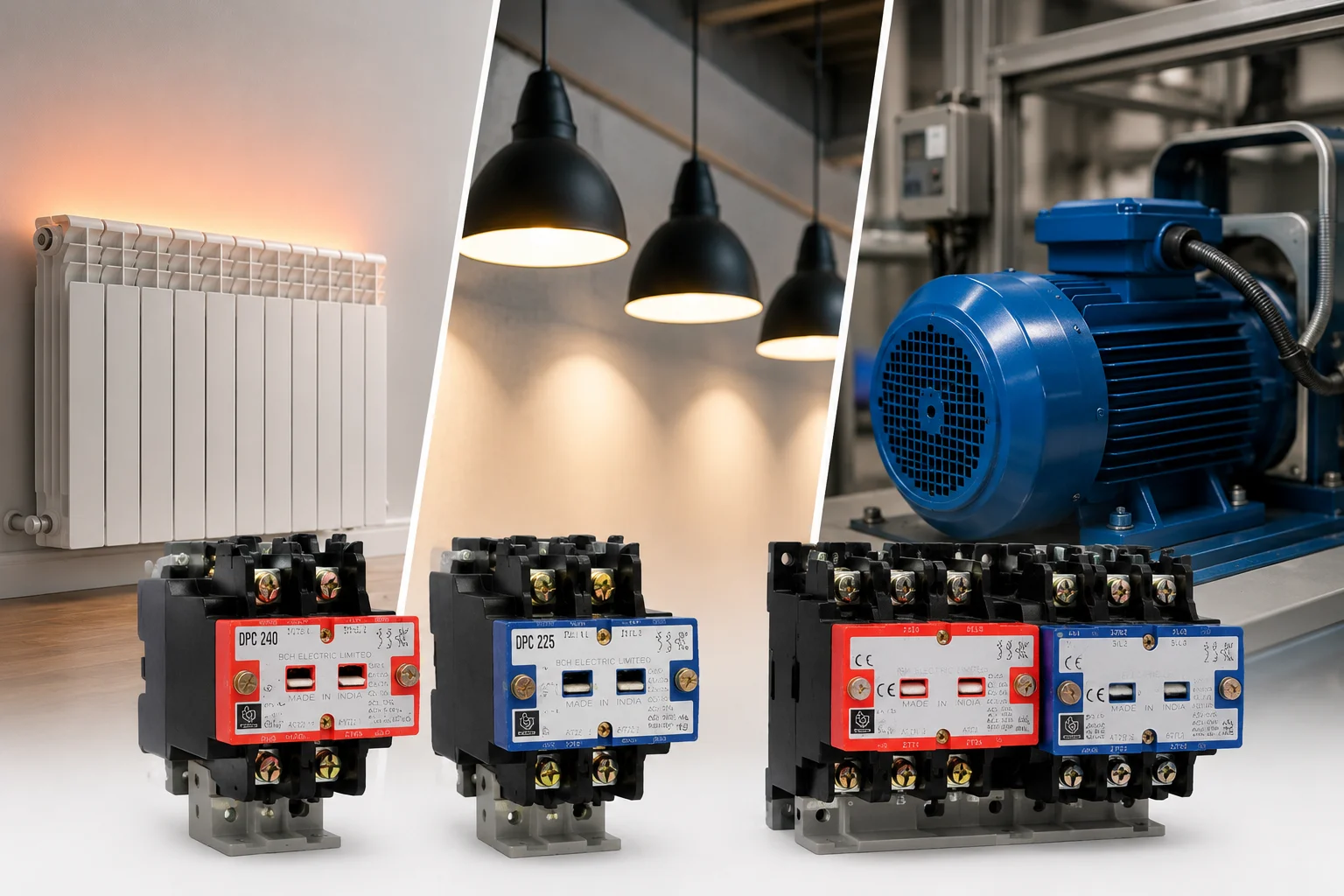
A 2 pole contactor is an electrically operated switching device with two main contacts that open and close together. In single-phase circuits, it is commonly used to control both supply conductors for heaters, lighting circuits, pumps, fans and other motor loads.
How do you select a 2 pole contactor?
To select a 2 pole contactor, first identify the load as heating, lighting or motor duty. Then confirm the operating voltage, full-load or input current, utilisation category, coil voltage, switching frequency, enclosure temperature and required auxiliary contacts. For heaters, check the AC-1 rating. For lighting, check lamp or LED driver inrush and the manufacturer’s lighting-duty table. For motors, use the nameplate full-load current and the stated AC-3 or motor-duty rating. A contactor should also be coordinated with fuses, MCBs, overload relays and temperature protection where required.
Why can’t one ampere rating cover every load?
A contactor’s ampere rating is valid only for the duty stated by the manufacturer. A 25A contactor may handle a 25A resistive heater but may not be suitable for a 25A motor or a large LED lighting bank. Motors draw much higher current during starting, and LED drivers can create a short but heavy inrush at switch-on.
This is why the front label is only a starting point. The useful rating is the one that matches the real load, voltage and operating conditions.
| Load type | Rating or category to check | Main selection issue |
| Resistive heating | AC-1 | Continuous current and panel temperature |
| Incandescent lighting | AC-5b or lighting table | Cold-filament switch-on current |
| Discharge lighting | AC-5a or lighting table | Starting gear and control components |
| LED lighting | Driver compatibility or inrush table | Peak inrush and number of drivers |
| Single-phase motor | AC-3 or motor-duty table | Starting current and overload protection |
Is a 2 pole contactor suitable for your circuit?
Use a 2 pole contactor when the circuit design requires two power contacts to open and close together. Before choosing the device, confirm that the load is single phase, identify which conductors must be switched, check the system voltage and frequency, and verify the isolation and wiring requirements for the installation. The pole arrangement should follow the circuit design, not only the available panel space. If the application may require more than two switching paths, compare the key differences and use cases of 2 pole and 4 pole contactors before finalising the pole configuration.
Which utilisation category should you use?
For resistive heating, AC-1 is normally the key category. It applies to non-inductive or slightly inductive loads such as electric heaters, heating elements, ovens, resistance furnaces and hot-water systems. The contactor must carry the continuous current under the actual panel temperature.
For lighting, check the dedicated lighting rating. AC-5a is used for electric-discharge lamp controls, while AC-5b applies to incandescent lamps. LED lighting should be checked against the manufacturer’s driver or inrush table because the steady current can be much lower than the switch-on peak.
For motors, AC-3 is commonly used for normal starting and stopping of squirrel-cage motors such as pumps, fans, compressors and HVAC equipment. Applications with inching, plugging or frequent reversing may require a more severe duty rating.
How do you calculate the required current?
For a single-phase heater, estimate current by dividing power by voltage. A 6kW heater at 230V draws about 26.1A, so the selected contactor needs an AC-1 rating above that value after derating. The next catalogue size may be 32A, but enclosure heat and switching rate still matter.
For lighting, use the luminaire or driver input current rather than lamp wattage alone. Check the number of luminaires, power factor, driver inrush current, inrush duration, number of drivers switched together and operations per day.
For motors, use the full-load current on the nameplate or manufacturer data sheet. Do not select only from kilowatt or horsepower because current changes with voltage, efficiency, power factor, motor design, starting method and mechanical load.
What coil voltage and switching frequency should be checked?
The coil voltage must match the control supply. Common choices include 24V AC, 24V DC, 48V AC, 110V AC and 220-240V AC. A 24V coil must not be connected directly to a 230V control circuit. Low or unstable coil voltage can cause humming, chattering, contact bounce, overheating and early failure.
Switching frequency is just as important. A contactor used twice per day has a different duty from one controlled by a thermostat, level controller or automatic lighting system. Compare the expected operations per hour with the electrical endurance data, not only the mechanical endurance figure.
How do panel conditions affect contactor selection?
The temperature inside the panel may be higher than the room temperature outside it. Closely mounted devices, transformers, power supplies, poor ventilation, direct sunlight and dust can all raise the operating temperature. If the panel temperature exceeds the manufacturer’s reference value, derating may be required.
Also check altitude, humidity, dust exposure, enclosure quality, terminal capacity, cable size and mounting clearances. For outdoor pump panels and agricultural sites, voltage fluctuation and enclosure quality can be as important as normal running current.
How should heating, lighting and motor selections differ?
For heating loads, calculate the operating current, confirm the voltage, select from the AC-1 rating, apply temperature derating, check thermostat cycling and provide suitable short-circuit and overtemperature protection.
For lighting loads, begin with the lamp or driver data. Confirm the lighting technology, number of lamps or drivers, total input current, inrush current, simultaneous switching and operations per day. For LED lighting, the approved number of drivers per contactor may be more useful than the steady-state current.
For motor loads, use the rated voltage, nameplate full-load current, starting method, starts per hour, starting duration and site conditions. Select from the stated motor or AC-3 rating, then choose and set the overload relay separately.
What protection is still required?
A contactor is a switching device. It should not be treated as a fuse, circuit breaker or motor-overload device. Heating circuits may need short-circuit protection, overcurrent protection, temperature control and independent overtemperature cut-off. Lighting circuits need suitable conductor and circuit protection. Motor circuits normally need short-circuit protection plus overload protection matched to the motor current.
BCH CPG and JPG contactors for pump control
BCH CPG and JPG models are presented for single-phase pump-control applications within the wider 2 pole and 4 pole contactor range. CPG models cover 12A, 16A, 20A, 25A, 32A and 40A, with a 160-220V wide-band AC coil option. JPG models cover 16A, 20A and 25A, with a 154-264V wide-band AC coil option.
| Specification | BCH CPG | BCH JPG |
| Current range | 12A to 40A | 16A to 25A |
| Wide-band AC coil | 160-220V | 154-264V |
| Electrical endurance | 1 million operations | 1 million operations |
| Mechanical endurance | 5 million operations | 2 million operations |
| Maximum operating frequency | 600 operations per hour | 1,200 operations per hour |
| Stated ambient rating | Up to 55 deg C | -5 deg C to +45 deg C |
| Product standard | IEC 60947-4-1 | IEC 60947-4-1 |
Compare these values with the pump nameplate current, coil supply, starts per hour and site temperature. For heating or lighting applications, confirm the relevant utilisation-category rating before selecting either model.
Before buying a 2 pole contactor, review the catalogue page or data sheet for the exact application. Check the operational-current rating at the required voltage, the utilisation category, coil voltage range, auxiliary-contact options, electrical endurance, mechanical endurance, maximum operations per hour, terminal capacity, operating temperature and any derating tables. For LED lighting, look for the approved number of drivers or the stated inrush limit. For motors, use the motor-duty table instead of the general thermal current.
- Ask for written confirmation when the load type is not listed in the catalogue.
- Keep the selected protection devices coordinated with the contactor rating.
- Record the selected coil voltage and auxiliary-contact arrangement before ordering.
Final 2 pole contactor checklist
- Confirm the circuit is single phase and a 2 pole arrangement is correct.
- Identify the load as heating, lighting or motor duty.
- Check voltage, frequency, current and utilisation category.
- Check starting current or inrush where it applies.
- Match the coil voltage to the control supply.
- Check operations per hour and electrical endurance.
- Apply ambient-temperature and enclosure derating.
- Provide short-circuit and overload protection where required.
Frequently asked questions
Can the same 2 pole contactor be used for heating, lighting and motor loads?
Yes, but only when the manufacturer provides suitable ratings for each application. The AC-1, lighting and motor-duty ratings can be different for the same device.
Which category is used for electric heaters?
Resistive electric heating normally falls under AC-1. Check the AC-1 current rating at the operating voltage and expected panel temperature.
Why can LED lighting need a larger contactor?
LED drivers can draw a high inrush current when they energise. If many drivers switch at once, the combined peak can exceed the contactor’s making capacity even when the running current is low.
Should a motor contactor be selected from motor power or current?
Use the nameplate full-load current and the manufacturer’s motor-duty table. Motor power is only a reference because voltage, efficiency and motor design affect actual current.
Does a 2 pole contactor protect a motor from overload?
No. The contactor switches the circuit. A suitable overload relay or approved motor-protection device is normally required for sustained overcurrent protection.
Conclusion
Selecting the right 2 pole contactor means matching its rating to the actual behavior of the connected load. For heating applications, consider the AC-1 current rating and operating temperature. For lighting circuits, evaluate the inrush current generated at switch-on. For motors, use the motor nameplate current and the appropriate motor-duty rating. Before finalising the contactor, also verify the coil voltage, switching frequency, enclosure conditions and required protection devices.
