
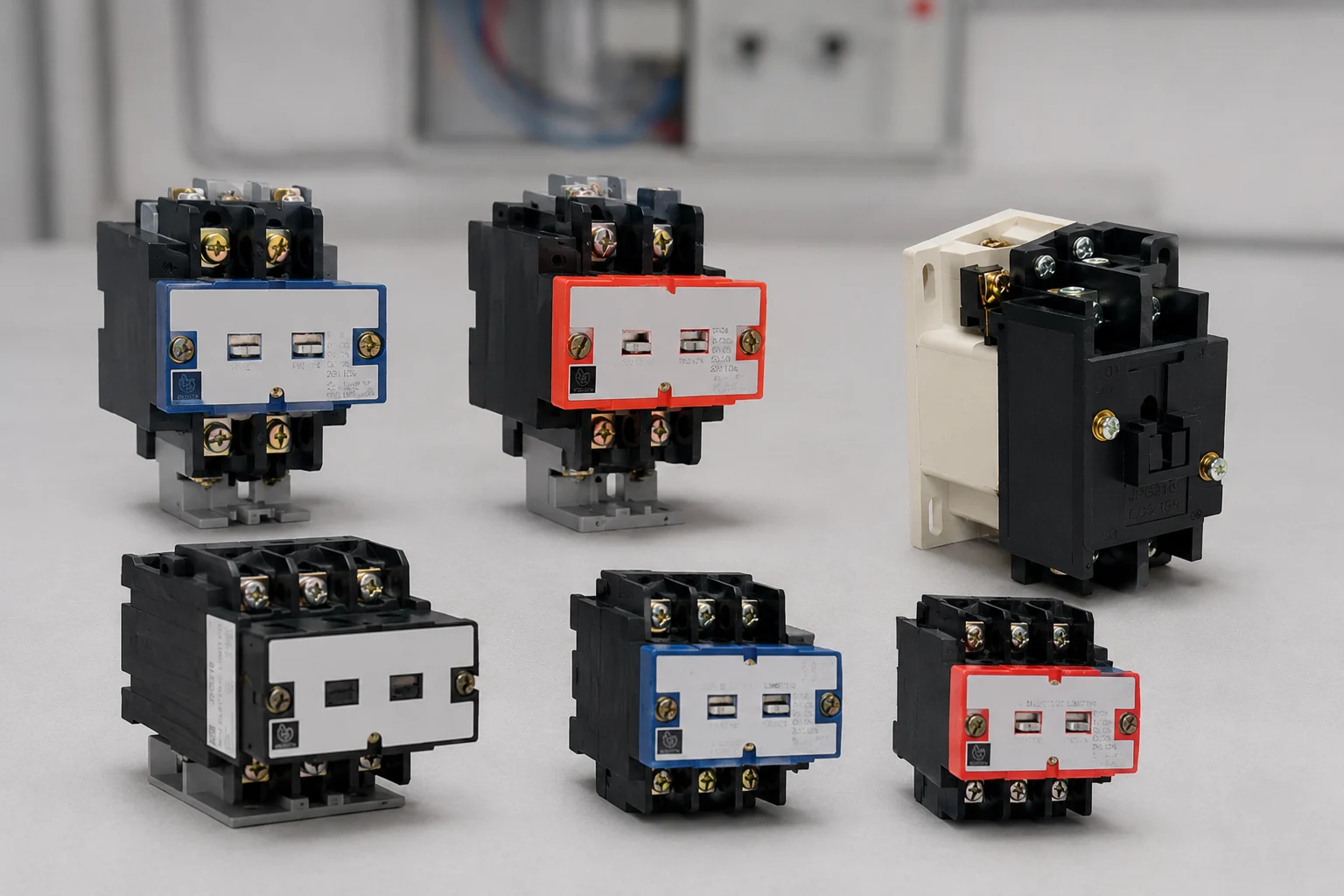
A 2 pole contactor is an electrically operated switch that controls two power lines at the same time. It is commonly used with single-phase loads, especially pumps, that need to start or stop through a push button, float switch, timer, or automatic controller.
A control voltage energizes the contactor coil. The internal contacts then close and send power to the load. When the control voltage is removed, the contacts open again.
Correct selection matters. The contactor must suit the load current, coil voltage, switching frequency, and working conditions. The circuit also needs separate short-circuit and overload protection.
What does a 2 pole contactor do?
The term “2 pole” refers to two main power paths inside the contactor. Both poles open and close together.
In a single-phase circuit, these poles can switch the two supply conductors feeding the load. When the coil is energized, both contacts close. When the coil is switched off, they return to their normal open position.
This arrangement allows remote or automatic operation. A lower-power control circuit gives the command, while the main contacts handle the load current.
BCH includes CPG and JPG models in its 4 pole and 2 pole contactor range. Both ranges are intended for single-phase pump control.
What is inside a 2 pole contactor?
The coil creates a magnetic field when it receives the rated control voltage. This field pulls the moving core towards the fixed core.
The moving core is linked to the main contacts. As it moves, the two power contacts close. Contact springs provide pressure between the fixed and moving contacts and return the mechanism when the coil is no longer energized.
A contactor may also have auxiliary contacts. They are used for status indication, holding circuits, and electrical interlocking rather than carrying the main load current.
BCH CPG and JPG contactors are available with 1NO + 1NC, 2NO, or 2NC auxiliary contact arrangements. NO means normally open. NC means normally closed.
How does a 2 pole contactor work?
The working principle is electromagnetic.
A control device first sends voltage to the coil. Current flowing through the coil creates a magnetic field, which pulls the moving core towards the fixed core. The attached main contacts close and complete both power paths.
The connected pump now receives power.
When the control device removes voltage from the coil, the magnetic field disappears. The spring mechanism returns the moving core to its original position. Both main contacts open and power to the load stops.
The contactor can repeat this cycle many times, which suits pump and motor circuits that start and stop regularly.
Basic 2 pole contactor wiring
A typical installation has a power circuit and a control circuit.
Power circuit
The incoming supply connects to the line side of the two main poles. The outgoing side connects to the load.
The basic path is:
Supply conductor 1 to main pole 1 to load conductor 1
Supply conductor 2 to main pole 2 to load conductor 2
Both paths close when the coil is energized.
Control circuit
The control circuit supplies the coil through a push button, timer, float switch, pressure switch, or pump controller.
A simple path is:
Control supply to control device to contactor coil to control-supply return
The coil voltage must match the control supply. A 24V coil needs a compatible 24V source, while a 220/240V AC coil needs the corresponding AC supply.
Auxiliary contacts may be used for a holding circuit, interlocking, or an ON/OFF signal.
Terminal markings vary between models. The installer should follow the product diagram rather than assume that all contactors use the same layout.
A contactor does not replace a fuse, circuit breaker, or overload relay. It switches normal operating current. Trained electrical personnel should complete the wiring after isolating and verifying the supply.
Where are 2 pole contactors used?
BCH positions its 2 pole CPG and JPG contactors mainly for single-phase pump control. Common installations include agricultural pumps, borewell pumps, water-transfer systems, tank-filling systems, and automatic water-level control panels.
Consider a storage tank controlled by a float switch. When the water level drops, the float switch energizes the contactor coil and the pump starts. Once the tank reaches the set level, the signal stops and the contactor opens.
The same principle works with a timer, pressure switch, or manual push-button station.
Contactors also appear in motor starters, lighting systems, HVAC equipment, cranes, welding equipment, and resistance furnaces. The pole configuration and rating must match the application.
The wider BCH contactor range covers other switching requirements.
BCH CPG and JPG 2 pole contactors
BCH offers two ranges for single-phase pump-control applications.
| Specification | CPG contactor | JPG contactor |
|---|---|---|
| Current range | 12A, 16A, 20A, 25A, 32A, 40A | 16A, 20A, 25A |
| Wide-band coil | 160 to 220V AC | 154 to 264V AC |
| Standard AC coils | 24V, 48V, 110V, 220/240V | 24V, 110V, 220 to 240V |
| Auxiliary contacts | 1NO + 1NC, 2NO, or 2NC | 1NO + 1NC, 2NO, or 2NC |
| Electrical endurance | 1 million operations | 1 million operations |
| Mechanical endurance | 5 million operations | 2 million operations |
| Maximum frequency | 600 operations per hour | 1,200 operations per hour |
| Ambient temperature | 55°C | -5°C to +45°C |
| Standard | IEC 60947-4-1 | IEC 60947-4-1 |
The CPG range covers 12A to 40A. BCH describes it as suitable for single-phase pump control in field conditions with voltage fluctuation. It has a 160 to 220V AC wide-band coil option and a stated mechanical endurance of 5 million operations.
The JPG range covers 16A, 20A, and 25A. Its wide-band coil range is 154 to 264V AC, and its maximum stated operating frequency is 1,200 operations per hour.
Both ranges use weld-resistant silver-alloy contacts. BCH also lists spare coils and contact kits.
How to choose the right 2 pole contactor
Start with the pump or load details.
For a detailed load-by-load comparison, read this guide on how to select a 2 pole contactor for heating, lighting and motor loads.
Check the operating current and duty. Motors can draw a higher current while starting, so selection should not rely only on running current or physical size.
Next, match the coil voltage with the control supply available in the panel.
Site conditions also matter. Check the expected voltage variation, panel temperature, and number of starts per hour. Compare these requirements with the coil range, ambient rating, operating frequency, and endurance of the selected model.
Choose the auxiliary contact arrangement according to the control logic. Holding, indication, and interlocking circuits may need different NO and NC combinations.
Finally, confirm the circuit protection. The panel may require a fuse or circuit breaker and suitable overload protection. The exact arrangement depends on the load and system design.
2 pole contactor vs relay
A contactor and a relay both respond to an electrical control signal, but they usually handle different duties.
A contactor is built for power switching and higher-current loads. It is designed to manage the arc formed when its contacts open under load.
A relay is more common in lower-current control and signaling circuits.
Choose between them based on the load current, load type, switching duty, and required service life. The guide on contactor vs relay explains the differences in more detail.
Frequently asked questions
What does 2 pole mean in a contactor?
It means the contactor has two main power contacts that open and close together.
Can a 2 pole contactor control a single-phase pump?
Yes. BCH CPG and JPG contactors are designed for single-phase pump-control applications. The rating and coil voltage must suit the pump and control circuit.
Does a contactor protect against a short circuit?
No. A contactor switches current during normal operation. The installation still needs suitable short-circuit protection.
Does a pump circuit need overload protection?
A contactor does not provide motor overload protection by itself. The panel may need an overload relay or another approved protective arrangement.
What happens if the coil voltage is wrong?
Low voltage may prevent the contactor from closing properly. Voltage above the coil rating may overheat or damage it.
Why does an AC contactor hum?
A slight sound may occur in normal operation. Excessive humming can indicate low coil voltage, dirt, loose mounting, or a fault in the magnetic assembly. A qualified technician should inspect it after isolating the supply.
Can the coil or contact kit be replaced?
BCH lists spare coils and contact kits for its CPG and JPG contactors. The replacement part must match the exact model.
Choosing a contactor for your application
A 2 pole contactor is useful when a single-phase load needs remote or automatic switching. Before selecting one, confirm the load current, coil voltage, starts per hour, ambient temperature, auxiliary contacts, and protection scheme.
BCH Electric Limited provides CPG and JPG options for different single-phase pump-control requirements. Share the pump rating, control voltage, switching frequency, and site conditions with the BCH team when you need help choosing a model.
