
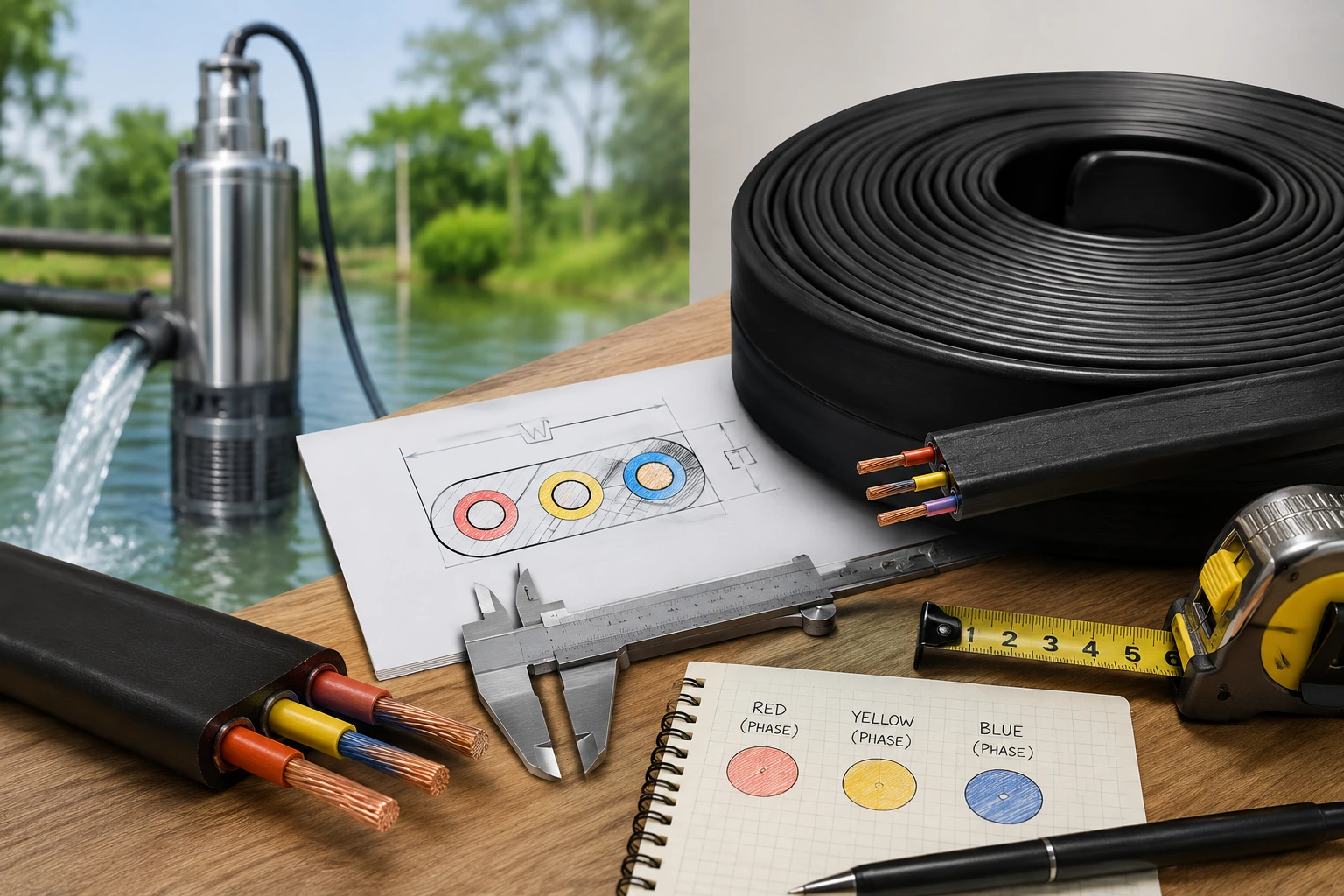
Quick answer: choose a 3-core flat cable from the pump’s rated and starting current, the complete one-way cable length, voltage-drop limits, conductor data, installation conditions, water exposure and fault-withstand requirements. Do not select cable size from pump horsepower alone.
A submersible pump cable has a harder job than simply carrying the motor’s normal running current. It may run through a long borewell, remain exposed to water, experience a significant starting current and depend on underwater joints that must stay electrically and mechanically sound. A cable can therefore look adequate on ampacity and still deliver too little voltage at the motor during starting.
For BCH applications, the starting point is the actual circuit data and the published range for BCH 3-core flat cables. The cable, starter, joint and motor should be reviewed as one system rather than as separate catalogue items.
What Determines the Correct 3-Core Flat Cable Size?
| Sizing Input | Why It Matters |
| Motor rated current | Establishes the continuous current the cable must carry. |
| Starting current and method | Determines the temporary voltage drop and starting stress. |
| One-way route length | Longer runs increase conductor resistance and voltage drop. |
| Conductor material and cross-section | Affect resistance, current capacity and fault withstand. |
| Water and installation conditions | Can influence thermal performance, insulation and sheath requirements. |
| Joint and termination method | Poor joints can add resistance and create a path for moisture. |
| Protective-device operation | Cable and protection must operate together during overload and faults. |
1. Start With the Pump Nameplate, Not an HP Lookup Table
Record the motor voltage, rated current, connection, starting method, expected acceleration time and operating duty. These are the inputs that tell you what the cable must carry in normal service and what it has to tolerate while the pump accelerates.
A horsepower-to-cable-size chart can be useful for a first shortlist, but it cannot see the borewell depth, the surface run back to the starter, a weak supply or a different starting method. Publishing or using one universal HP table without these assumptions can produce a misleading selection.
2. Measure the Complete One-Way Cable Route
Use the full one-way route from the starter terminals to the submersible motor. That includes the surface section and the underwater length. Cable resistance increases with length, so a deep borewell can make voltage drop the controlling design condition even when the cable can comfortably carry the running current.
Record the route in the design file. If the pump depth, starter location or routing changes later, the voltage-drop check should be repeated rather than assuming the original size is still suitable.
3. Check Current-Carrying Capacity for the Real Installation
The conductor cross-section must cover the design current under the actual installation and environmental conditions. Water temperature, surrounding conditions, grouping or routing can affect how a cable dissipates heat. The relevant manufacturer tables and installation rules should therefore be used for the specific construction being considered.
This is also where conductor material matters. Do not substitute a cable simply because the nominal size looks the same; use the published electrical data for the exact conductor and cable construction.
4. Calculate Running Voltage Drop
Once current capacity is acceptable, calculate voltage drop for the complete route. Excessive voltage loss can leave the motor operating below the intended terminal voltage, which may increase current and thermal stress or reduce usable motor performance.
The source draft deliberately avoids a universal numerical limit because the permissible value depends on the motor, supply and applicable design criteria. Keep that approach: document the chosen limit and the evidence behind it.
5. Check Starting Voltage Drop Separately
Starting is often the point where an apparently adequate cable shows its weakness. The temporary current is higher than the steady running current, so the voltage available at the motor can fall further during acceleration. A pump may start during a short workshop test yet struggle in the installed borewell when the cable is longer or the supply is weaker.
Use the actual starting method and motor data when checking this condition. If starting voltage is insufficient, the right answer is not automatically a larger protective-device setting; the cable, starting method, supply and motor duty may need to be reviewed together.
6. Verify Water Exposure, Insulation and Sheath Suitability
A borewell cable must be suitable for its intended water exposure and service conditions. The face of the selection is electrical, but the insulation and sheath are equally important because a mechanically damaged or moisture-affected cable can become an insulation problem even when the conductor size is correct.
If you are still at the product-selection stage, review the BCH guide to choosing 3-core flat cable alongside the current product data so construction and application conditions are considered together.
7. Treat Joints and Terminations as Part of the Cable Circuit
A high-resistance joint can create local heating and voltage loss. A poorly sealed underwater joint can also admit moisture. The cable calculation is therefore incomplete if the joint is treated as an afterthought.
- Use the approved jointing method and components for the selected cable and pump application.
- Control strip length, conductor preparation, connector or crimp quality and sealing.
- Allow sealants or joint systems to cure as required before immersion.
- Record joint location and test results so future maintenance teams know what was installed.
8. Confirm Fault Withstand and Protective-Device Operation
Cable selection must also support safe fault clearing. The system review should cover conductor short-circuit withstand, the available fault current and operation of the protective devices assigned to overload and short-circuit protection. Similar current markings on two devices do not prove that they will coordinate in the same way.
For a wider view of the pump-control side, BCH also provides motor starter and submersible pump starter resources. Use the exact current catalogue or technical table for the references under consideration.
A Practical Cable-Sizing Workflow
- Record motor voltage, rated current and starting method.
- Measure the complete one-way route from starter to motor.
- Select a conductor cross-section whose published current capacity covers the installation conditions.
- Calculate running voltage drop for the full route.
- Check starting voltage drop and the motor’s ability to accelerate under the available terminal voltage.
- Confirm insulation, sheath and cable construction for continuous water exposure.
- Verify underwater jointing, terminations, short-circuit withstand and protective-device operation.
- Validate the final choice against BCH and motor-manufacturer data, then save the assumptions with the project record.
Worked Application Scenario: Deep Borewell With a Long Surface Run
Consider a pump installed well below ground with a long surface run back to the starter. The useful starting document is not a cable-size guess; it is a one-page application sheet. Record the pump nameplate current, starting method, total route length, supply voltage at the installation, proposed conductor data, joint method and operating conditions.
The engineer then checks current capacity, running voltage drop and starting voltage drop in sequence. If the first cable choice fails the starting-voltage check, a larger conductor may be required, but the decision can also involve the supply or starting method. The point is to solve the system constraint rather than hide it with a larger breaker or overload setting.
What to Put in the Purchase Specification
A useful purchase specification describes the application before it names a preferred cable. Include the motor data, supply, total route length, operating environment, water exposure, jointing requirement and the electrical checks that must be satisfied.
- Conductor material and required cross-section based on the approved calculation.
- Cable construction and suitability for the intended submersible application.
- Rated voltage and applicable manufacturer data for the exact reference.
- Reel or supply length needed to minimise unnecessary joints.
- Jointing and termination requirements.
- Documentation needed for commissioning and future replacement.
Installation and Commissioning Checks
Good sizing can still be undone by poor installation. Inspect the route before lowering the pump, protect the cable from sharp edges and uncontrolled pulling, and follow the support method specified for the pump and cable. Test the cable and joint before installation, after lowering and under representative operating conditions where applicable.
Energised tests should be planned and carried out by competent personnel using suitable instruments and protection. Measure motor-circuit voltage and current during starting as well as steady operation. Keep the results with the cable calculation so a later service engineer has a meaningful baseline.
FAQs: 3-Core Flat Cable Size for Submersible Pumps
Can I select a submersible pump cable only from motor HP?
No. Horsepower can help with an initial shortlist, but the final size also depends on motor current, starting method, cable length, voltage drop, installation conditions and the published data for the exact cable construction.
Why can a cable carry the running current but still be too small?
Because voltage drop, especially during motor starting, can become unacceptable before the conductor reaches its steady-state current limit.
Does borewell depth affect cable size?
Yes. A deeper installation increases the one-way conductor length and therefore resistance and voltage drop. The full route from starter to motor should be used in the calculation.
Can I increase the overload setting to compensate for an undersized cable?
No. The source guidance is explicit: correct the conductor or voltage-drop problem instead of using a higher overload setting to mask it.
Why are joints important in cable sizing and performance?
A poor joint can add resistance, create local heat and allow moisture ingress. Joint quality is therefore part of the installed cable circuit, not merely an installation detail.
Why use a flat cable in a borewell?
The format is intended for submersible pump routing and water exposure, but the exact construction still has to match the application and manufacturer guidance.
