
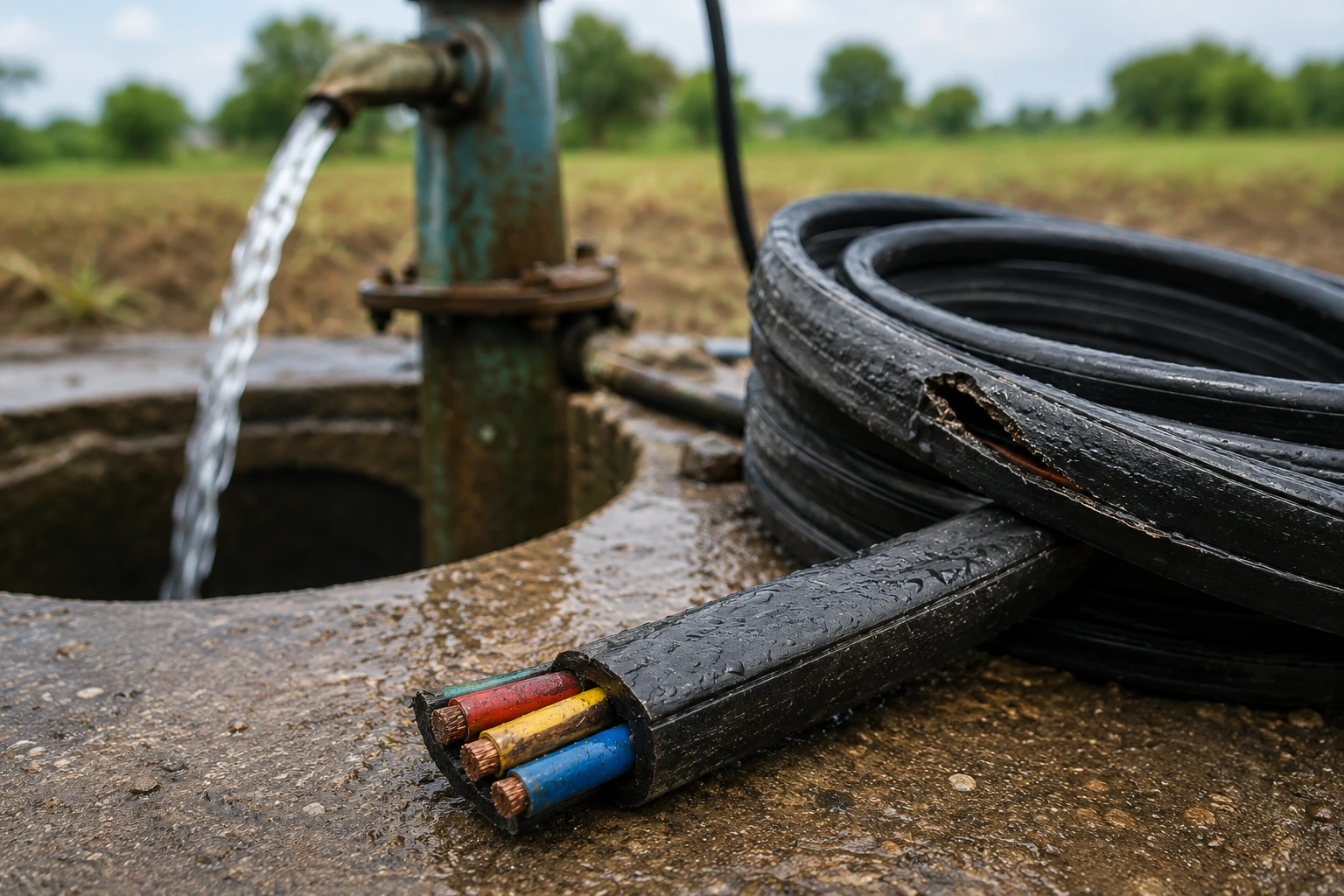
Quick answer: many borewell cable failures begin at installation stress points or where water can enter the cable system – especially joints, sharp edges, clamps, unsupported lengths and the motor entry. Electrical symptoms can include falling insulation resistance, phase imbalance, repeated starter trips and voltage loss under load.
A submersible pump cable works in an environment where a small installation defect can become a long-term electrical problem. Abrasion may start as a damaged sheath. A poorly sealed joint can let moisture migrate beyond the visible defect. A resistive connection may pass an insulation test and still cause voltage loss once the motor is loaded.
For troubleshooting, begin with the installed system and the actual cable construction. The BCH 3-Core Flat Cable product family provides the product reference point; the diagnosis should then include the joint, borewell route, supports, motor entry and starter behaviour.
Common Failure Modes at a Glance
| Failure Mode | Typical Evidence | Prevention / Control |
| Abrasion | Flattened, cut or worn sheath near supports or borewell edges | Smooth routing, controlled lowering and approved supports |
| Moisture ingress | Insulation resistance deteriorates over time | Correct joint kit, clean jointing and effective sealing |
| High-resistance joint | Local heating or voltage drop under load | Correct conductor preparation, connector/crimp and inspection |
| Mechanical pull | Conductor, sheath or motor-entry damage | Use the required support method; do not make the cable carry unintended mechanical load |
| Undersized cable | Low motor terminal voltage, heating or difficult starting | Recalculate for the full route and starting condition |
1. Abrasion at Borewell Edges, Clamps and Supports
Cable damage often begins mechanically. Sharp metal edges, rough borewell surfaces, uncontrolled movement or overtight supports can flatten or cut the outer sheath. Once the protective construction is compromised, moisture and insulation deterioration can follow.
Inspect the borewell head and the full accessible route before lowering the pump. Keep the cable clear of sharp surfaces and follow the pump and cable manufacturers’ support and spacing instructions. The aim is to control movement without crushing the cable.
2. Moisture Ingress Through a Joint
Underwater joints deserve special attention because a sealing defect can allow water to move beyond the immediate joint area. The visible damage may be small while the affected cable length is larger.
Jointing should be a clean, repeatable process. Control conductor preparation, connector or crimp quality, sealing and cure time. Record insulation resistance before installation and after lowering so future test results have a baseline for comparison.
3. High-Resistance Conductor Joints
A joint can be electrically poor without creating an immediate insulation-to-earth fault. A loose, contaminated or badly prepared connection may add resistance, create local heat and reduce the voltage available at the motor.
This explains an important troubleshooting pattern: a cable may show acceptable insulation resistance yet still suffer excessive voltage drop in service. Include conductor resistance and loaded-voltage checks when the symptom appears only while the pump is running or starting.
4. Mechanical Pull and Unsupported Cable Length
A flat submersible cable is an electrical component, not automatically a mechanical support for the pump assembly. If the installation allows uncontrolled tensile load, damage can appear at joints, supports or the motor entry even when the sheath looks acceptable elsewhere.
Use the mechanical support arrangement required by the pump and cable manufacturers. During retrieval, inspect where the cable has been tied, clamped or bent; these locations often show the history of installation stress more clearly than the accessible top section.
5. Damage at the Motor Entry
The motor entry is another transition point where bending, pull, sealing and vibration come together. When fault-finding, treat this area as part of the system boundary rather than stopping the inspection at the last visible joint.
If the pump is retrieved, document the entry condition before disturbing it. Photographs, resistance measurements and inspection notes can help separate an original installation issue from damage created during removal.
6. Undersized Cable and Excessive Voltage Drop
Not every repeated trip is caused by damaged insulation. A long cable that is too small for the actual route can leave the motor with inadequate terminal voltage, particularly during starting. The resulting symptoms may be confused with a starter problem or mechanical overload.
If sizing is in doubt, use the BCH 3-core flat cable selection guide and recalculate from the motor current, starting condition and full one-way route rather than replacing the damaged section with the same size by default.
A Safe Fault-Finding Sequence
- Isolate the system and disconnect the cable at both ends using an approved safe procedure.
- Inspect accessible joints, cable entry points, supports and visible sheath damage.
- Test each core to earth and between cores using suitable test equipment and a test voltage appropriate to the equipment and manufacturer guidance.
- Compare results with equipment limits and previous maintenance records rather than treating one reading in isolation.
- Where necessary, sectionalise only as part of an approved repair plan.
- Replace damaged cable length when the reliability of a repair cannot be demonstrated.
Use the Trip Pattern as Evidence
Repeated starter operation should not be bypassed simply to keep the pump running. First identify what actually operated: a short-circuit protective device, overload function, residual-current device or control relay points to a different investigation.
Timing also matters. An immediate trip points toward a different fault set from a trip after several minutes. A fault that appears only when hot may involve overload or a resistive connection; a fault that appears during wet weather strengthens the case for insulation and ingress checks. Change one variable at a time and record measurements instead of altering several settings together.
Repair or Replace? What the Decision Should Consider
The visible defect is not always the full defect. Water migration, conductor damage or repeated previous joints can extend the risk beyond one obvious point. A repair should therefore be accepted only when the proposed method and subsequent tests demonstrate a reliable result for the service conditions.
The source guidance is deliberately cautious about drying and reusing wet cable: do so only when the manufacturer permits it and testing shows that the insulation system remains sound. When repair reliability is uncertain, replacing the affected length is the safer engineering decision.
Installation Controls That Prevent Repeat Failures
- Inspect the borewell head and cable route before lowering the pump.
- Keep the cable away from sharp metal edges and uncontrolled rubbing points.
- Use the support and spacing method specified for the cable and pump.
- Make underwater joints in a clean, controlled process and allow sealing systems to cure.
- Record insulation resistance before installation, after lowering and during maintenance.
- Confirm conductor size against the full route and starting-voltage requirement.
- Keep a record of previous joint locations and cable replacements.
What to Record During Maintenance
A useful maintenance record contains measured values, not only “checked OK.” Track insulation resistance, conductor resistance where relevant, phase currents, terminal voltages under load, joint observations and the condition of the cable when a pump is retrieved. Trends are often more useful than a single pass/fail reading.
When the fault may involve the control side as well as the cable, review the current BCH motor starter and submersible pump starter resources before changing settings or substituting a starter component.
FAQs: Borewell 3-Core Flat Cable Failures
Can a wet submersible cable be dried and reused?
Only if the cable manufacturer permits it and testing proves that the insulation system remains sound. Moisture can migrate beyond the visible defect, so drying the surface alone does not prove the cable is fit for service.
Why can insulation resistance look acceptable while voltage drops under load?
A high-resistance conductor joint can pass an insulation-to-earth test yet create significant voltage loss when current flows. Conductor resistance and loaded-voltage measurements help identify this type of fault.
What are the most common physical damage points?
Joints, sharp borewell edges, overtight supports, unsupported lengths and the motor entry are important inspection points because they combine electrical exposure with mechanical stress.
Should I keep increasing the starter setting if the pump keeps tripping?
No. First identify which protective element operated and investigate the underlying electrical or mechanical cause. Repeated operation is evidence that should be diagnosed, not bypassed.
Can an undersized cable look like a motor problem?
Yes. Excessive voltage drop can reduce motor terminal voltage, especially during starting, and may contribute to difficult acceleration, higher current or repeated protection operation.
What should be measured after a cable repair?
Use the tests required by the cable, joint and equipment manufacturers. The source guidance specifically emphasises insulation-resistance history, conductor resistance, loaded voltage and observations at the repaired or retrieved section.
