
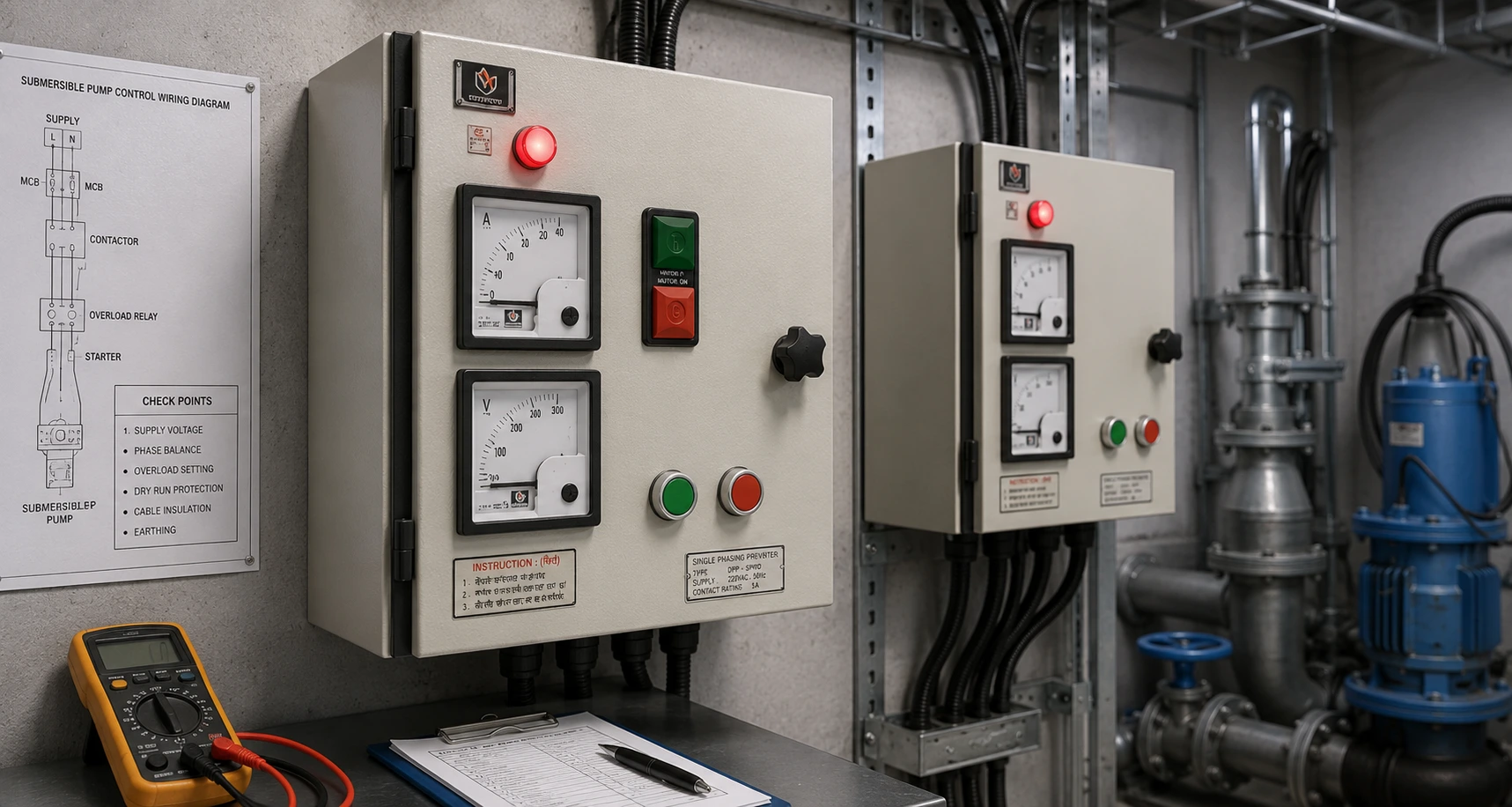
A submersible pump starter that trips repeatedly is usually doing exactly what a protective or control function is intended to do: reacting to an abnormal electrical, mechanical or water-related condition. The trip itself is evidence. Repeatedly resetting the starter without finding the cause can allow a cable, motor or pump problem to become more serious.
| Quick answer Common causes include overload, low supply voltage, excessive starting current, single phasing or phase imbalance, cable or joint faults, moisture ingress, dry-run conditions, incorrect protection settings and control-circuit voltage problems. The safest diagnosis starts by recording when the trip occurs and identifying which protective element operated. |
For product context, review BCH Motor Starters and the Single-Phase Submersible Pump Starter range before comparing ratings or settings.
First, note exactly when the starter trips
Timing is one of the most useful clues. A trip that happens immediately after the start command points to a different group of checks from a trip that appears after several minutes of running. The same applies to faults that occur only after rainfall, after borewell maintenance, at low water level or when the supply voltage is weak.
|
Symptom |
Likely checks |
First response |
|
Trips instantly |
Short circuit, earth fault, incorrect connection |
Isolate and test cable/motor insulation and continuity |
|
Trips during starting |
Low voltage, long cable, high starting current, mechanical resistance |
Measure terminal voltage and starting current under a controlled test |
|
Trips after several minutes |
Overload, poor cooling, high friction, weak supply |
Compare phase currents, voltage and pump duty |
|
Dry-run indication |
Low water level or incorrect dry-run threshold |
Verify actual water condition and commissioning values |
|
Trips after rain or maintenance |
Moisture at glands, joints or cable entry |
Inspect and test the complete cable path |
|
Contactor chatters or drops out |
Low coil voltage or loose control wiring |
Check control supply and terminals |
1. Overload or excessive running current
If the pump starts normally but trips after running for a period, compare the measured current with the motor nameplate, approved starter range and protection setting. High running current can be linked to hydraulic loading, mechanical friction, incorrect connection, poor voltage conditions or a setting that does not match the application.
Do not solve the symptom by simply increasing the overload setting. The source article is explicit on this point: determine why the measured current exceeds the intended setting before changing protection. Raising a setting without evidence can reduce motor protection.
For a related diagnostic process, see BCH’s Overload Relay Reset and Troubleshooting Guide.
2. Low voltage during starting
A pump may receive acceptable voltage when idle but see a substantial drop when the motor starts. Long cable runs, weak feeders and resistive joints can all reduce the voltage available at the motor during acceleration. The result can be a longer start, higher thermal stress and a trip that appears to be a starter problem even though the root cause sits elsewhere in the circuit.
Measure supply and terminal voltage under a representative starting condition using a planned test. A no-load voltage reading on its own does not show what the motor experiences during acceleration.
3. Cable, joint or moisture faults
Submersible installations place cable and joints in demanding conditions. If tripping begins after rainfall, borewell servicing or a cable repair, pay particular attention to glands, underwater joints, insulation resistance and evidence of moisture. A starter that behaves normally when the downhole cable is disconnected points the investigation toward the cable, joint or motor, but testing is still required to identify the exact fault.
4. Single phasing or phase imbalance
On three-phase installations, current and voltage should be reviewed phase by phase. A missing phase, poor connection or meaningful imbalance can change motor current and heating. Do not rely on a single total reading. Record phase values separately and compare them with the equipment limits and the original commissioning data.
5. Dry-run or low-water protection
A dry-run indication should be investigated as a process condition as well as an electrical event. Confirm the actual water level, pump submergence and the threshold used during commissioning. If tripping begins only when the water level falls, the protection may be responding correctly rather than malfunctioning.
6. Control-circuit voltage and contactor drop-out
Chattering or repeated contactor drop-out can come from low coil voltage, loose control wiring or an unstable control supply. Inspect terminals and measure the control voltage under the condition in which the fault appears. A component that operates correctly during a bench test may still behave differently when supply voltage dips on site.
If the installation uses a DOL arrangement, BCH’s DOL Starter Troubleshooting Guide provides a useful companion reference.
A safe diagnosis sequence
- Isolate, lock out and verify absence of voltage before opening or disconnecting the circuit.
- Record which device or protection function tripped and when the event occurred.
- Inspect terminals, glands, cable joints and accessible cable sections for heat, looseness or moisture.
- Check motor and cable insulation using the test values and procedure approved for the equipment.
- Confirm the starter range and overload setting against the motor nameplate and approved documentation.
- Measure supply voltage, phase current and starting behaviour only under a controlled energised test plan.
- Compare the results with pump, motor, cable and starter instructions.
- Correct the root cause, document the final readings and only then return the installation to service.
What not to do when a submersible starter keeps tripping
- Do not keep resetting the starter without recording the trip condition.
- Do not increase the overload setting simply to keep the pump running.
- Do not assume the starter is defective before checking the cable, motor, supply and hydraulic load.
- Do not replace a contactor or relay only because another device has a similar ampere marking.
- Do not perform energised testing without competent personnel, suitable instruments and the required protective measures.
When starter selection should be reviewed again
Revisit the original selection if the motor changes, the cable route becomes longer, the supply arrangement changes, operating hours increase or nuisance trips become frequent. The starter, contactor, overload function, short-circuit protection, cable and motor have to work as a coordinated system.
BCH publishes Motor Starters and Submersible Pump Starters downloads that can be used to verify current product information for the exact reference under review.
Information worth recording after troubleshooting
- Which protective device or function operated
- Supply voltage and phase values
- Starting and running current by phase
- Cable and motor insulation test results
- Water condition and pump load
- Starter and overload settings
- Any changes made and the person who approved them
Frequently Asked Questions
Can I increase the overload setting temporarily?
No. First determine why measured current exceeds the intended setting. Increasing it without evidence can reduce motor protection.
Why does the starter work when the downhole cable is disconnected?
That points the investigation toward the cable, joint or motor, but insulation and load testing are still needed to identify the exact fault.
Why does a pump trip only during starting?
Low starting voltage, a long cable run, high inrush, mechanical resistance or an incorrect setting can all contribute. Measure the actual start condition rather than relying on no-load readings.
Should I replace the starter after repeated trips?
Not automatically. A repeated trip is a symptom. Check the complete supply-starter-cable-motor-pump system before deciding which component needs correction or replacement.
When should the starter settings be reviewed?
Review them after a motor, cable, supply or operating-duty change, or when repeated nuisance trips indicate the original assumptions may no longer apply.
Need help selecting or reviewing a BCH starter?
For a project-specific discussion, compare the application with BCH Motor Starters and send the operating details through the BCH enquiry page. Share the motor nameplate, supply voltage, cable length, current readings, trip timing and existing starter details so the application can be reviewed against current product data.
