
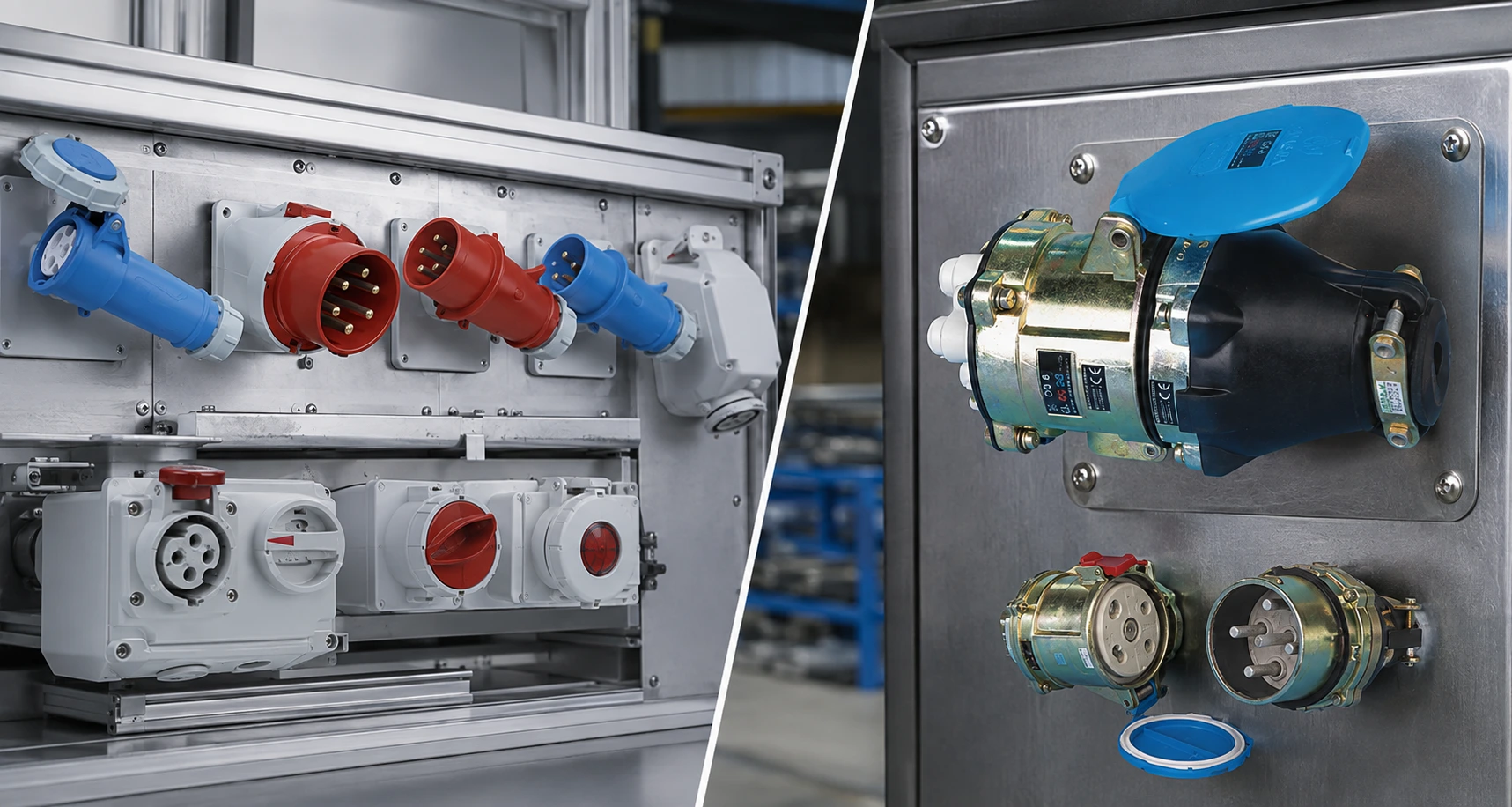
The difference between interlocked and non-interlocked industrial sockets is mainly about how the connection is operated. An interlocked design controls the relationship between the switching state and plug insertion or removal. A non-interlocked socket depends more heavily on a separate upstream switch and the operating procedure used on site.
|
Quick answer |
Start with the BCH Plugs & Sockets family to compare the available industrial connection options.
Interlocked vs non-interlocked sockets at a glance
|
Selection factor |
Interlocked socket |
Non-interlocked socket |
|
Removal under load |
Mechanically restricted by the product sequence |
Must be prevented by procedure or another switching device |
|
Local switching |
Often integrated |
Usually provided separately |
|
Connection frequency |
Well suited to frequent operational connection |
Can suit controlled, infrequent connection |
|
Operational control |
Sequence is built into the product design |
Relies more on system design and operator procedure |
|
Panel / installation complexity |
May be higher |
Often simpler |
|
Best fit |
Applications where connection sequence needs stronger control |
Applications with established upstream isolation and low connection frequency |
What does an interlocked industrial socket do?
In an interlocked socket, the product is designed so the plug and switch follow a defined sequence. Depending on the construction, the plug cannot be removed while the switch is on, and the switch cannot be turned on until the plug is correctly inserted. The aim is to reduce the chance of making or breaking the connection in an unintended state.
BCH also lists DS Decontactors with an Integral Switching Device within its plugs and sockets portfolio. Use the exact product documentation to confirm the operating sequence and declared ratings for a selected reference.
How is a non-interlocked socket different?
A non-interlocked industrial socket does not mechanically enforce the same switch-and-plug sequence. Safe operation therefore depends on the broader circuit: upstream isolation, operating instructions, supervision, lockout arrangements and the behaviour expected from the user.
That does not make a non-interlocked socket inherently unsuitable. It means the selection decision has to consider how the connection will actually be used, not just the socket rating.
When an interlocked socket is usually the stronger choice
- Equipment is connected and disconnected frequently during normal operations.
- There is a credible chance that an operator could attempt to remove the plug while the load is energised.
- Local switching at the connection point is operationally useful.
- The site wants the switching sequence to be enforced by the product rather than procedure alone.
- Mobile or temporary equipment is used by different operators across shifts.
When a non-interlocked socket may be appropriate
- Connection and disconnection are infrequent and controlled.
- A suitable upstream switch or isolating arrangement is already part of the installation.
- The operating procedure clearly prevents removal under load.
- The application does not require an integral switching sequence at the socket itself.
- The complete circuit has been reviewed for the load, fault level, cable and environment.
Interlocking does not replace the rest of the electrical design
An interlocked socket does not automatically become a maintenance isolator, a hazardous-area connector or a substitute for circuit protection. Confirm the making and breaking capability, lockout provision, enclosure rating, product certification and the conditions under which the IP rating applies.
The connector, cable and protective device form one circuit. A higher-rated plug does not increase the capacity of an undersized cable or socket circuit, and an interlock does not replace suitable overcurrent or fault protection.
Selection questions to answer before ordering
- What voltage, frequency, current and pole arrangement does the load require?
- How often will equipment be connected and disconnected?
- Could an operator try to unplug the equipment while it is carrying load?
- Is local switching or lockout required at the connection point?
- Will the connector face water, dust, impact, chemicals or outdoor exposure?
- What cable size and terminal range are required?
- What is the prospective fault current and what upstream protection is provided?
- What enclosure rating applies when the plug is connected and when it is removed?
- Does the application require a particular industrial connector configuration or compatibility arrangement?
- Which product data will be retained for future maintenance or replacement?
Environment can change the decision
A workshop outlet and an outdoor process connection can have very different mechanical and environmental demands. Water, dust, impact, strain on the cable and repeated handling all affect the product selection. Confirm the enclosure and cable-entry requirements for the exact installation rather than assuming every industrial socket provides the same environmental protection.
For related application considerations, read BCH’s guide to industrial plug and socket types for harsh environments.
BCH also lists Heavy-Duty Industrial PS/SS Type Plugs & Sockets as a dedicated product family in the sitemap.
Installation and commissioning checks
- Verify the exact plug and socket references and compatibility before energisation.
- Check conductor cross-section, strip length, terminals, tightening and cable strain relief.
- Confirm protective-earth continuity and pole arrangement.
- Test the interlock or switching sequence with the supply isolated before live operation.
- Confirm lockout provisions and operating labels where required.
- Test the circuit under representative load using a planned commissioning procedure.
- Record the final product reference and operating instructions in the maintenance documentation.
A practical example: a workshop outlet used several times a day
Consider mobile machinery that is connected and disconnected repeatedly during a shift. The key question is not simply whether the socket can carry the current. The designer also needs to decide how removal under load is prevented, whether local switching is required, how the connector is exposed to dust or impact, and how the upstream protective device is coordinated with the cable and connected equipment.
Where that operating pattern creates a meaningful risk of incorrect sequence, an interlocked design can provide a more controlled interface. Where connection is infrequent and isolation is already managed elsewhere, a non-interlocked arrangement may remain appropriate. The decision should be documented against the actual application.
Frequently Asked Questions
Does an interlocked socket replace the circuit breaker?
No. The circuit still needs suitable overcurrent and fault protection for the cable, socket and connected load.
Is every interlocked socket a maintenance isolator?
No. Confirm the product’s declared switching, isolation and lockout functions before treating it as an isolating device.
Can I rely on the IP rating when the plug is removed?
Only under the product’s stated cover, cap and installation conditions. Check the declared rating for both connected and disconnected states.
When is a non-interlocked socket reasonable?
It can be appropriate where connection is controlled and infrequent, with a suitable upstream switching or isolation procedure that prevents removal under load.
Does a higher-current plug make the circuit safer?
Not by itself. Cable capacity, socket rating, protection, terminals and the connected load must all be suitable for the circuit.
Compare BCH industrial plug and socket options
Review the BCH Plugs & Sockets range and the broader Industrial Plugs & Sockets guide for additional selection context. For an application-specific requirement, send the operating and environmental details to BCH.
