
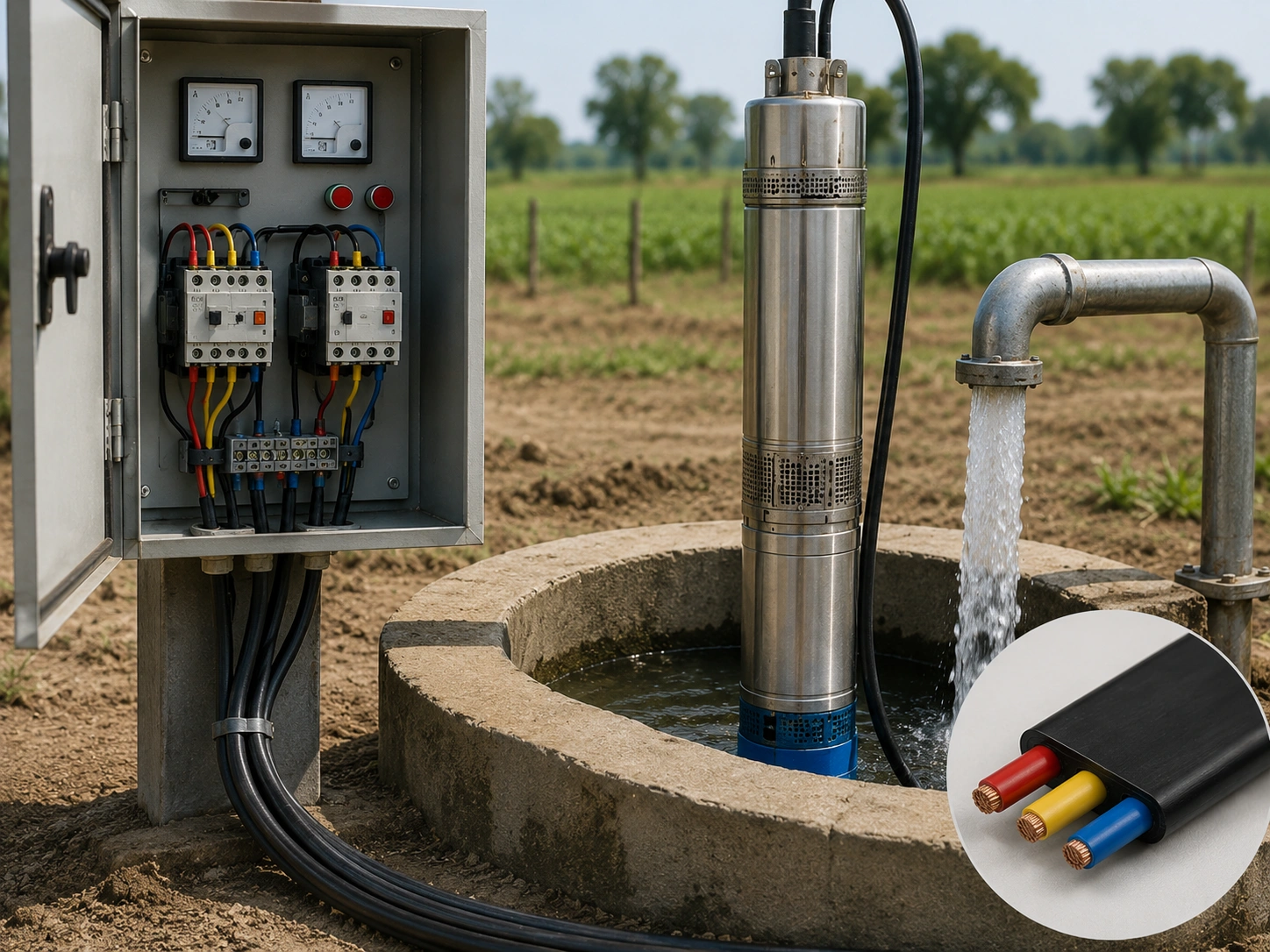
How do you choose the correct 3-core flat cable size for a submersible pump?
Select a submersible-pump cable from the motor’s rated current, starting current, complete cable length, conductor material, installation conditions and permissible voltage drop—not from pump horsepower alone. A cable can carry the running current and still allow too much voltage drop during starting, especially in a deep borewell or weak supply. The insulation, sheath and jointing method must also suit continuous water exposure. Start with BCH India’s 3-core flat cable product range for construction and product-family information, then validate the final conductor size against the actual motor, route and manufacturer data.
Why is horsepower alone not enough for cable sizing?
Two pumps with the same horsepower can have different nameplate currents, starting methods, cable lengths and supply conditions. Borewell depth increases conductor length and resistance; a weak rural feeder can lower the voltage available at the starter before the motor even begins to accelerate. If the cable is selected only from a universal HP-to-size table, the installation may appear acceptable at steady load yet struggle during starting.
For a broader selection view, BCH’s guide on choosing the right 3-core flat cable can be used alongside the site-specific calculation. The final decision should still state the assumptions for current, length, temperature, voltage drop and installation method.
Which inputs have the biggest effect on 3-core flat cable size?
| Input | Why it matters | Evidence to collect |
| Motor rated current | Sets the continuous-load requirement | Motor nameplate and manufacturer data |
| Starting current / starting method | Can create a larger temporary voltage drop | Starter type and measured or declared start data |
| One-way cable route | Longer routes increase resistance | Measured starter-to-motor route |
| Conductor material and size | Determines resistance and ampacity | Cable construction and manufacturer table |
| Water / installation temperature | Can change thermal conditions | Actual borewell and route conditions |
| Joint method and condition | Poor joints add resistance and moisture risk | Jointing procedure and inspection record |
| Supply voltage | Low incoming voltage reduces starting margin | Voltage at rest and during a representative start |
| Protection | Cable and motor must be protected under fault and overload conditions | Protective-device data and coordination check |
What is the practical sizing workflow?
- Photograph or record the pump-motor nameplate: voltage, phase, rated current and any starting information.
- Measure the complete one-way route from starter terminals to the motor, including the borewell drop and surface run.
- Shortlist a conductor size whose current-carrying capacity suits the installation and environment.
- Calculate the running voltage drop using the chosen conductor data and actual route length.
- Check starting voltage drop using a realistic starting-current assumption from the motor/starter documentation.
- Confirm that the expected motor-terminal voltage is adequate for starting torque and stable acceleration.
- Verify insulation, sheath and jointing suitability for the water-exposed installation.
- Check short-circuit withstand and whether the protective device can operate correctly with the available fault current.
- Validate the selected size against BCH’s wires and cables range and the motor manufacturer’s information before purchase.
How does voltage drop affect a submersible pump?
Voltage drop reduces the voltage available at the motor terminals. During steady operation that can increase current or reduce efficiency depending on the motor and load. During starting, the effect can be more severe because starting current is higher while the motor needs sufficient torque to accelerate the pump. If the motor accelerates slowly, both the motor and starter remain in a high-stress condition for longer.
A cable problem can therefore appear as a starter or protection complaint. BCH’s article on common 3-core flat cable failures in borewells is useful when an installation has repeat trips, joint problems or deterioration rather than a straightforward new-cable selection.
Should the cable be sized for running current or starting current?
Both checks matter, but they answer different questions. Continuous current and installation conditions determine whether the conductor can operate thermally within its intended range. Starting current is used to test the temporary voltage drop and starting performance. A conductor can pass the ampacity check and still produce unacceptable starting voltage drop on a long borewell run. That is why the selection process needs both a thermal check and a voltage-drop check.
How should the starter and cable be reviewed together?
The cable ends at the starter, so cable and starter selection cannot be separated completely. A long cable changes the motor-terminal voltage during starting and can influence how an overload or voltage-sensitive protection feature behaves. For installations using a dedicated pump starter, review the BCH single-phase submersible pump starter together with the cable route and motor data. For three-phase pumps, apply the same system principle with the appropriate starter and phase-protection architecture.
What should be checked for underwater joints and water exposure?
- Cable construction approved for the intended submersible or water-exposed service.
- A jointing method compatible with the cable construction and pump lead.
- Clean conductor preparation and correct connector or crimping practice.
- Sealing that prevents moisture entry and does not create excessive local resistance.
- Mechanical support so the cable and joint are not carrying unintended tensile load.
- Inspection of the route for sharp edges, crushing, abrasion or repeated movement.
Where construction or catalogue details are needed during specification, use the current BCH wires and cables download section rather than relying on an old field table or a generic market chart.
Worked example: why the same pump may need a different cable on a deeper borewell
Consider two installations using pumps with the same nameplate current. One motor is close to the starter; the other is installed much deeper with a longer surface run. The second route has greater conductor resistance, so its running and starting voltage drops are higher for the same conductor size. If the supply at the deeper installation is also weaker, the available motor-terminal voltage during starting can be lower again. The correct response is not automatically to change the overload setting. The engineer first checks cable size, route, joints, supply voltage and starting method, then selects the conductor from the combined evidence.
What should the purchase specification include?
- Pump motor voltage, phase and rated current.
- Starting method and any declared starting-current data.
- Measured one-way route length.
- Required conductor material and cross-section after calculation.
- Cable construction and suitability for water exposure.
- Jointing and termination method.
- Applicable environmental and installation conditions.
- Protective-device coordination and short-circuit withstand requirement.
- Manufacturer documentation to be retained with the installation record.
For product availability or application guidance, share the pump nameplate, route length and supply information through the BCH enquiry page. If local support is preferred, use the BCH sales-office directory to identify the appropriate regional contact.
Frequently asked questions
Can I choose 3-core flat cable only from pump HP?
No. HP is only an initial reference. Final selection should use motor rated current, route length, starting conditions, conductor data, voltage drop and installation environment.
Can I increase the overload setting to compensate for a small cable?
No. A cable or voltage-drop problem should be corrected at the conductor, route, supply or starting-method level. Raising protection settings can leave the motor or cable inadequately protected.
Why is starting voltage drop important?
The motor needs adequate terminal voltage to produce starting torque. A long cable can create a larger drop during the high-current starting period than during normal running.
Why use flat cable in a borewell?
Flat submersible cable is intended for pump-routing conditions where geometry and water exposure matter, but the exact construction and approval must match the installation and manufacturer documentation.
Technical note
Do not publish a universal HP-to-cable-size table without stating voltage, length, conductor and installation assumptions. Model-specific current, construction and temperature information should be checked against current BCH and motor-manufacturer documentation before the article or installation is treated as final.
