Choose the starting method around the load, not only motor kW
DOL, star-delta and soft starting all bring a motor up to speed, but they do it in different ways. The correct choice depends on the torque the load needs during acceleration, the starting current the supply can tolerate, the motor connection, acceptable mechanical stress, starts per hour and the process requirement. Choosing from motor power alone can produce a starter that looks correct on paper but struggles in the actual machine.
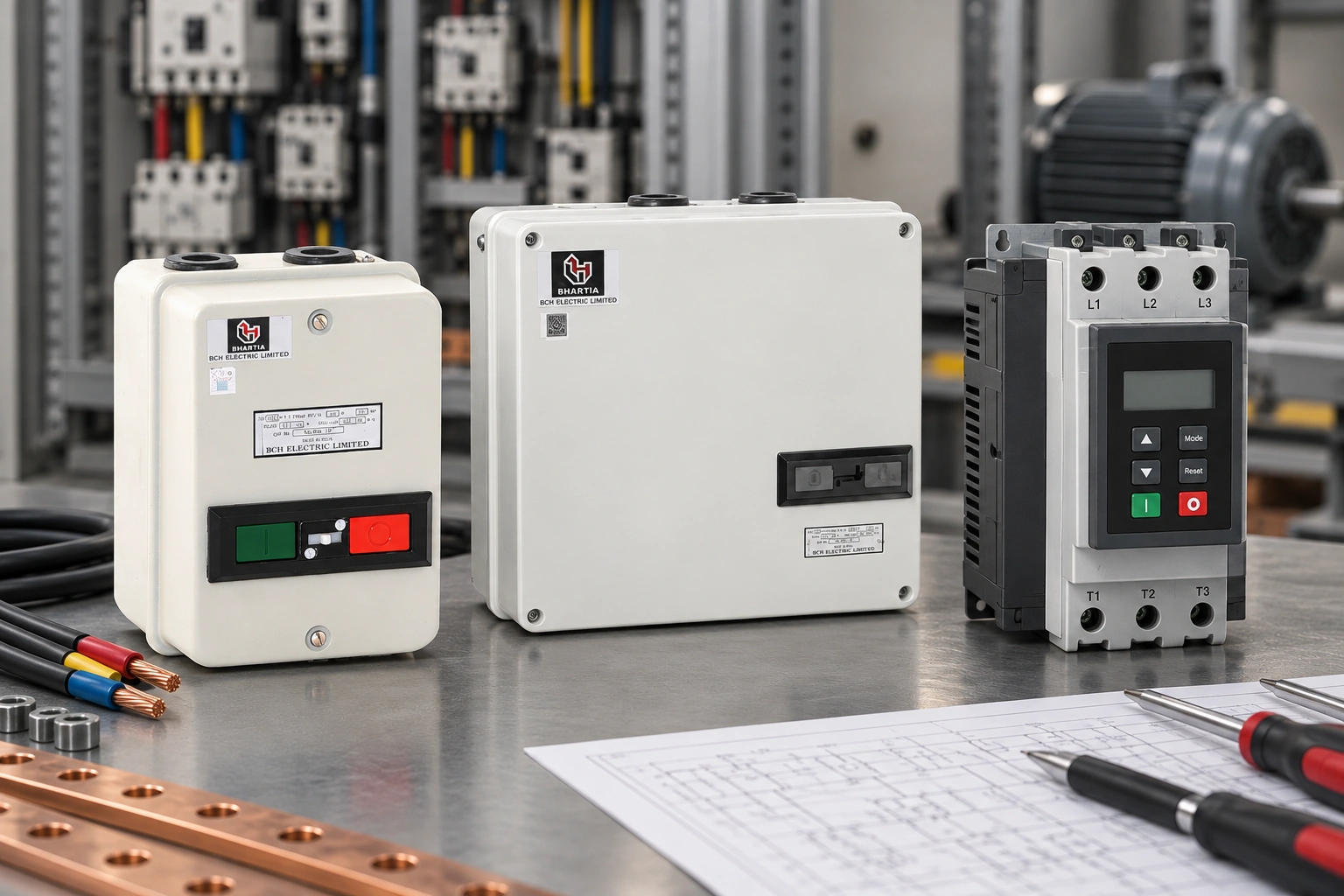
A direct-on-line (DOL) starter applies full line voltage to the motor. Star-delta reduces voltage during the starting period and then changes to delta for normal running on a compatible motor. A soft starter controls applied voltage electronically to produce a smoother ramp. Each method has a place; none is automatically the “best” solution for every motor.
Quick comparison
|
Method |
Starting behaviour | Typical fit |
Main caution |
|
DOL |
Full-voltage start; high current and torque | Small motors or strong supplies where the process accepts the step |
Starting current and mechanical shock |
|
Star-delta |
Reduced-voltage start; transition to delta | Compatible motors with relatively low starting-torque demand |
Reduced torque and transition behaviour |
|
Soft starter |
Adjustable voltage ramp and current limit | Pumps, conveyors and loads needing smoother acceleration |
Settings must suit load and start time |
DOL: simple, direct and often appropriate
DOL is the simplest of the three methods. Because the motor receives full line voltage immediately, it develops strong starting torque but also draws a high starting current. That can be acceptable on a robust supply and for a motor whose mechanical load can tolerate the rapid torque step. Simplicity also makes DOL straightforward to understand, commission and maintain.
The limitation is not that DOL is inherently poor; it is that the supply and machine must be able to live with the start. A weak feeder may suffer an unacceptable voltage dip. Pumps, belts, couplings or gearboxes may experience a sharper mechanical event than the process wants. Repeated starts can also add substantial thermal stress.
For BCH configurations, the DOL starter range is the natural product reference when the application supports full-voltage starting.
Star-delta: lower starting stress, but lower starting torque too
Star-delta starting reduces the voltage applied to each winding during the initial start. That reduces line current, but it also reduces starting torque substantially because motor torque varies approximately with the square of applied voltage. A machine that starts easily unloaded may therefore be a good candidate, while a heavily loaded conveyor or high-breakaway-torque machine may fail to accelerate satisfactorily.
Motor compatibility is essential. The winding ends must be accessible and the motor must be suitable to run in delta at the line voltage. The transition from star to delta also needs correct timing. If changeover occurs at the wrong point, the motor can experience a noticeable current and torque disturbance.
Where star-delta is appropriate, review the BCH star-delta starter information together with the motor nameplate and terminal arrangement.
Soft starter: controlled acceleration without speed control
A soft starter controls motor voltage during starting and, where supported, during stopping. This can reduce the sudden electrical and mechanical step associated with DOL and can be useful on pumps, conveyors and other loads that benefit from smoother acceleration. The settings still have to match the process. A ramp that is too long can keep the motor in a high-slip condition for too long, adding heat or failing to establish useful process flow promptly.
A soft starter should not be confused with a variable-frequency drive. Its main purpose is controlled starting and stopping, not continuous speed control. If the process needs adjustable operating speed or frequent speed changes, a drive-based solution should be assessed separately.
Six questions that usually settle the choice
- What torque does the driven load require from standstill?
- What starting-current or voltage-dip limit applies at the plant or utility connection?
- How much acceleration time is acceptable for the process?
- Can the motor be connected for star-delta at the actual supply voltage?
- How many starts per hour and what utilisation duty are expected?
- Does the process need speed control, or only controlled starting and stopping?
These questions are more useful than a simple kW lookup because they connect the starting method to the real system. The motor, driven load and electrical supply all have to agree with the selected method.
Supply strength can change the answer
Measure or calculate the supply conditions at the installation point. Long cable runs, weak rural feeders and heavily loaded transformers can reduce motor terminal voltage during starting. That can extend acceleration time and make a marginal selection fail. The starting method should therefore be checked against the actual network, not only the nominal supply voltage.
Prospective short-circuit current also matters because the starter still needs coordinated protection. The selected contactor, overload function, short-circuit protective device, cable and motor must work as a system. Similar current ratings are not evidence that a substituted device will preserve the same coordination performance.
For the protection side of the starter, BCH’s Type 1 vs Type 2 motor starter coordination guide explains why the exact protective combination matters after a short circuit.
Pumps need a process check, not a generic rule
Pumps are often used as an example for soft starting because a controlled ramp can reduce hydraulic shock. That does not mean every pump needs a soft starter. A small pump on a strong supply may operate perfectly well with DOL. Conversely, a soft-start ramp that is too gentle or too long can delay useful flow and increase motor heating. Use the motor, pump and starter behaviour together.
For submersible applications, the BCH blog on pump starter protection for dry run, single phasing and voltage faults is relevant because starting method and protective functions should be considered together, not as separate decisions.
Mechanical load matters as much as electrical current
The starting method changes how torque is applied to the driven machine. DOL gives a fast step, star-delta deliberately reduces torque during the first stage, and a soft starter can shape the acceleration ramp. Consider couplings, belts, gearboxes, product handling and hydraulic systems when deciding what level of mechanical shock is acceptable.
If a star-delta starter fails to accelerate, the solution is not automatically to increase the changeover time. The load may simply need more starting torque than the star connection can provide. Likewise, if a DOL start creates unacceptable process disturbance, the issue may be mechanical or hydraulic even when the electrical system can supply the current.
Installation and commissioning checks
Before energisation, verify the exact starter references, control voltage, motor terminal connections, overload setting, protection device and wiring against the approved drawing. For star-delta, confirm the six-terminal motor connection and changeover logic. For a soft starter, confirm the programmed ramp and current-limit parameters against the application data.
Commission under representative load. Measure phase current and voltage during starting and steady operation where practical. Record acceleration time and note any unusual vibration, hydraulic shock, transition disturbance or failure to reach speed. These observations are part of the engineering evidence; they are more useful than a simple statement that the motor started successfully.
A practical decision path
- Confirm motor voltage, connection and full-load current.
- Define the load torque requirement from standstill through acceleration.
- Check supply strength and any starting-current restriction.
- Confirm required starts per hour and thermal duty.
- Use DOL when full-voltage starting is acceptable and the supply and machine can tolerate it.
- Use star-delta only when the motor is compatible and reduced starting torque is sufficient.
- Evaluate a soft starter when smoother acceleration or stopping is needed without continuous speed control.
- Check coordinated protection, enclosure conditions and commissioning settings for the final method.
The BCH motor starter range provides the relevant starter families, while the motor starter product literature can be used to confirm current published data for the selected reference.
The cheapest starter is not always the lowest-cost solution
Initial equipment cost is only one part of the decision. A simple DOL starter can be the most economical choice when the supply and machine can tolerate the start. But if repeated voltage dip disrupts nearby loads or mechanical shock increases maintenance on couplings and piping, a different starting method may reduce lifecycle cost. The reverse is also true: adding a soft starter where the process does not need controlled acceleration can add complexity without solving a real problem.
The engineering comparison should therefore include electrical impact, mechanical impact, commissioning effort, maintenance skill and process downtime. This keeps the choice tied to the operating objective rather than to a preference for the most sophisticated device.
Recheck the choice when the process changes
A starting method that worked well at commissioning may become marginal after a process change. A pump may see a different head, a conveyor may carry a heavier product, or a fan may be modified. These changes can alter breakaway torque and acceleration time even though the motor nameplate is unchanged.
If start time increases, measured voltage falls further than before or the motor begins tripping during acceleration, revisit the original assumptions. Do not treat the starter setting as permanent simply because the equipment operated successfully in the past.
FAQs
Does a soft starter save energy during normal running?
Its main purpose is controlled starting and stopping. It does not normally provide the variable-speed energy savings associated with a correctly applied variable-frequency drive.
Can every motor use star-delta starting?
No. The motor must have accessible winding ends and be suitable to run in delta at the line voltage. Confirm the nameplate and terminal arrangement before selection.
Why might star-delta fail to start a loaded machine?
Star connection reduces applied winding voltage and therefore starting torque. If the load requires more torque than the motor can produce in star, the motor may accelerate too slowly or fail to reach the changeover point.
When is DOL still the best choice?
DOL can be an excellent choice when the supply is strong enough, the motor and load can tolerate the starting current and mechanical step, and the application values simplicity.
Is a soft starter the same as a VFD?
No. A soft starter manages the starting and stopping voltage profile. A VFD also controls operating frequency and is used when the process requires variable speed.
What should be checked after changing the starting method?
Recheck protection coordination, overload settings, cable and supply conditions, acceleration time, starts per hour, control logic and the mechanical response of the driven load.
