
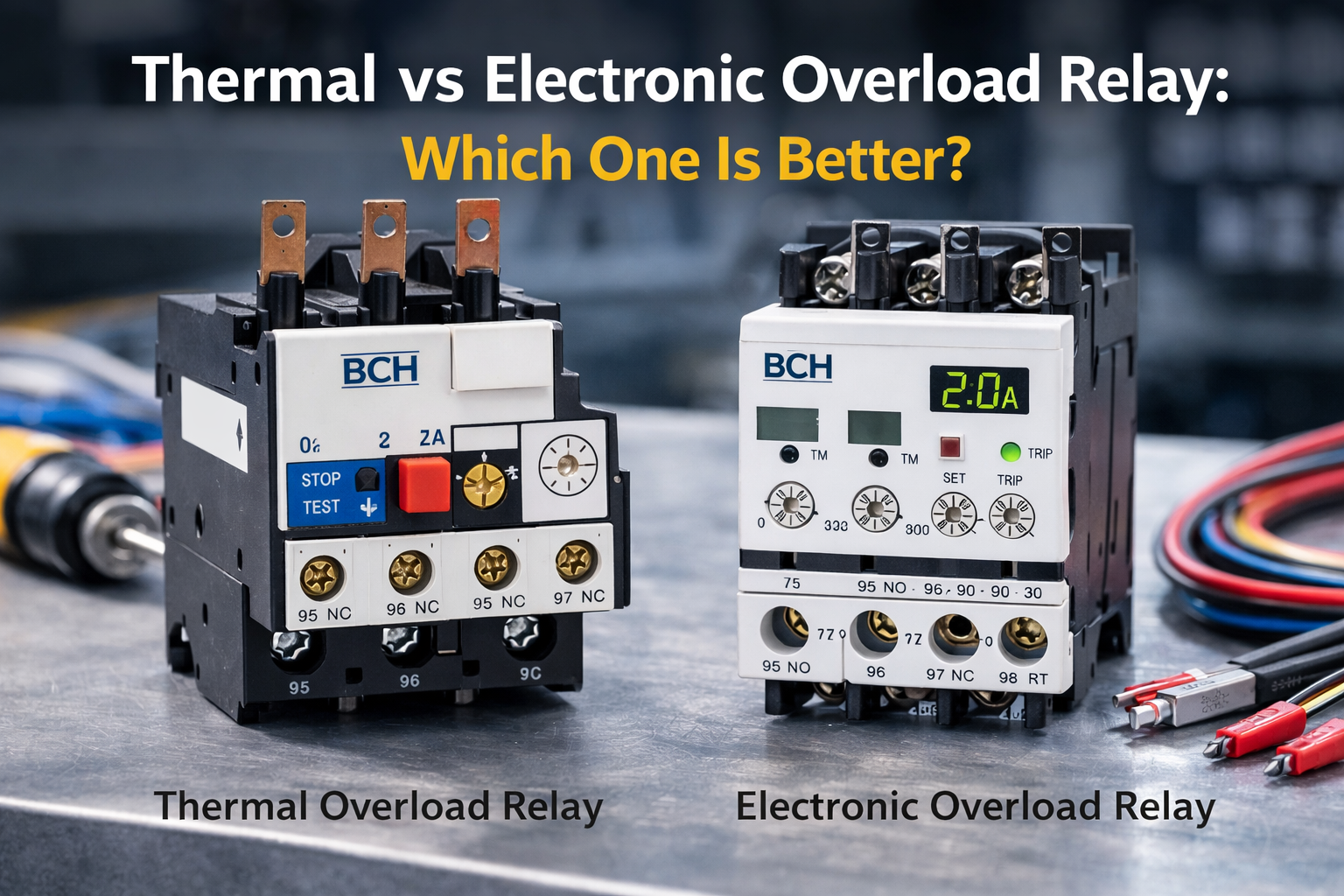
In industrial motor control systems, protecting motors from overload conditions is essential to ensure safety, efficiency, and long-term reliability. Motors are exposed to varying load conditions, voltage fluctuations, and operational stress, making them vulnerable to overheating and damage.
To prevent such issues, overload relays are used alongside contactors to provide protection against excessive current over time. However, with advancements in technology, engineers now have two primary options:
Each type has its own advantages, limitations, and ideal applications. In this guide, we provide a detailed comparison of thermal vs electronic overload relays, helping you determine which option is better for your specific industrial needs.
What Is an Overload Relay?
An overload relay is a protective device used in motor circuits to:
-
Detect excessive current over a period of time
-
Prevent motor overheating
-
Disconnect the motor before damage occurs
Unlike MCBs or MCCBs, overload relays do not respond instantly. Instead, they mimic the thermal behavior of a motor, allowing short-duration current surges while protecting against sustained overload conditions.
Understanding Thermal Overload Relays
How Thermal Overload Relays Work
Thermal overload relays operate based on heat generated by current flow.
They typically use a bimetallic strip that bends when heated due to overload current. When the temperature exceeds a certain threshold:
-
The strip bends
-
The relay trips
-
The motor circuit is disconnected
Advantages of Thermal Overload Relays
1. Simple and Reliable Design
Thermal relays have a straightforward construction, making them easy to install and maintain.
2. Cost-Effective Solution
They are generally more affordable compared to electronic relays, making them suitable for standard applications.
3. Proven Technology
Thermal relays have been used for decades and are widely trusted in industrial environments.
4. Natural Thermal Matching
They inherently follow the heating characteristics of the motor.
Limitations of Thermal Overload Relays
1. Less Accuracy
Thermal relays may not provide highly precise protection under varying conditions.
2. Sensitive to Ambient Temperature
Changes in surrounding temperature can affect performance.
3. Slower Response
They rely on heat buildup, which can delay tripping in certain conditions.
4. Limited Protection Features
They may not detect phase imbalance or phase failure effectively.
Understanding Electronic Overload Relays
How Electronic Overload Relays Work
Electronic overload relays use current sensors and electronic circuits to monitor motor current in real time.
They analyze:
-
Current magnitude
-
Phase imbalance
-
Temperature conditions (in some models)
When abnormal conditions are detected, the relay trips instantly based on programmed settings.
Advantages of Electronic Overload Relays
1. High Accuracy
Electronic relays provide precise current measurement and tripping characteristics.
2. Adjustable Settings
They allow flexible configuration for different motor ratings and operating conditions.
3. Phase Loss & Imbalance Protection
Electronic relays can detect:
-
Phase failure
-
Phase imbalance
-
Asymmetrical loads
4. Faster Response Time
They react quickly to abnormal conditions, reducing the risk of motor damage.
5. Temperature Compensation
Performance is less affected by ambient temperature changes.
6. Advanced Monitoring Features
Some models offer:
-
Fault indication
-
Reset options
-
Integration with control systems
Limitations of Electronic Overload Relays
1. Higher Cost
They are more expensive than thermal relays.
2. More Complex Setup
Installation and configuration require technical knowledge.
3. Dependence on Electronics
Electronic components may require stable power conditions.
Thermal vs Electronic Overload Relay: Detailed Comparison
| Feature | Thermal Overload Relay | Electronic Overload Relay |
|---|---|---|
| Working Principle | Heat-based (bimetal strip) | Electronic current sensing |
| Accuracy | Moderate | High |
| Response Time | Slower | Faster |
| Temperature Sensitivity | Affected by ambient temperature | Temperature compensated |
| Phase Failure Protection | Limited | Advanced detection |
| Adjustability | Limited | Highly adjustable |
| Maintenance | Low | Moderate |
| Cost | Lower | Higher |
| Application Suitability | Basic motor protection | Advanced motor protection |
Which One Is Better?
The answer depends on your application requirements.
Choose Thermal Overload Relay If:
-
You have a simple motor application
-
Budget is a constraint
-
Operating conditions are stable
-
Basic protection is sufficient
Thermal relays are ideal for:
-
Small industries
-
Standard motor applications
-
Low-cost installations
Choose Electronic Overload Relay If:
-
You require high precision protection
-
The motor operates under variable load conditions
-
Phase imbalance protection is critical
-
The system involves automation or PLC integration
-
Downtime must be minimized
Electronic relays are best suited for:
-
Large industrial plants
-
Automation systems
-
Critical applications where failure is costly
Applications of Overload Relays
Both types of relays are widely used in:
-
Motor control panels
-
Pumping systems
-
HVAC systems
-
Conveyor systems
-
Manufacturing machinery
-
Industrial automation setups
Choosing the right relay ensures optimal performance and protection in these applications.
Role of Overload Relays in Motor Efficiency
Overload relays do more than just protect motors—they also improve efficiency.
They help:
-
Prevent overheating
-
Reduce energy wastage
-
Extend motor lifespan
-
Minimize maintenance costs
By ensuring motors operate within safe limits, overload relays contribute to overall system efficiency.
Importance of Choosing a Reliable Manufacturer
The quality of overload relays significantly impacts performance and safety.
Low-quality relays can result in:
-
Incorrect tripping
-
Delayed response
-
Motor damage
-
Increased downtime
Trusted manufacturers like BCH India provide reliable overload relay solutions designed for industrial applications.
Through https://bchindia.com/, professionals can access technical resources, product specifications, and guidance for selecting the right protection devices.
Future Trends in Overload Relay Technology
Industrial protection systems are evolving with:
-
Smart monitoring systems
-
Integration with automation platforms
-
Real-time diagnostics
-
Energy-efficient motor control
Electronic overload relays are expected to play a major role in future industrial systems due to their advanced capabilities.
Common Mistakes to Avoid
When selecting overload relays, avoid:
- Choosing based only on cost
- Ignoring motor characteristics
- Not considering environmental conditions
- Incorrect relay settings
- Using thermal relays in critical applications
Proper selection ensures safety and long-term reliability.
Conclusion
Both thermal and electronic overload relays have their place in industrial motor control systems.
-
Thermal overload relays are simple, cost-effective, and suitable for standard applications
-
Electronic overload relays offer advanced protection, higher accuracy, and better performance in demanding environments
The best choice depends on your application, budget, and operational requirements.
For modern industrial systems where reliability, precision, and efficiency are critical, electronic overload relays are increasingly preferred. However, thermal relays remain a practical solution for simpler setups.
For more information on motor protection solutions and industrial electrical components, visit https://bchindia.com/.
