
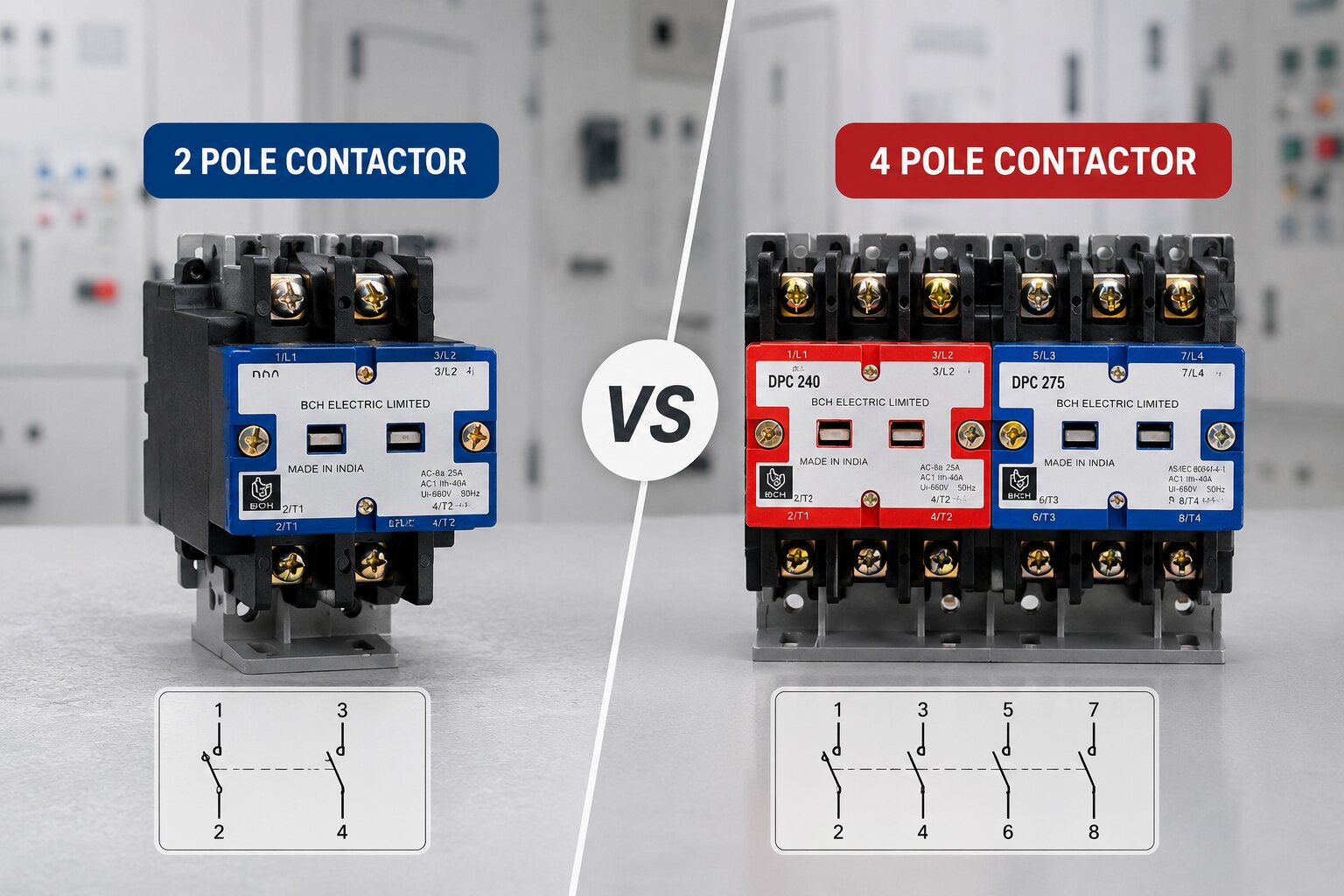
A 2 pole contactor switches two power conductors at the same time. It is commonly used in single phase circuits such as pumps, heaters, fans and lighting banks. A 4 pole contactor switches four conductors together. It is used when a circuit needs four switching paths, often three phases plus neutral. The pole count does not decide current capacity, motor rating or coil voltage. For any 2 pole contactor vs 4 pole contactor choice, match the device to the circuit arrangement, load current, utilisation category, coil voltage, switching frequency and protection scheme.
What is a pole in a contactor?
A pole is one main current carrying path inside a contactor. When the coil receives the correct control voltage, all main poles change position together. A 2 pole contactor has two main switching contacts. A 4 pole contactor has four. The pole count tells you how many conductors the contactor can open or close at once, but it does not tell you the ampere rating, duty rating or coil voltage.
What is the difference between 2 pole and 4 pole contactor?
The difference between 2 pole and 4 pole contactor types is the number of independent power paths they switch. A 2 pole contactor suits a circuit that needs two contacts to operate together. A 4 pole contactor suits a circuit that needs four contacts to operate together, such as a three phase and neutral arrangement where the neutral must also disconnect.
| Selection factor |
2 pole contactor |
4 pole contactor |
| Main poles | Two | Four |
| Conductors switched | Two conductors | Four conductors |
| Common circuit type | Single phase circuits | Three phase plus neutral or other four conductor circuits |
| Typical uses | Pumps, heaters, fans, lighting and small motors | Four wire distribution, agricultural starters and industrial panels |
| Panel impact | Usually smaller with fewer power connections | Usually wider with more wiring points |
| Neutral switching | Possible only where two conductor switching is required and permitted | Useful when the design requires three phases and neutral to switch together |
| Selection basis | Load type, current, duty, coil voltage and protection | Circuit arrangement, current, duty, coil voltage and protection |
When should you use a 2 pole contactor?
Use a 2 pole contactor when the approved circuit design requires two conductors to switch together. Common 2 pole contactor uses include single phase water pumps, agricultural pump panels, electric heaters, lighting circuits, fans, blowers, small compressors and HVAC control panels.
Before selecting the model, confirm the operating voltage, full load current, starting or inrush current, utilisation category, coil voltage and expected operations per hour. For motor loads, select from the motor duty or AC-3 rating rather than only the general thermal current. For application-specific selection, read this guide on how to select a 2 pole contactor for heating, lighting and motor loads.
When should you use a 4 pole contactor?
Use a 4 pole contactor when four conductors must open and close through one switching device. Typical 4 pole contactor applications include three phase and neutral switching, four wire distribution, agricultural starters, heating and lighting control systems, power transfer arrangements and industrial automation panels.
Do not choose a 4 pole contactor only because the supply is three phase. Many standard three phase motor circuits use three main poles. The fourth pole is useful only when the circuit has another conductor, such as neutral, that the design requires the contactor to switch. A qualified electrical professional should confirm whether neutral switching is permitted and required.
Does a 4 pole contactor carry more current?
Not automatically. Pole count and current rating describe different things. Pole count says how many power paths the contactor controls. Current rating says how much current each pole can carry or switch under stated conditions. A 25A 2 pole contactor and a 25A 4 pole contactor may have the same per pole rating. The 4 pole version gives extra switching paths, not extra current capacity.
Also check the rating under the correct utilisation category. A contactor can have one rating for AC-1 resistive duty and a lower rating for AC-3 motor duty. Do not connect poles in parallel to raise current capacity unless the manufacturer explicitly allows it and gives wiring and derating instructions.
How to select the right contactor pole count
- Count the conductors that must switch at the same time.
- Confirm whether the circuit is single phase, three phase or three phase plus neutral.
- Check whether the neutral must disconnect with the phase conductors.
- Match the operational current to the actual load and utilisation category.
- Match the coil voltage to the control supply.
- Check switching frequency, auxiliary contacts, terminal capacity and enclosure conditions.
- Use separate short circuit and overload protection where the circuit requires it.
BCH 2 pole and 4 pole contactor options
BCH offers 2 pole and 4 pole contactors for pump control, agricultural starters and industrial applications. CPG and JPG 2 pole contactors suit single phase pump control applications, with CPG models covering 12A to 40A and JPG models covering 16A to 25A.
BCH NHD 4 pole contactors serve agricultural starters and demanding industrial applications. The published range includes 12A to 40A current ratings, wide band coil options, add-on auxiliary contacts, AC-3 electrical endurance of one million operations, mechanical endurance of five million operations, maximum operating frequency of 600 operations per hour and IEC 60947-4-1 compliance. Select the final model from the BCH data sheet for the circuit, load and site conditions. Read how motor starters work with contactors and overload relays to understand how these components coordinate.
Common mistakes to avoid
- Choosing by pole count alone instead of current, voltage and duty.
- Assuming four poles always means higher capacity.
- Using a general current rating for motor, heating or lighting loads.
- Ignoring coil voltage or control supply frequency.
- Adding neutral switching without checking the circuit design.
- Using a contactor as a substitute for overload or short circuit protection.
Final selection checklist
Before ordering, confirm the number of conductors to switch, supply voltage, load current, starting current, utilisation category, coil voltage, operations per hour, electrical and mechanical endurance, auxiliary contacts, cable size, terminal capacity, enclosure temperature, derating, short circuit protection and motor overload protection where applicable.
Frequently asked questions
Can I use a 4 pole contactor for a single phase load?
It may be possible in some designs, but it can add size, wiring and cost when only two switching paths are needed. Choose the pole count that matches the approved circuit design.
Does a three phase motor need a 4 pole contactor?
Not usually. A standard three phase motor commonly uses three power poles. A fourth pole is needed only when another conductor must also switch.
Can a 2 pole contactor switch phase and neutral?
It can switch two designated conductors when the product rating, circuit design and local wiring rules permit that arrangement. The design should be checked by a qualified professional.
Is a 4 pole contactor safer than a 2 pole contactor?
No contactor is safer only because it has more poles. Safety depends on correct selection, installation, protection coordination and maintenance.
Conclusion
The right choice depends on the conductors the circuit must switch. Choose a 2 pole contactor for suitable two conductor circuits and a 4 pole contactor when four conductors must operate together. Then confirm the current rating, utilisation category, coil voltage, switching frequency, auxiliary contacts, environment and protection scheme before buying. For help matching the pole arrangement and contactor rating to your application, contact the BCH Electric team.
