
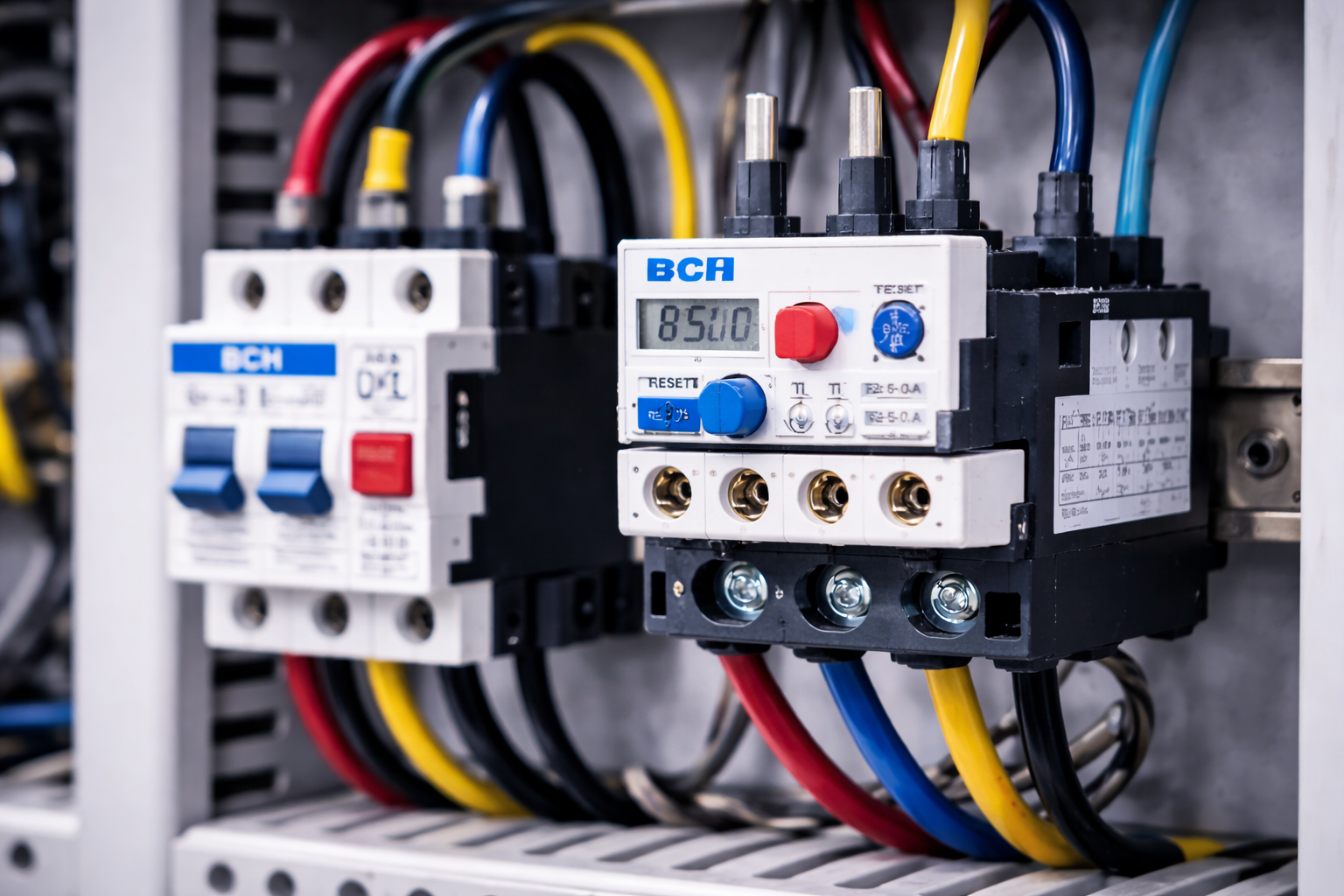
Electric motors are the backbone of industrial operations, powering everything from conveyor systems and pumps to compressors and manufacturing machinery. However, motors cannot be connected directly to the power supply without proper control and protection. This is where motor starters come into play.
A motor starter is not a single device—it is a combination of components, primarily including a contactor and an overload relay, working together to ensure safe motor operation.
In this guide, we explain how motor starters work with contactors and overload relays, along with their functionality, working principle, and importance in industrial systems.
What Is a Motor Starter?
A motor starter is an electrical device used to:
- Start and stop a motor
- Control power supply to the motor
- Protect the motor from overload conditions
A typical motor starter consists of:
- Contactor (switching device)
- Overload relay (protection device)
- Control circuit (push buttons, PLC, etc.)
Motor starters are essential in ensuring safe, efficient, and controlled motor operation.
Why Motors Need Starters
When a motor starts, it draws a high inrush current—typically 6 to 8 times its rated current. Without proper control, this can cause:
- Voltage dips
- Equipment stress
- Electrical faults
- Reduced motor life
Motor starters help:
- Control starting current
- Protect against overload
- Ensure safe switching
Key Components of a Motor Starter
1. Contactor (Switching Device)
A contactor is an electrically operated switch used to control power flow to the motor.
Functions:
- Connects motor to power supply
- Disconnects power when required
- Allows remote operation
When the control circuit energizes the contactor coil:
- Contacts close → Motor starts
- Coil de-energizes → Contacts open → Motor stops
2. Overload Relay (Protection Device)
An overload relay protects the motor from prolonged overcurrent conditions.
Functions:
- Monitors motor current
- Detects overload conditions
- Trips the circuit when necessary
Unlike MCBs, overload relays allow temporary current surges but protect against sustained overload.
3. Control Circuit
The control circuit operates the starter using:
- Push buttons (Start/Stop)
- PLC signals
- Sensors
It controls the contactor coil and overall motor operation.
How Motor Starters Work: Step-by-Step
Step 1: Start Command Initiated
When the operator presses the Start button:
- Control circuit is activated
- Current flows to the contactor coil
Step 2: Contactor Energizes
Once energized:
- Contactor coil creates a magnetic field
- Contacts close
- Power flows to the motor
Motor starts running
Step 3: Motor Runs Normally
During operation:
- Motor draws normal current
- Overload relay continuously monitors current
Step 4: Overload Condition Detection
If motor draws excessive current:
- Overload relay senses the condition
- Internal mechanism activates
Step 5: Relay Trips the Circuit
When overload persists:
- Relay trips
- Contactor coil is de-energized
- Contacts open
Motor stops automatically
Step 6: Reset and Restart
After resolving the issue:
- Relay is reset (manual or automatic)
- Motor can be restarted safely
Interaction Between Contactor and Overload Relay
The coordination between contactor and overload relay is critical.
| Component | Role |
|---|---|
| Contactor | Controls ON/OFF switching |
| Overload Relay | Protects motor from damage |
How They Work Together:
- Contactor supplies power
- Overload relay monitors current
- If overload occurs → relay interrupts contactor circuit
This ensures both control and protection in a single system.
Types of Motor Starters
1. Direct-On-Line (DOL) Starter
- Simplest and most common
- Directly connects motor to supply
- Used for small motors
2. Star-Delta Starter
- Reduces starting current
- Used for larger motors
3. Soft Starter
- Provides gradual voltage increase
- Reduces mechanical stress
4. Automatic Motor Starter
- Controlled via PLC or sensors
- Used in automation systems
Advantages of Using Motor Starters
Motor starters provide several benefits:
- Controlled motor startup
- Protection against overload
- Reduced electrical stress
- Improved motor lifespan
- Enhanced operational safety
These advantages make motor starters essential in industrial systems.
Applications of Motor Starters
Motor starters are used in:
Industrial Machinery
- Manufacturing equipment
- CNC machines
- Automation systems
Pumping Systems
- Water supply
- Irrigation
- Industrial fluid handling
HVAC Systems
- Air conditioning units
- Cooling systems
- Ventilation systems
Conveyor Systems
- Material handling
- Warehousing
- Logistics
Common Mistakes to Avoid
Avoid these common errors:
- Incorrect contactor selection
- Improper overload relay settings
- Ignoring motor rating
- Poor wiring practices
- Using low-quality components
These mistakes can lead to system failure and motor damage.
Importance of Quality Components
The performance of a motor starter depends on the quality of its components.
High-quality contactors and overload relays ensure:
- Reliable switching
- Accurate protection
- Long operational life
- Reduced maintenance
Trusted manufacturers like BCH India provide industrial-grade motor control components designed for demanding environments.
Through https://bchindia.com/, professionals can access:
- Product specifications
- Technical resources
- Industrial electrical solutions
Future Trends in Motor Control Systems
Motor control technology is evolving rapidly.
Key trends include:
- Smart motor starters
- IoT-enabled monitoring
- Energy-efficient systems
- Predictive maintenance
These advancements improve efficiency and reduce downtime.
Conclusion
Motor starters play a critical role in industrial electrical systems by combining control and protection functions through contactors and overload relays.
Understanding how these components work together helps engineers and electricians:
- Ensure safe motor operation
- Prevent equipment damage
- Improve system efficiency
- Reduce downtime
By selecting the right motor starter components and ensuring proper installation, industries can achieve reliable and efficient motor control.
For more information on motor control solutions and industrial electrical components, visit https://bchindia.com/.
