
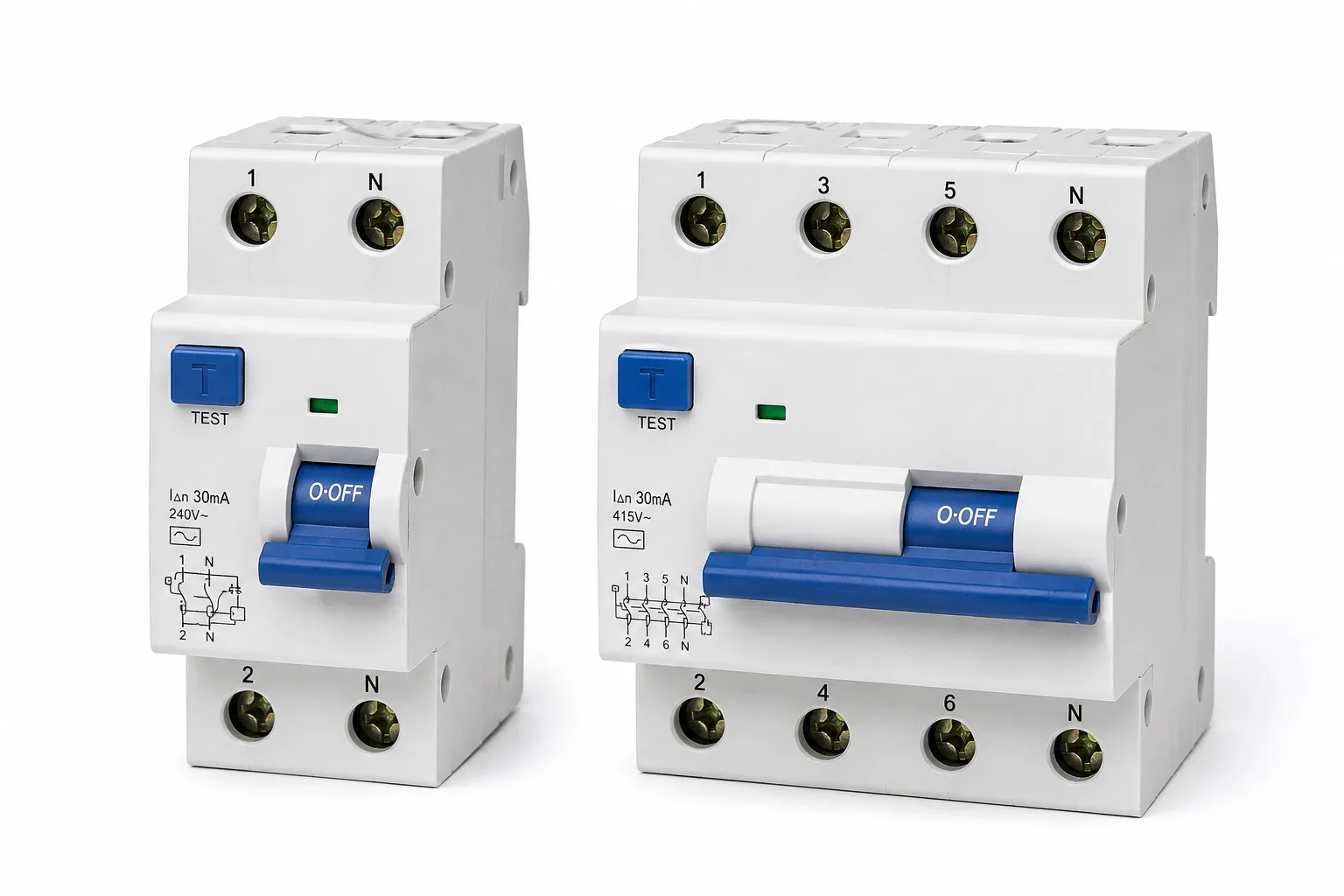
Electrical safety is a critical requirement in residential, commercial, and industrial power systems. One of the most important devices used for electrical protection is the RCCB, also known as a Residual Current Circuit Breaker. RCCBs are designed to protect people and electrical systems from electric shock, leakage current, and fire hazards caused by electrical faults.
When selecting an RCCB for your electrical installation, one of the key decisions is choosing between a single-phase RCCB and a three-phase RCCB. While both devices serve the same primary purpose, they are designed for different electrical systems and applications.
Understanding the difference between single-phase and three-phase RCCBs can help you choose the right protection solution for your home, commercial building, or industrial facility.
In this guide, we will explain how RCCBs work, compare single-phase and three-phase RCCBs, and help you determine which one best suits your electrical requirements.
What Is an RCCB?
An RCCB (Residual Current Circuit Breaker) is an electrical safety device that disconnects the power supply when it detects leakage current in a circuit.
Leakage current occurs when electricity flows through an unintended path, such as through a damaged wire, faulty insulation, or even a human body. If left unchecked, leakage current can lead to electric shocks, electrical fires, or damage to connected equipment.
An RCCB continuously monitors the balance between the live and neutral conductors. Under normal conditions, the current flowing through the live wire and returning through the neutral wire should be equal.
If the RCCB detects an imbalance, it quickly trips the circuit and cuts off power to prevent hazards.
RCCBs are widely used in:
- Residential electrical systems
- Commercial buildings
- Industrial power distribution systems
- Manufacturing facilities
- Data centers
- Hospitals and healthcare facilities
- Outdoor electrical installations
Why RCCBs Are Important in Electrical Safety
Modern electrical systems require reliable protection against leakage current and accidental electric shock.
Installing the right RCCB helps:
- Prevent electrical shock hazards
- Protect against earth leakage faults
- Reduce the risk of electrical fires
- Improve electrical system safety
- Protect sensitive electrical equipment
- Ensure compliance with electrical safety standards
Whether for homes or industrial facilities, RCCBs play a major role in improving electrical protection and operational safety.
What Is a Single-Phase RCCB?
A single-phase RCCB is specifically designed for single-phase electrical systems.
It monitors current flow between the live and neutral conductors in a single-phase circuit. If leakage current is detected, the RCCB disconnects the power supply immediately.
Features of Single-Phase RCCBs
- Designed for single-phase power supply systems
- Typically available in 2-pole configurations
- Suitable for residential and light commercial applications
- Provides protection against electric shock and earth leakage
- Compact and easy to install
Common Applications of Single-Phase RCCBs
Single-phase RCCBs are widely used in:
- Residential homes
- Apartments
- Small offices
- Retail shops
- Lighting circuits
- Home distribution boards
These RCCBs are ideal for environments with relatively lower power demands.
Advantages of Single-Phase RCCBs
- Cost-effective electrical protection solution
- Easy installation and maintenance
- Suitable for domestic electrical systems
- Reliable protection against leakage current
- Compact design for small distribution boards
What Is a Three-Phase RCCB?
A three-phase RCCB is designed to provide leakage current protection in three-phase electrical systems.
It monitors the current balance across all three phases and the neutral conductor. If any imbalance caused by earth leakage is detected, the RCCB disconnects the circuit.
Features of Three-Phase RCCBs
- Designed for three-phase power systems
- Typically available in 4-pole configurations
- Suitable for industrial and commercial applications
- Handles higher electrical loads
- Provides comprehensive leakage current protection
Common Applications of Three-Phase RCCBs
Three-phase RCCBs are commonly installed in:
- Industrial manufacturing plants
- Commercial buildings
- HVAC systems
- Heavy machinery installations
- Data centers
- Large electrical distribution systems
- Motor control panels
Advantages of Three-Phase RCCBs
- Suitable for high-load electrical systems
- Reliable protection for industrial equipment
- Improved electrical safety in large installations
- Efficient monitoring of multi-phase systems
- Helps prevent equipment damage and downtime
Single-Phase vs Three-Phase RCCB: Key Differences
Understanding the differences between these RCCBs is important for selecting the right device.
|
Feature |
Single-Phase RCCB | Three-Phase RCCB |
|
Electrical System |
Single-phase supply |
Three-phase supply |
|
Number of Poles |
Typically 2-pole | Typically 4-pole |
| Application | Residential and small commercial |
Industrial and large commercial |
|
Load Capacity |
Lower electrical loads | Higher electrical loads |
|
Installation Complexity |
Simple installation |
More complex installation |
|
Typical Use |
Homes, shops, offices |
Factories, machinery, industrial systems |
The correct RCCB depends primarily on the type of electrical supply system and load requirements.
How to Choose the Right RCCB
Selecting the right RCCB involves more than just choosing between single-phase and three-phase configurations.
Here are some important factors to consider.
1. Type of Electrical Supply
The first step is identifying whether your electrical system uses single-phase or three-phase power.
- Homes and small offices usually require single-phase RCCBs
- Industrial facilities and large commercial buildings often require three-phase RCCBs
2. Load Requirements
Evaluate the electrical load connected to the system.
For heavy machinery, industrial motors, and large HVAC systems, a three-phase RCCB is typically necessary.
For lighting circuits, residential appliances, and small office systems, a single-phase RCCB is generally sufficient.
3. Sensitivity Rating
RCCBs are available with different sensitivity ratings, such as 30mA, 100mA, and 300mA.
- 30mA RCCBs are commonly used for personal protection against electric shock
- Higher sensitivity ratings are often used for fire protection and industrial applications
Choosing the correct sensitivity level is important for effective electrical protection.
4. Environmental Conditions
Industrial environments may expose RCCBs to dust, moisture, vibration, and temperature variations.
Selecting high-quality RCCBs designed for harsh environments can improve long-term reliability and performance.
5. Compliance with Standards
Always ensure the RCCB complies with relevant electrical safety standards and industry regulations.
Reliable RCCBs should undergo rigorous testing to ensure consistent protection performance.
Common Mistakes to Avoid When Choosing RCCBs
Selecting the wrong RCCB can compromise electrical safety and system performance.
Here are some common mistakes to avoid.
Using a Single-Phase RCCB in a Three-Phase System
A single-phase RCCB cannot provide proper protection in a three-phase electrical system.
Ignoring Load Requirements
Installing an RCCB that cannot handle the system load may lead to nuisance tripping or equipment failure.
Choosing Incorrect Sensitivity Ratings
Using an inappropriate sensitivity level can reduce protection effectiveness.
Overlooking Installation Environment
Industrial environments may require RCCBs with enhanced durability and protection.
The Importance of Quality RCCBs
Not all RCCBs offer the same level of performance and reliability.
High-quality RCCBs are designed with advanced safety features, reliable tripping mechanisms, and durable construction to ensure consistent protection.
Choosing a trusted electrical protection solution helps:
- Improve operational safety
- Minimize electrical hazards
- Reduce downtime
- Protect expensive equipment
- Ensure long-term reliability
For industrial and commercial applications, using premium-quality RCCBs is especially important because electrical failures can lead to costly disruptions.
Future Trends in Electrical Protection Systems
As electrical systems become more advanced, demand for intelligent and high-performance protection devices continues to grow.
Modern RCCBs are increasingly integrated with:
- Smart monitoring systems
- Advanced fault detection technologies
- Energy-efficient electrical systems
- Industrial automation infrastructure
These developments are helping improve electrical safety, operational efficiency, and predictive maintenance capabilities.
Conclusion
Choosing between a single-phase RCCB and a three-phase RCCB depends on the type of electrical system, load requirements, and application environment.
- Single-phase RCCBs are ideal for residential homes, small offices, and light commercial applications.
- Three-phase RCCBs are designed for industrial systems, heavy electrical loads, and large commercial installations.
Selecting the correct RCCB is essential for ensuring electrical safety, preventing leakage current hazards, and protecting valuable electrical equipment.
At “BCH Electric Limited” we create advanced electrical protection solutions designed to support safe, reliable, and efficient power distribution across residential, commercial, and industrial applications.
By understanding the differences between single-phase and three-phase RCCBs, businesses and facility owners can make informed decisions that improve safety, reliability, and long-term electrical system performance.
