
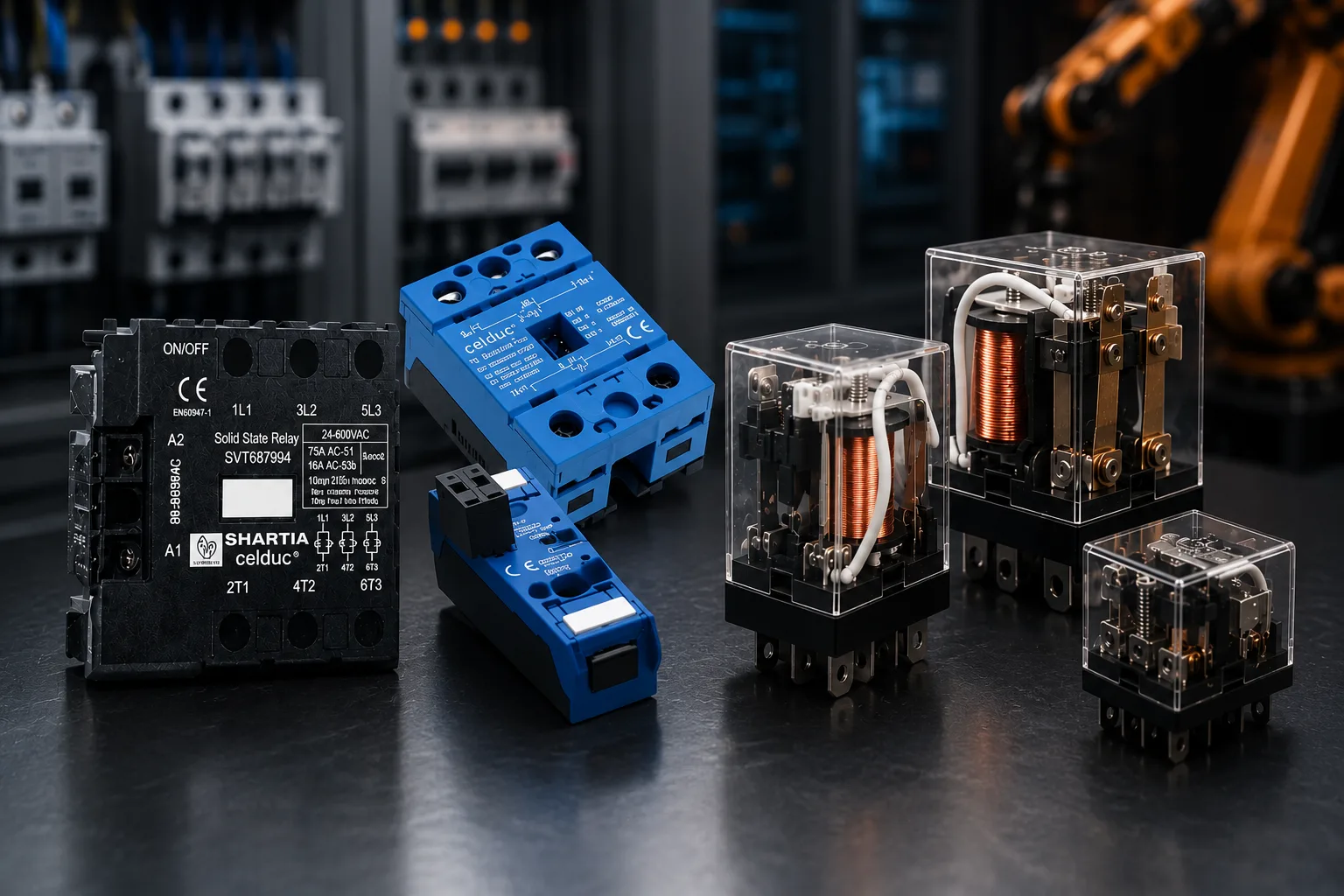
In modern industrial automation, choosing the right relay can directly impact system performance, reliability, and maintenance costs. Two of the most commonly used switching devices are Solid State Relays (SSRs) and Mechanical Relays. While both perform the same basic function of switching electrical loads, they operate very differently and are suited for different automation applications.
If you are designing or upgrading an automation system, understanding the difference between these relay technologies is essential. In this guide, we compare solid state relays and mechanical relays based on performance, durability, switching speed, energy efficiency, and industrial applications.
What Is a Solid State Relay?
A Solid State Relay (SSR) is an electronic switching device that uses semiconductor components instead of moving mechanical contacts. It switches electrical loads electronically when a control signal is applied.
Unlike traditional relays, SSRs have no moving parts. This design allows them to operate silently, switch faster, and offer longer operational life in demanding industrial environments.
Key Features of Solid State Relays
- Fast switching speed
- No mechanical wear and tear
- Silent operation
- High resistance to vibration and shock
- Suitable for frequent switching applications
- Longer service life
SSRs are widely used in industrial automation systems, temperature control systems, PLC panels, semiconductor manufacturing, packaging machines, and process control applications.
What Is a Mechanical Relay?
A Mechanical Relay, also known as an electromechanical relay, operates using physical contacts and an electromagnetic coil. When current passes through the coil, the contacts open or close to control the electrical circuit.
Mechanical relays have been used in industrial systems for decades because of their simple design and ability to handle high surge currents.
Key Features of Mechanical Relays
- Lower initial cost
- Ability to handle high inrush current
- Electrical isolation between circuits
- Available in multiple contact configurations
- Easy to troubleshoot and replace
Mechanical relays are commonly used in motor control circuits, power distribution systems, automotive systems, and industrial machinery.
Solid State Relay vs Mechanical Relay: Major Differences
Understanding the practical differences between SSRs and mechanical relays helps industries select the right solution for automation efficiency and reliability.
|
Feature |
Solid State Relay |
Mechanical Relay |
|
Switching Method |
Electronic semiconductor switching | Physical moving contacts |
|
Switching Speed |
Very fast |
Slower |
|
Noise |
Silent operation |
Audible clicking sound |
|
Lifespan |
Longer lifespan |
Limited by contact wear |
|
Maintenance |
Minimal maintenance |
Requires periodic maintenance |
|
Resistance to Shock/Vibration |
Excellent |
Moderate |
|
Heat Generation |
Higher heat dissipation |
Lower heat generation |
|
Initial Cost |
Higher |
Lower |
| Switching Frequency | Ideal for frequent switching |
Not ideal for continuous switching |
Which Relay Performs Better in Automation?
The answer depends on the automation application and operating conditions.
When Solid State Relays Are Better
Solid State Relays are ideal for high-speed and high-frequency switching environments. Since there are no moving parts, SSRs offer exceptional reliability in automated production lines where continuous operation is critical.
Industries prefer SSRs for:
- Industrial automation systems
- PLC-based control panels
- HVAC systems
- Temperature controllers
- Semiconductor equipment
- Packaging and printing machinery
- Medical equipment
Their silent operation and resistance to vibration make them highly suitable for modern smart factories and Industry 4.0 environments.
Another major advantage is reduced downtime. Because SSRs experience less mechanical wear, they require less maintenance compared to electromechanical relays.
When Mechanical Relays Are Better
Mechanical relays are still widely used because they are cost-effective and capable of handling higher surge currents.
They are suitable for:
- Motor starters
- Heavy-duty industrial loads
- Power switching applications
- Automotive electrical systems
- Applications with low switching frequency
For systems where switching occurs only occasionally, mechanical relays remain a practical and economical choice.
Advantages of Solid State Relays in Industrial Automation
As automation technology advances, more industries are shifting toward solid state relay technology due to its operational benefits.
1. Longer Operational Life
Since SSRs do not rely on moving contacts, there is minimal physical wear. This significantly increases relay lifespan and reduces replacement frequency.
2. Faster Switching Performance
SSRs switch in milliseconds, making them ideal for precision automation and high-speed manufacturing processes.
3. Reduced Maintenance Costs
With fewer mechanical failures, maintenance requirements are much lower. This helps improve production uptime and lowers operational expenses.
4. Better Reliability in Harsh Environments
Solid state relays perform reliably in environments with dust, vibration, humidity, and continuous operation.
5. Silent Operation
Unlike electromechanical relays, SSRs operate without clicking sounds, making them suitable for noise-sensitive environments.
Factors to Consider Before Choosing a Relay
Before selecting a relay for industrial automation, consider the following factors:
- Load type and voltage requirements
- Switching frequency
- Operating temperature
- Expected relay lifespan
- Environmental conditions
- Maintenance requirements
- Budget and system scalability
For high-speed automation and long-term reliability, solid state relays are often the preferred choice. For lower-cost applications with less frequent switching, mechanical relays can still deliver reliable performance.
Final Verdict
Both solid state relays and mechanical relays have important roles in industrial automation systems. Mechanical relays remain useful for cost-sensitive and heavy-load applications, while solid state relays offer superior performance, faster switching, and longer life for advanced automation environments.
As industries move toward smarter and more efficient manufacturing systems, SSR technology continues to gain popularity due to its reliability, durability, and low maintenance requirements.
Choosing the right relay ultimately depends on your automation goals, operational demands, and long-term performance expectations.
For industries looking to improve efficiency and reduce downtime, solid state relays are increasingly becoming the preferred solution in modern automation systems.
