
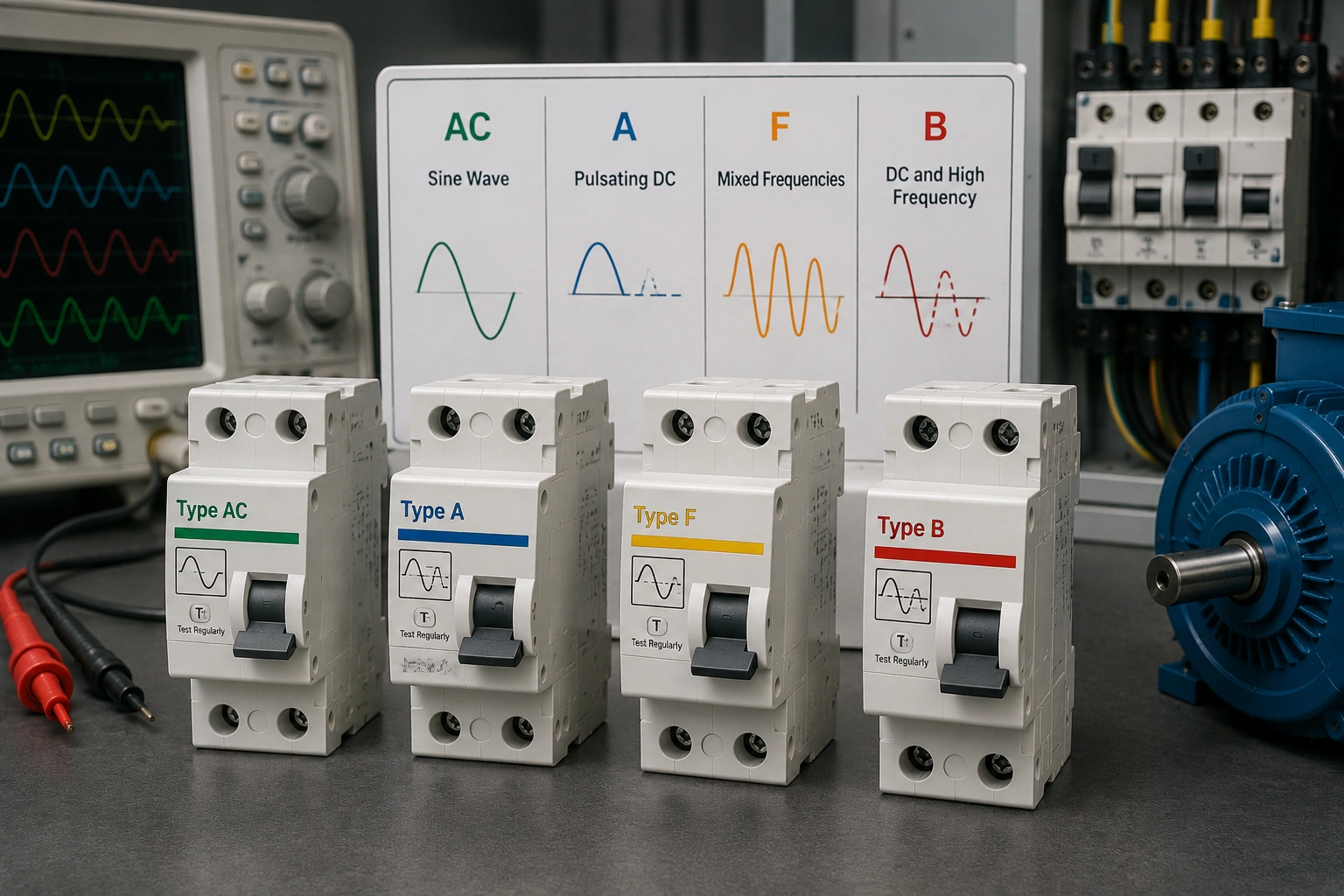
What is the difference between Type AC, A, F and B RCCBs?
RCCB type selection should begin with the residual-current waveform that the connected equipment is capable of producing. Type AC RCCBs are designed for sinusoidal alternating residual current, while Type A devices also respond to pulsating DC residual current. For certain single-phase inverter-driven loads, Type F extends this capability to specified mixed-frequency residual currents, whereas Type B covers a broader range that can include smooth DC and specified higher-frequency components.
However, choosing the RCCB with the widest detection capability is not necessarily the right approach. The final selection should also consider the earthing arrangement, rated residual current, time characteristic, standing leakage, pole configuration and the connected equipment manufacturer’s requirements. Therefore, the appropriate BCH RCCB range should be selected only after evaluating both the circuit conditions and the expected residual-current waveform.
|
RCCB type |
Waveform capability described in the supplied draft |
Application clue |
|
Type AC |
Sinusoidal AC residual current |
Simple loads without relevant electronic conversion |
|
Type A |
AC plus pulsating DC residual current |
Many modern single-phase electronic loads |
|
Type F |
Type A coverage plus specified mixed-frequency behaviour |
Certain single-phase inverter-driven equipment |
|
Type B |
AC, pulsating DC, smooth DC and specified frequencies |
Equipment that can produce smooth DC leakage |
Why the leakage waveform is the starting point
An RCCB works by detecting an imbalance between conductors passing through its sensing system. The critical selection question is not simply whether a building is residential, commercial or industrial; it is what type of residual current can appear in the circuit. Modern electronic equipment can change the shape of leakage current through rectifiers, filters, inverters, DC links and switching power supplies.
This is why a circuit that previously served simple resistive or electromechanical loads may need a fresh review after the load mix changes. A new UPS, drive, inverter-driven appliance or electronic power supply can alter normal leakage and fault-current waveform. The RCCB choice should be tied to the connected equipment rather than copied from an old distribution-board schedule.
What does Type AC RCCB cover?
Type AC is associated with sinusoidal alternating residual current. It can be appropriate where the connected equipment does not create relevant pulsating or smooth DC residual-current components and where the applicable equipment and installation requirements allow it. The important limitation is that Type AC should not be used by habit simply because it was commonly installed in older circuits.
During a retrofit, list every fixed load and identify the electronic conversion stages. If the circuit contains modern equipment with rectifiers or electronic controls, the manufacturer’s RCD/RCCB requirement should take priority over an assumption based on the building type.
When is Type A RCCB relevant?
Type A extends the detection capability beyond sinusoidal AC residual current to include pulsating DC residual current. That makes it relevant to many modern single-phase electronic loads. However, the correct engineering question is not ‘Is Type A better than Type AC?’ but ‘Can this load create a residual-current waveform that requires Type A capability?’
Using a wider-capability device without understanding the circuit can still leave other issues unresolved. Standing leakage may be too high, several circuits may be grouped unnecessarily, a borrowed neutral may cause unwanted trips, or the rated residual current may be inappropriate. Waveform type is only one part of the selection.
What is Type F RCCB used for?
The supplied draft describes Type F as extending Type A coverage for specified mixed-frequency behaviour and associates it with certain single-phase inverter-driven appliances or equipment. This matters because some electronic loads can create residual-current components that are not well represented by a simple sinusoidal or pulsating-DC description.
Type F should therefore be selected from the equipment requirement and current product documentation. It should not be treated as a generic intermediate option chosen only because Type A appears insufficient and Type B appears expensive. The intended load and waveform conditions must support the choice.
When should Type B RCCB be considered?
Type B is intended for a broader range of residual currents that can include smooth DC and specified higher-frequency components. This can make it relevant where power-electronic equipment has the ability to create smooth DC leakage. The supplied draft also makes an important caution: Type B should not be selected for every circuit simply because it has wider detection capability.
A Type B decision still has to fit the earthing system, normal leakage, circuit subdivision, rated residual current, selectivity requirements and equipment manufacturer’s instructions. Wider waveform capability does not remove the need for proper installation design.
RCCB type, sensitivity and pole arrangement are separate decisions
One of the most common selection mistakes is to mix together waveform type, sensitivity and pole count. They answer different questions. Waveform type addresses the residual-current shape. Sensitivity addresses the rated residual operating current. Pole arrangement addresses the circuit conductors that pass through the device. BCH’s guide to 30 mA vs 100 mA vs 300 mA RCCB selection focuses on sensitivity, while the single-phase vs three-phase RCCB guide addresses phase and pole arrangement.
For example, specifying Type A does not tell the installer whether the device should be 30 mA or 300 mA, and specifying 30 mA does not tell the designer whether Type AC, A, F or B is needed. A complete specification records each decision separately.
Why electronics can increase nuisance-tripping risk
Healthy electronic equipment can have normal leakage through filters and capacitive paths. When many loads share one RCCB, their standing leakage can add. The device may then operate even though no single load has developed a dangerous insulation fault. This is not necessarily a defective RCCB; it can be a circuit-subdivision problem.
The design should estimate or measure standing leakage under representative operation. If several electronic loads are expected, consider how circuits are grouped so that normal leakage remains manageable and a single trip does not unnecessarily remove a large part of the installation.
Why neutral routing is critical
All conductors intended to be measured by one RCCB must remain associated with that device. A borrowed neutral, combined neutral or incorrect downstream neutral connection can create an apparent imbalance and cause a sound RCCB to trip. Neutral errors can also make diagnosis difficult because the trip may appear load-related when the actual problem is circuit topology.
During commissioning and troubleshooting, trace the neutral as carefully as the phase conductor. If several RCCBs are installed in one board, each circuit neutral should return through the correct device without cross-connections.
What should be checked before choosing the RCCB type?
- Record the supply voltage, phase arrangement and earthing system.
- List all fixed electronic loads, rectifiers, drives, inverters, filters, UPS equipment and DC links.
- Obtain the connected-equipment manufacturer’s RCD/RCCB requirement wherever available.
- Choose the residual-current waveform type required by the load.
- Select sensitivity separately using the principles in BCH’s RCCB sensitivity guide.
- Confirm phase and pole requirements using the single-phase vs three-phase RCCB guide.
- Estimate or measure normal standing leakage and review circuit subdivision.
- Check neutral routing and prevent borrowed or combined neutrals.
- Verify the separate overcurrent-protection arrangement.
- Check upstream/downstream selectivity or time-delay requirements where multiple residual-current devices are used.
- Record the selected type, sensitivity, pole arrangement, circuit loads and commissioning test results.
Does an RCCB replace an MCB or other overcurrent protection?
No. The supplied draft clearly separates residual-current protection from overcurrent protection. An RCCB without integral overcurrent protection is not intended to replace an MCB, MCCB or another suitable overcurrent protective device. A residual-current fault and an overload or short circuit are different conditions and may be handled by different devices in the final architecture.
This distinction matters during troubleshooting. If a breaker trips, investigate overcurrent or short-circuit evidence. If the RCCB operates, investigate residual-current imbalance, leakage, neutral routing and connected loads. Treating every trip as the same fault leads to unnecessary component replacement.
How should an existing nuisance-tripping problem be investigated?
Do not solve repeated RCCB trips by immediately installing a device with a higher residual-current setting or a different waveform type. First identify the actual trip pattern. BCH’s RCCB tripping and troubleshooting guide is the relevant internal reference for a fault-driven review.
- Record which device operated and preserve the indication before resetting.
- Note whether the trip occurs immediately, after a delay, only when a specific load starts or only in wet conditions.
- Disconnect or isolate loads systematically using an approved procedure rather than changing several variables at once.
- Inspect neutral routing and look for cross-connected neutrals.
- Review standing leakage from healthy electronic equipment.
- Check cable, appliance and enclosure insulation where moisture or damage is suspected.
- Confirm that the selected RCCB type is compatible with the connected equipment.
Worked example: office floor with electronic loads
Consider an office floor containing general socket circuits, LED drivers, computers, UPS equipment and several inverter-driven appliances. The old design used one Type AC RCCB for a large group of circuits. After the load mix changes, nuisance trips begin. A correct review starts by inventorying the equipment, measuring or estimating standing leakage, checking neutral routing and confirming the RCD requirements of the electronic loads.
The solution may involve circuit subdivision and a different RCCB type on selected circuits rather than replacing the entire board with one universal Type B device. Sensitivity is chosen separately from waveform type, and overcurrent protection remains a separate function. The final design documents which circuits use which RCCB type and why.
Worked example: inverter-driven single-phase equipment
For a dedicated single-phase circuit serving inverter-driven equipment, the equipment manufacturer may require an RCCB capable of specified mixed-frequency residual currents. That requirement can make Type F relevant. The designer still checks rated current, sensitivity, standing leakage, earthing and upstream coordination. The purpose of Type F is not to avoid nuisance trips by default; it is to match the device to the expected waveform behaviour.
What should be written into the purchase specification?
A useful RCCB specification should state the waveform type, rated operational current, rated residual current, pole arrangement, supply characteristics and any required time-delay or selectivity behaviour. It should identify the exact BCH RCCB product family used for the shortlist and require current product documentation rather than relying on a generic description.
The specification should also state the connected load category or equipment requirement that justifies the selected RCCB type. This makes the decision auditable and helps a future maintenance engineer understand why a particular Type A, F or B device was installed.
Installation and commissioning checks
- Confirm phase and neutral conductors pass through the intended device correctly.
- Verify conductor size, strip length, terminal condition and tightening requirements.
- Check the RCCB type, rated current, sensitivity and pole arrangement against the approved schedule.
- Use the manufacturer’s test procedure and test button as instructed.
- Measure representative leakage/current conditions where the design depends on standing leakage.
- Confirm downstream neutrals are not shared across separate RCCBs.
- Record the circuit loads, final device reference and commissioning results.
Common RCCB selection mistakes
- Choosing by building type instead of residual-current waveform.
- Assuming Type B is automatically best because it has wider detection capability.
- Using Type AC by habit after electronic loads are added.
- Confusing RCCB waveform type with 30 mA, 100 mA or 300 mA sensitivity.
- Ignoring healthy standing leakage from multiple electronic loads.
- Sharing or borrowing neutral conductors between circuits.
- Expecting an RCCB to provide overload or short-circuit protection by itself.
- Changing the RCCB type before diagnosing repeated trips.
Frequently Asked Questions
Is Type A RCCB always better than Type AC?
No. Type A detects additional waveform conditions, but correct selection depends on the residual-current waveform expected from the connected equipment and the applicable installation requirements.
Should every circuit with electronics use Type B?
No. Type B is intended for a broader set of residual-current conditions, including smooth DC in specified applications. Use the equipment requirement and actual circuit characteristics rather than assuming the widest type is always necessary.
Can changing from 30 mA to 100 mA stop nuisance trips?
It may reduce sensitivity, but changing the rating without understanding the protection objective can make the design inappropriate. Diagnose standing leakage, neutral routing and the load first.
Does RCCB type affect overcurrent protection?
Waveform type defines residual-current detection capability. Overload and short-circuit protection remain separate design functions unless a combined device is used.
Where can BCH help with an RCCB application?
Share the earthing arrangement, connected loads, RCCB type requirement, sensitivity and trip history through the BCH enquiry page or use the BCH sales office directory for regional support.
Conclusion
The correct choice between Type AC, A, F and B RCCBs starts with the leakage waveform the connected equipment can produce. Type selection should then be combined with separate decisions about sensitivity, pole arrangement, earthing, standing leakage, neutral routing and overcurrent protection. A reliable design does not ask which RCCB type is universally best; it asks which type matches the actual circuit and can be justified by equipment requirements, current product data and a documented commissioning process.
