
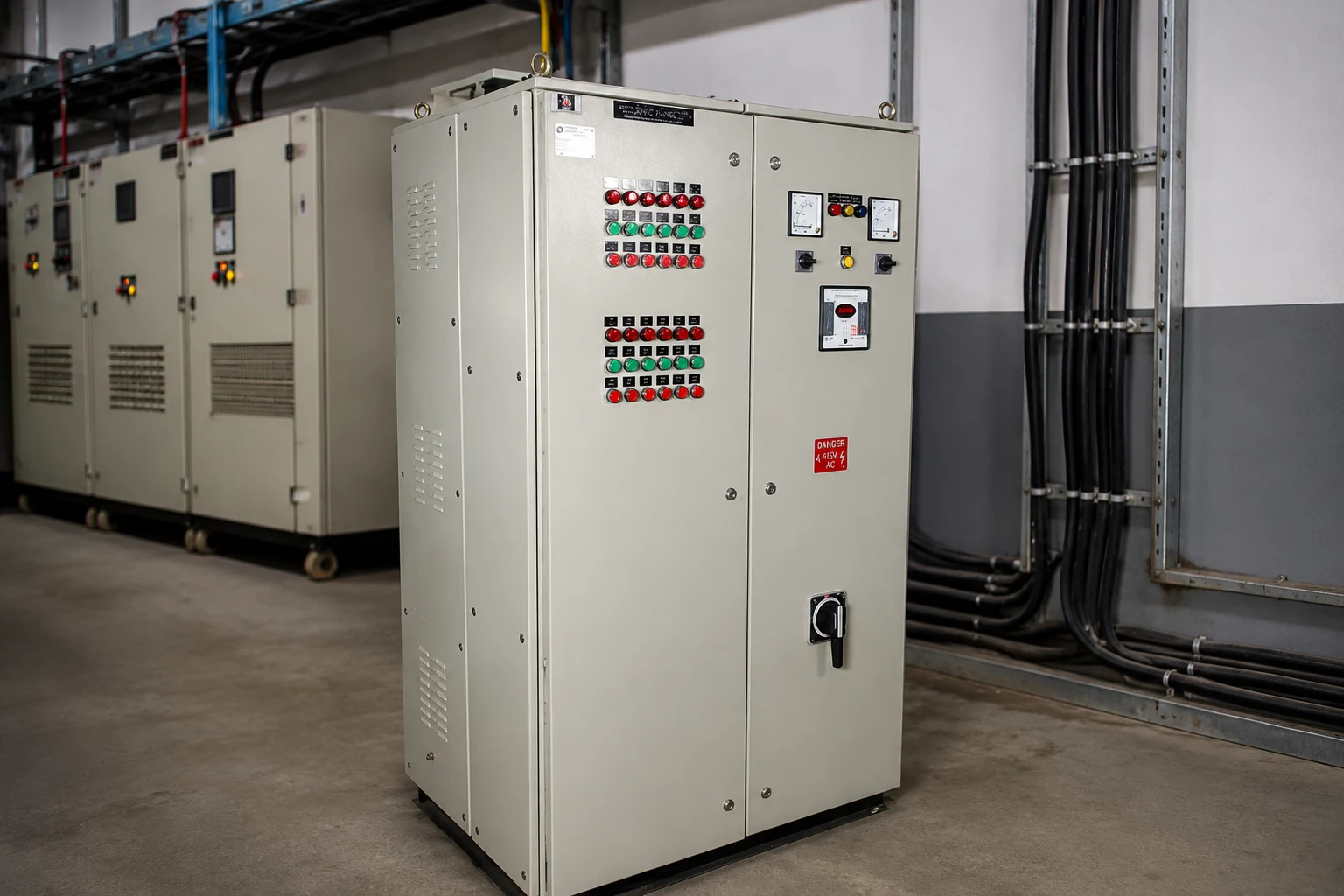
An APFC panel is used to improve power factor by adding the right amount of capacitor kVAR into a low-voltage electrical system. In industrial plants, it helps manage reactive power, reduce poor power factor penalties, and keep the electrical network more stable when loads keep changing.
The real challenge is not only selecting an APFC panel. The bigger challenge is choosing the correct step size. If the capacitor steps are too small, the system may stay under-corrected. If the steps are too large or poorly sequenced, the system may over-correct and move toward leading power factor. Both conditions can create heat, nuisance switching, capacitor stress, and avoidable maintenance issues.
For plants using motors, compressors, fabrication equipment, pumps, HVAC loads, or mixed LV distribution panels, APFC step calculation should be done with actual load behaviour in mind. That is where BCH Electric’s Power Factor Management Systems become relevant for plant teams, panel builders, consultants, and maintenance engineers.
Quick Answer
The right way to size an APFC panel is to calculate the required kVAR from the existing power factor, target power factor, and real kW load. After that, the total kVAR should be divided into logical capacitor steps so the APFC relay can add or remove correction smoothly as the load changes.
A practical APFC panel selection should confirm:
- Existing power factor
- Target power factor
- Maximum and average kW load
- Required kVAR
- Step size and switching sequence
- Harmonic level
- Capacitor and reactor selection
- Panel ventilation and service access
- Coordination with MCC, PCC, and other LV panels
The goal is simple: the panel should correct power factor without hunting, overheating, or pushing the system into over-correction.
What Is an APFC Panel?
An APFC panel, or Automatic Power Factor Correction panel, is an electrical panel that automatically switches capacitor banks ON and OFF based on the reactive power requirement of the system. It usually includes capacitor banks, an APFC relay, switching contactors or thyristor switching modules, protection devices, busbars, control wiring, and ventilation arrangements.
In a plant, many inductive loads such as motors and transformers draw reactive power. This reactive power does not perform useful work, but it still loads the electrical network. An APFC panel compensates for this by adding capacitive reactive power in controlled steps.
For wider electrical system planning, APFC panels should be reviewed along with Power Control & Protection requirements, especially where the same facility also uses MCC, PCC, feeders, protection devices, and distribution panels.
Why Step Calculation Matters in an APFC Panel
Step calculation decides how smoothly the APFC panel responds to changing load. A panel with the right total kVAR but poor step selection can still perform badly.
For example, if a plant needs around 180 kVAR of correction and the panel is built with very large steps, the relay may keep switching too much correction in and out. This can cause step hunting, contactor wear, voltage fluctuation, and capacitor stress.
On the other hand, if the total correction is too low or the steps are too small for the actual load, the system may remain under-corrected. The power factor may improve slightly, but the plant may still face penalties or poor electrical efficiency.
Good APFC step calculation helps the panel match the actual load pattern instead of reacting roughly to it.
How an APFC Panel Works
An APFC panel works by sensing the power factor of the electrical system and switching capacitor banks as required. The APFC relay receives current and voltage signals, compares the measured power factor with the target setting, and decides which capacitor steps should be switched ON or OFF.
When the load increases and power factor drops, the relay adds capacitor steps. When the load reduces, the relay removes capacitor steps. This automatic switching keeps the power factor close to the target value.
A typical APFC panel includes:
| Component | Role in the APFC Panel |
|---|---|
| APFC Relay | Monitors power factor and controls capacitor switching |
| Capacitor Banks | Provide reactive power compensation |
| Switching Contactors or Thyristor Modules | Switch capacitor steps as per relay command |
| Detuned Reactors | Help protect capacitors where harmonic levels are high |
| Protection Devices | Protect the capacitor banks and panel circuits |
| Busbars and Control Wiring | Carry power and control signals within the panel |
| Enclosure and Ventilation | Protect the system and manage heat inside the panel |
BCH’s APFC Relay and LT Capacitor options are important parts of the power factor correction system, especially where stable switching and capacitor life are priorities.
Basic Formula for APFC Panel kVAR Calculation
The common formula used for power factor correction is:
Required kVAR = kW × (tan φ1 – tan φ2)
Where:
- kW is the real power load
- φ1 is the angle of the existing power factor
- φ2 is the angle of the target power factor
The formula helps estimate how much capacitive kVAR is needed to move from the existing power factor to the target power factor.
Example Calculation
Suppose a plant has:
- Load: 400 kW
- Existing power factor: 0.80
- Target power factor: 0.96
For 0.80 power factor, tan φ1 is approximately 0.75.
For 0.96 power factor, tan φ2 is approximately 0.29.
Required kVAR = 400 × (0.75 – 0.29)
Required kVAR = 400 × 0.46
Required kVAR = 184 kVAR approximately
In this case, the APFC panel may be planned around 180 to 200 kVAR, depending on actual site readings, load variation, safety margin, harmonic conditions, and the final engineering review.
For a deeper calculation approach, readers can also refer to BCH’s guide on how to calculate required kVAR for power factor correction.
How to Decide APFC Panel Step Size
Once the total kVAR is known, the next step is to divide it into suitable capacitor steps. This is where many selection mistakes happen.
A 200 kVAR APFC panel can be designed in different ways. For example:
| Total kVAR | Possible Step Combination | Suitable When |
| 200 kVAR | 25 + 25 + 50 + 50 + 50 | Load changes in medium steps |
| 200 kVAR | 10 + 20 + 30 + 40 + 50 + 50 | Load variation is more gradual |
| 200 kVAR | 50 + 50 + 50 + 50 | Load is stable and correction is less sensitive |
| 200 kVAR | 5 + 10 + 25 + 40 + 60 + 60 | Load fluctuates and finer correction is needed |
There is no single best step pattern for every plant. The right choice depends on load variation, operating hours, starting frequency, motor duty, harmonic level, and the sensitivity of the electrical system.
For industrial LV panels, step selection should also be reviewed with the main distribution arrangement. If the APFC panel works near an MCC or PCC, the correction plan should match the actual feeder arrangement. BCH’s MCC, PCC and IMCC solutions are often reviewed in the same electrical planning stage.
How Under-Correction Happens
Under-correction happens when the APFC panel does not add enough kVAR to bring the power factor close to the target value. The plant may still run, but the expected power factor improvement is not achieved.
Common reasons for under-correction include:
- Total kVAR is lower than the actual requirement
- Capacitor banks have lost capacity over time
- Some capacitor steps are not switching
- APFC relay settings are incorrect
- CT ratio or CT wiring is wrong
- Load has increased after panel installation
- Harmonics are affecting capacitor performance
- Poor maintenance has reduced capacitor health
Under-correction is often noticed when the monthly bill still shows poor power factor penalties even after installing an APFC panel. It can also appear when the panel works normally on paper, but the actual load pattern has changed.
How Over-Correction Happens
Over-correction happens when the APFC panel adds more capacitive kVAR than the system needs. This can push the system toward leading power factor, especially during low-load conditions.
Common reasons for over-correction include:
- Capacitor steps are too large
- Fixed capacitors remain connected during light load
- Relay settings are too aggressive
- Switching delay is too short
- Load drops quickly but capacitor steps do not disconnect in time
- Capacitor banks are not matched with real operating duty
- Incorrect CT placement gives wrong feedback to the relay
Over-correction should not be ignored. A leading power factor can create voltage rise, switching stress, and unnecessary strain on the electrical network. In some facilities, it may also affect generator operation or sensitive equipment.
APFC Step Calculation Checklist
Before finalising an APFC panel, use this checklist to reduce the risk of under- or over-correction.
1. Confirm the Actual Load
Do not rely only on connected load. Connected load and running load are different. A plant may have 800 kW connected load but only 350 to 450 kW running during normal operation.
Use actual meter readings, demand data, or load study results wherever possible.
2. Confirm Existing and Target Power Factor
The existing power factor tells you where the system is today. The target power factor tells you where the system needs to be. Many plants target 0.95 to 0.99, but the correct value should be based on utility requirements, plant load type, and system behaviour.
3. Calculate Required kVAR
Use the power factor correction formula to estimate the required kVAR. Avoid choosing capacitor size only from a rough thumb rule. Thumb rules may help in early discussion, but final selection should be based on actual data.
4. Divide kVAR into Practical Steps
The step size should match the load variation. If the plant load changes frequently, finer steps may be needed. If the load is stable, larger steps may work.
5. Review Harmonic Conditions
Harmonics can reduce capacitor life and create overheating. If the plant uses VFDs, UPS systems, welding machines, rectifiers, or nonlinear loads, harmonic levels should be checked before finalising the APFC panel.
Where harmonics are present, detuned reactors may be required.
6. Check Switching Duty
Frequent switching can wear out contactors and stress capacitors. The APFC relay delay, step sequence, and contactor selection should match the switching duty.
7. Check Panel Location and Ventilation
Capacitors are sensitive to heat. Poor ventilation, high ambient temperature, dust, and cramped installation can reduce service life. The panel should have enough space for airflow, inspection, and maintenance.
8. Coordinate with Protection and LV Panels
An APFC panel should not be treated as a separate box. It must coordinate with upstream protection, feeder rating, MCC/PCC design, cable size, earthing, and plant distribution. This is why APFC selection often belongs inside the wider LV panel and power protection discussion.
Common Mistakes While Selecting an APFC Panel
The most common APFC panel mistakes usually start before the purchase order is placed.
Choosing Only by Total kVAR
A 200 kVAR panel is not automatically suitable just because the calculation suggests 200 kVAR. The step combination, relay settings, capacitor type, reactor requirement, and panel layout matter just as much.
Ignoring Harmonics
Capacitors and harmonics are a sensitive combination. If harmonic levels are high and the panel is not designed for that condition, capacitor overheating and failure can follow.
Using Large Steps for Variable Loads
Large steps can work in stable-load systems. In variable-load systems, they may cause over-correction, step hunting, and unstable power factor correction.
Not Checking CT Placement
The APFC relay depends on correct feedback. If the CT is placed incorrectly or wired with wrong polarity, the relay may switch steps at the wrong time.
Poor Maintenance Access
If the panel is hard to inspect, teams delay maintenance. Dust, loose connections, weak capacitors, failed contactors, and blocked ventilation can then reduce performance.
Treating APFC as a One-Time Installation
Load patterns change. Machines are added. Shifts change. Motors are replaced. A panel that was correctly selected three years ago may need review if the plant has changed.
Where APFC Panels Are Commonly Used
APFC panels are commonly used in industrial and commercial electrical systems where inductive loads affect power factor.
Typical applications include:
- Manufacturing plants
- Process industries
- Compressor rooms
- Pump houses
- Fabrication units
- Textile plants
- HVAC-heavy buildings
- Warehouses and logistics facilities
- Commercial complexes
- LV distribution systems with mixed loads
In these applications, the APFC panel helps maintain power factor closer to the desired range. For heavy or mixed electrical networks, BCH’s Power Factor Management Systems provide the product path for capacitor banks, APFC panels, relays, and related power factor correction equipment.
APFC Panel and Industrial LV Panels
An APFC panel works best when it is planned as part of the LV distribution system. It should coordinate with the main incomer, feeder panels, MCC, PCC, and protection devices.
For example, if the plant has multiple motor feeders and changing process loads, the APFC panel should be positioned and sized so it corrects the right part of the system. Poor location can result in incorrect sensing, uneven correction, or limited benefit.
This is why the application context matters. For plants reviewing correction along with LV protection, BCH’s Power Control & Protection page is a useful reference point for understanding the wider electrical system.
When Should You Review an Existing APFC Panel?
An existing APFC panel should be reviewed when the plant sees repeated power factor penalties, capacitor failures, overheating, step hunting, relay alarms, or unstable readings.
A review is also useful when:
- New machines have been added
- Plant load has increased
- VFDs or UPS systems have been installed
- The panel is more than a few years old
- Capacitors have not been tested recently
- Power factor remains poor despite correction
- The panel switches too frequently
- Maintenance teams report heat or noise inside the panel
In many cases, the issue is not the entire panel. It may be wrong step sizing, weak capacitors, wrong relay settings, harmonic stress, or a mismatch between old design and current load.
How BCH Electric Fits into APFC Panel Selection
BCH Electric provides power factor management solutions for industrial electrical systems where performance, service life, and system coordination matter. For APFC panel selection, the discussion should begin with the actual load, required kVAR, harmonic condition, step size, and the way the panel will coordinate with the rest of the LV network.
Readers comparing APFC options can explore BCH’s APFC Panel, LT Capacitor, and APFC Relay pages to understand the product path in more detail.
For a broader assembly view, BCH also has a guide on how to build an APFC panel with BCH products.
Final Checklist Before Choosing an APFC Panel
Before selecting or upgrading an APFC panel, confirm these points:
- What is the present power factor?
- What is the target power factor?
- What is the actual running kW load?
- How much kVAR correction is required?
- What step size will match the load pattern?
- Is the load stable or highly variable?
- Are harmonics present in the system?
- Is a detuned reactor required?
- Is the CT installed in the correct location?
- Are relay settings suitable for the application?
- Is there enough ventilation inside the panel?
- Is the panel easy to inspect and maintain?
- Does it coordinate with MCC, PCC, and upstream protection?
Once these points are clear, the APFC panel discussion becomes more accurate and more useful. It also reduces the chances of buying a panel that looks correct on paper but struggles after commissioning.
For product selection or application support, you can connect with BCH Electric through the Contact Us page.
Frequently Asked Questions
What is an APFC panel?
An APFC panel is an Automatic Power Factor Correction panel. It automatically switches capacitor banks ON and OFF to improve the power factor of an electrical system. It is commonly used in industrial and commercial LV networks with motors, transformers, compressors, pumps, and other inductive loads.
Why is step calculation important in an APFC panel?
Step calculation is important because it decides how smoothly the panel corrects power factor. If the steps are too small, the system may remain under-corrected. If the steps are too large, the system may over-correct or switch frequently. Correct step sizing helps maintain stable correction.
How do I calculate required kVAR for an APFC panel?
Required kVAR can be calculated using this formula: kVAR = kW × (tan φ1 – tan φ2). Here, φ1 is based on the existing power factor and φ2 is based on the target power factor. Actual plant load data should be used for final selection.
What causes under-correction in an APFC panel?
Under-correction can happen because of low total kVAR, weak capacitors, failed capacitor steps, wrong relay settings, CT wiring errors, increased plant load, or poor maintenance. It usually shows up as continued power factor penalties or poor power factor readings.
What causes over-correction in an APFC panel?
Over-correction can happen when capacitor steps are too large, fixed capacitors remain connected during low load, relay settings are incorrect, or the panel does not disconnect steps quickly enough when load drops. It can push the system toward leading power factor.
Can an APFC panel reduce electricity bills?
An APFC panel can help reduce power factor penalties and improve the use of electrical capacity. It does not reduce the real energy consumed by machines, but it can improve the billing impact where poor power factor penalties apply.
Should harmonics be checked before installing an APFC panel?
Yes. Harmonics should be checked, especially in plants with VFDs, UPS systems, welding machines, rectifiers, or nonlinear loads. Harmonics can overheat capacitors and reduce service life. In such cases, detuned reactors may be required.
How often should an APFC panel be maintained?
APFC panels should be inspected regularly as part of electrical maintenance. Capacitor health, contactor condition, relay settings, ventilation, cable tightness, and signs of overheating should be checked. The exact schedule depends on plant duty, environment, and operating hours.
