
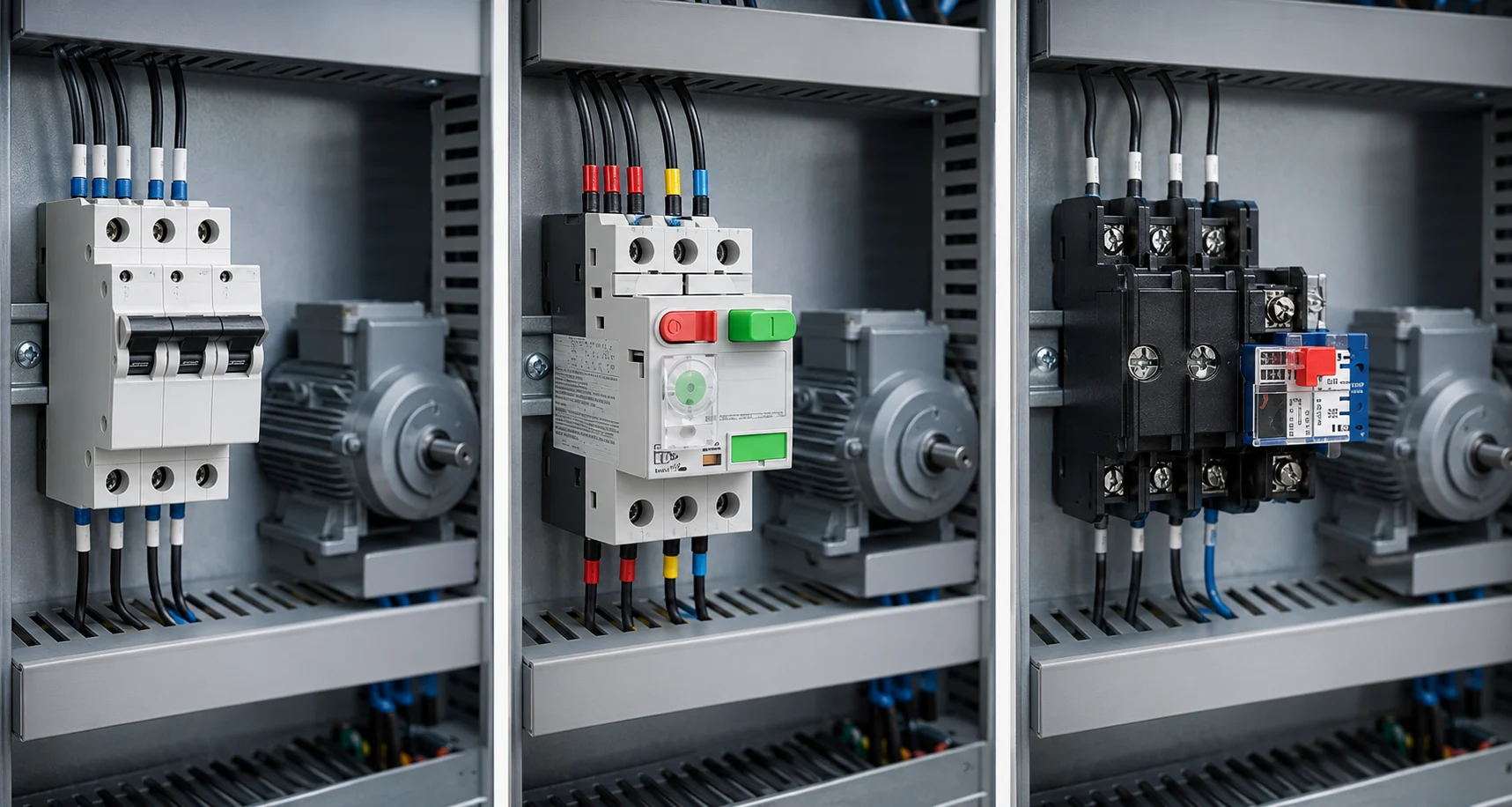
The short answer
An MCB mainly protects branch conductors against overload and short circuit. An overload relay protects a motor against sustained overcurrent and, depending on the design, phase-loss or imbalance conditions, but it does not normally interrupt a short circuit by itself. An MPCB combines motor-oriented overload and short-circuit protection with manual switching in one device. A complete starter may still require a contactor when remote, automatic or frequent switching is needed.
The devices are not interchangeable simply because their current ratings look similar. A motor feeder must tolerate starting current, protect the cable, respond correctly to overload, and safely clear or initiate clearing of a short circuit at the available fault level.
MPCB, MCB and overload relay comparison
|
Device |
Primary role | Motor setting | Short-circuit protection | Remote switching |
|
MCB |
Cable and branch-circuit overcurrent protection | Fixed rated current and trip curve | Yes, within declared breaking capacity |
No |
|
Overload relay |
Motor overload and phase-condition protection | Adjustable around motor full-load current | No; needs an upstream protective device |
Works with a contactor |
|
MPCB |
Motor overload, short circuit and local isolation | Adjustable motor-current range | Yes, within declared rating |
Add a contactor where required |
Why an MCB alone is not automatically enough
An MCB is designed primarily around conductor protection. Its rated current and magnetic trip curve must still tolerate the motor’s starting current. If the curve is too sensitive for the inrush and acceleration time, nuisance tripping can occur even when the motor is healthy.
An MCB also does not provide the same adjustable motor-overload function as an MPCB or overload relay. The design must therefore verify both cable protection and motor protection rather than treating one breaker rating as the complete answer.
For a broader explanation of breaker characteristics and selection, review the BCH MCB working and selection guide.
Why an overload relay cannot clear a short circuit by itself
An overload relay is intended to respond to sustained overcurrent and motor-related thermal conditions. It usually operates the control circuit so that the contactor opens. It is not normally the device that interrupts high short-circuit energy.
The motor feeder therefore needs an upstream short-circuit protective device such as an MCB, MCCB, fuse or MPCB, selected for the actual prospective fault current and tested coordination arrangement.
When setting or troubleshooting an overload relay, use the overload relay setting guide for industrial motors together with the exact product data.
When an MPCB is the practical choice
An MPCB is often the practical choice when a panel needs compact motor-specific protection, an adjustable current range and local switching in one device. This can simplify machine panels with several motor feeders and reduce the number of separate protection components.
The selected MPCB still has to match the motor full-load current, starting profile, available fault level, enclosure conditions and the exact contactor combination. Compact construction does not remove the need for coordination.
Use the BCH MPCB product page to review the current product family, and consult the motor control product catalogue for detailed selection information.
When separate devices may be better
An MCB or MCCB with a separate overload relay may be preferred when the project standard requires separate branch and motor protection, when a tested starter combination already exists, or when the available fault level exceeds the rating of the shortlisted MPCB.
Separate devices can also provide more flexibility for replacement, reset policy, protection class and coordination. The trade-off is additional panel space, wiring and engineering checks.
For a practical view of how these parts operate together, see how motor starters work with contactors and overload relays.
Selection workflow for a motor feeder
- Record the motor rated voltage, phase, frequency, nameplate current, duty, starting method, acceleration time and starts per hour.
- Determine the load pattern and identify temporary conditions that the feeder must tolerate without tripping.
- Calculate or obtain the prospective short-circuit current at the installation point.
- Select a device whose adjustable range includes the motor full-load current.
- Check the starting current and duration against the applicable trip curve.
- Verify cable protection and conductor withstand.
- Check coordination with the contactor and upstream protective device using manufacturer tables.
- Review ambient temperature, enclosure ventilation, cable entry and terminal accessibility.
- Confirm the final setting and commissioning test method before energisation.
- Save the selected references, settings, calculations and test results in the panel record.
The final selection should come from circuit conditions, trip curves, coordination tables and verified manufacturer data.
What must be checked as one system
|
System element |
What the review must confirm |
|
Incoming protective device |
Must safely handle the available fault level and coordinate with downstream protection. |
|
Motor branch conductors |
Must be protected against overload and short circuit within their thermal limits. |
|
Contactor |
Must suit the utilization category, current, switching duty and control voltage. |
|
Overload function |
Must be adjustable to the motor and suitable for the expected starting and duty pattern. |
|
Motor |
Nameplate current, starting method, acceleration time and operating environment must be known. |
Worked application: conveyor motor
Consider a conveyor motor that starts several times per shift and must be restored quickly after a genuine overload. The first useful document is a one-page application sheet covering the load, operating schedule, current, starting time, cable details, supply voltage and the effect of a trip on production.
The engineer then checks four questions: Will the device carry the normal load? Will it tolerate legitimate starting current? Will it protect the cable and motor within their limits? Will it clear or initiate clearing of a fault safely at the available fault level?
If the first choice fails one of these checks, the answer is not automatically a larger rating. The solution may require a different cable, starting method, enclosure, control architecture or protection combination.
Installation and commissioning checks
- Confirm conductor material, cross-section, strip length, lug or ferrule and tightening torque.
- Verify terminal capacity, clearances and ventilation around heat-producing components.
- Check device references, accessories, pole arrangement, earthing and neutral routing against the approved drawing.
- Confirm adjustable settings against the signed setting schedule.
- Test mechanical operation and interlocking with the supply isolated.
- Measure starting and running current under representative operating conditions.
- Record phase values separately where imbalance matters.
- Use competent personnel, suitable instruments and appropriate protective equipment for energised tests.
What repeated tripping can reveal
Repeated operation of a protective device is evidence, not an inconvenience to be bypassed. First identify which element operated. An MCB trip, MPCB trip, overload flag and control relay alarm point to different investigations.
Timing is also useful. An immediate trip suggests a different cause from a trip after ten minutes. A starting trip may involve inrush, voltage dip, acceleration time or mechanical loading. A hot-condition trip may indicate overload, poor ventilation or a resistive connection.
For troubleshooting after an overload operation, refer to the BCH overload relay reset and troubleshooting guide.
How to write the purchase specification
A useful purchase specification describes the application before naming a product. State the supply system, motor data, duty, environment, required functions and prospective fault current. Then list the ratings and documents that must be declared.
- Rated operational voltage and current
- Adjustable overload range
- Short-circuit rating or required upstream protection
- Pole arrangement
- Utilization category for the contactor
- Coil or control voltage
- Terminal range and enclosure conditions
- Compatible accessories and tested coordination combinations
- Catalogue, curve and commissioning documentation
For current product literature, use the BCH download centre. For application-specific support, submit the motor and circuit data through the BCH enquiry page.
Maintenance and periodic review
Inspection frequency should reflect the environment, switching duty, consequence of failure and manufacturer instructions. A clean indoor panel with a stable load does not need the same attention as a motor starter exposed to heat, dust, moisture and daily voltage variation.
Revisit the design after a larger motor, transformer change, longer operating hours, repeated nuisance trips or major cable changes. These can alter demand, fault level and thermal conditions. Do not preserve an old setting only because it worked before the system changed.
Frequently asked questions
Can an MPCB replace an overload relay?
It can provide the motor-overload function when its adjustment range and trip characteristics suit the motor. A contactor may still be required for remote, automatic or frequent switching.
Is an MCB enough for a motor?
Not automatically. The feeder still needs motor-overload protection and a trip characteristic that tolerates the starting current. Validate the complete circuit rather than selecting only by amperes.
Does an overload relay protect against short circuit?
Normally no. It needs an upstream short-circuit protective device such as an MCB, MCCB, fuse or MPCB.
Why does a healthy motor trip during starting?
Possible causes include an unsuitable trip curve, low supply voltage, excessive acceleration time, mechanical loading, incorrect setting or poor coordination.
What information should be shared before selecting an MPCB?
Share motor nameplate current, voltage, phase, starting method, starting time, starts per hour, cable details, enclosure conditions and prospective fault current.
Final takeaway
Use an MCB for branch and conductor protection, an overload relay for adjustable motor-overload protection, and an MPCB where combined motor-oriented overload, short-circuit protection and local switching fit the circuit requirements. The correct answer depends on the complete feeder, not one current rating.
Before finalising the schedule, compare the exact BCH MPCB, MCB, overload relay and contactor references against the motor data, trip curves, coordination tables and available fault level.
